

Sodium (Na) and water
Sodium is a naturally occurring element that enters water as dissolved sodium ions (Na+). Its concentration varies with geology, seawater influence, road-salt runoff, wastewater and industrial inputs. Typical seawater contains roughly 11 g/L of sodium; freshwater concentrations are usually much lower but can vary widely.
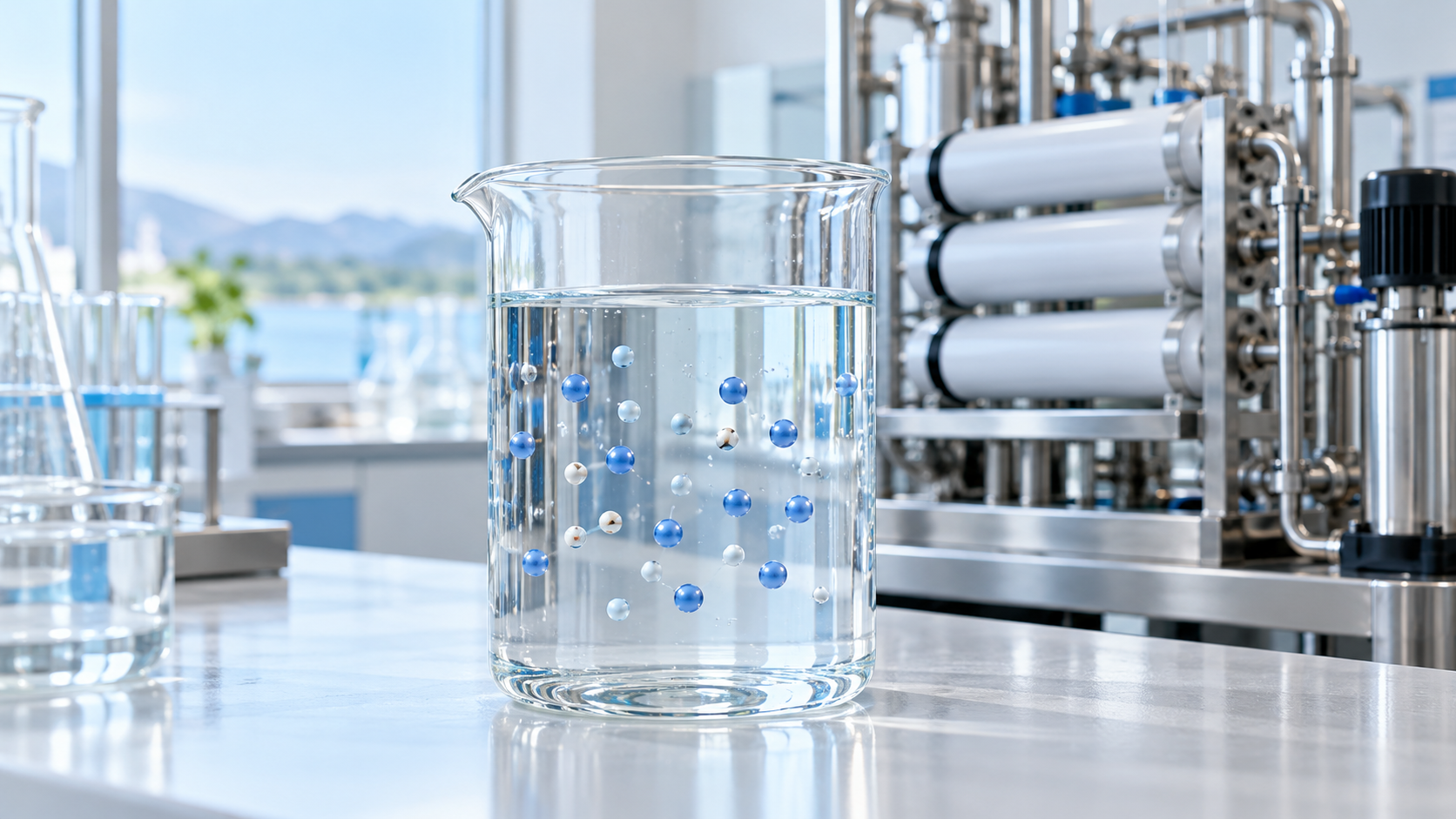
How does sodium metal react with water?
Elemental sodium reacts vigorously and exothermically with water:
2Na(s) + 2H2O(l) → 2NaOH(aq) + H2(g)
The reaction forms sodium hydroxide, an alkaline and corrosive solution, and hydrogen gas. Heat from the reaction may ignite the hydrogen or sodium. This reaction describes sodium metal; dissolved sodium ions and ordinary sodium salts such as sodium chloride do not react with water in the same way.
Sodium compounds in water
Sodium is commonly present as Na+ alongside ions such as chloride, bicarbonate, sulphate and carbonate. Many sodium salts dissolve readily in water, so ordinary filtration does not remove dissolved sodium. Concentrations depend on the water source and local conditions; a water analysis is needed to establish the value for a particular supply.
Why is sodium present in water?
Weathering of rocks releases sodium to soil and surface water. Sodium can also enter water from seawater intrusion, de-icing salt runoff, wastewater, irrigation return flows and some industrial discharges. The relative importance of these sources varies by location and season.
In fresh water, elevated sodium can affect taste and may make water less suitable for sensitive crops or soils, depending on the concentration and the accompanying ions. Salinity and sodium-related irrigation risks should be assessed using a full water analysis rather than sodium concentration alone.
Sodium in drinking water and health
Sodium is an essential nutrient, but total dietary intake matters. The World Health Organization advises adults to consume less than 2 g of sodium per day (equivalent to less than 5 g of salt). WHO has not set a health-based guideline value for sodium in drinking water; concentrations above about 200 mg/L may affect taste. Drinking-water sodium levels vary, so use a laboratory result or supplier report for the actual concentration.
People who have been advised to limit sodium may wish to ask their water supplier or treatment provider about the sodium level, including any increase from a sodium-cycle water softener. Individual dietary or medical advice should come from a qualified health professional.
For more information, see common sodium salts in aqueous solutions, their solubility and removal technologies.
How can sodium be removed from water?
Dissolved sodium is removed by processes that separate or exchange ions, including reverse osmosis, electrodialysis and demineralisation by ion exchange. Distillation can also reduce dissolved salts. The suitable process depends on feed-water composition, flow, recovery, required product-water quality and concentrate disposal. Conventional sodium-cycle softening does not remove sodium: it exchanges calcium and magnesium for sodium and can increase the sodium concentration in treated water.
For treatment design, assess sodium together with the other dissolved ions and the intended use of the treated water. Lenntech provides reverse osmosis and electrodialysis technologies for dissolved-salt reduction.
Last reviewed: 3 November 2026 by Lenntech.
Sources and further reading