

Sulfur (S) and water
Sulfur is present in water in different chemical forms rather than usually as elemental sulfur. The forms have different sources and treatment implications: hydrogen sulfide (H2S) can cause a rotten-egg odor, sulfate (SO42−) is a dissolved ion, and sulfide minerals can contribute to acid mine drainage.
Hydrogen sulfide and odor
Hydrogen sulfide may occur in oxygen-poor groundwater or form when microorganisms reduce sulfate under anaerobic conditions. It has a characteristic rotten-egg odor that can be detectable at low concentrations and can affect the acceptability of drinking-water. WHO notes that sulfides are readily oxidized in well-aerated or chlorinated water, so concentrations are usually low in oxygenated supplies.
Depending on the water analysis, treatment can use aeration or a chemical oxidant to convert sulfide, followed by filtration to retain the particles formed. The process must be selected for the actual concentration, pH and other constituents; testing is needed to confirm removal.
Sulfate and reverse-osmosis scaling
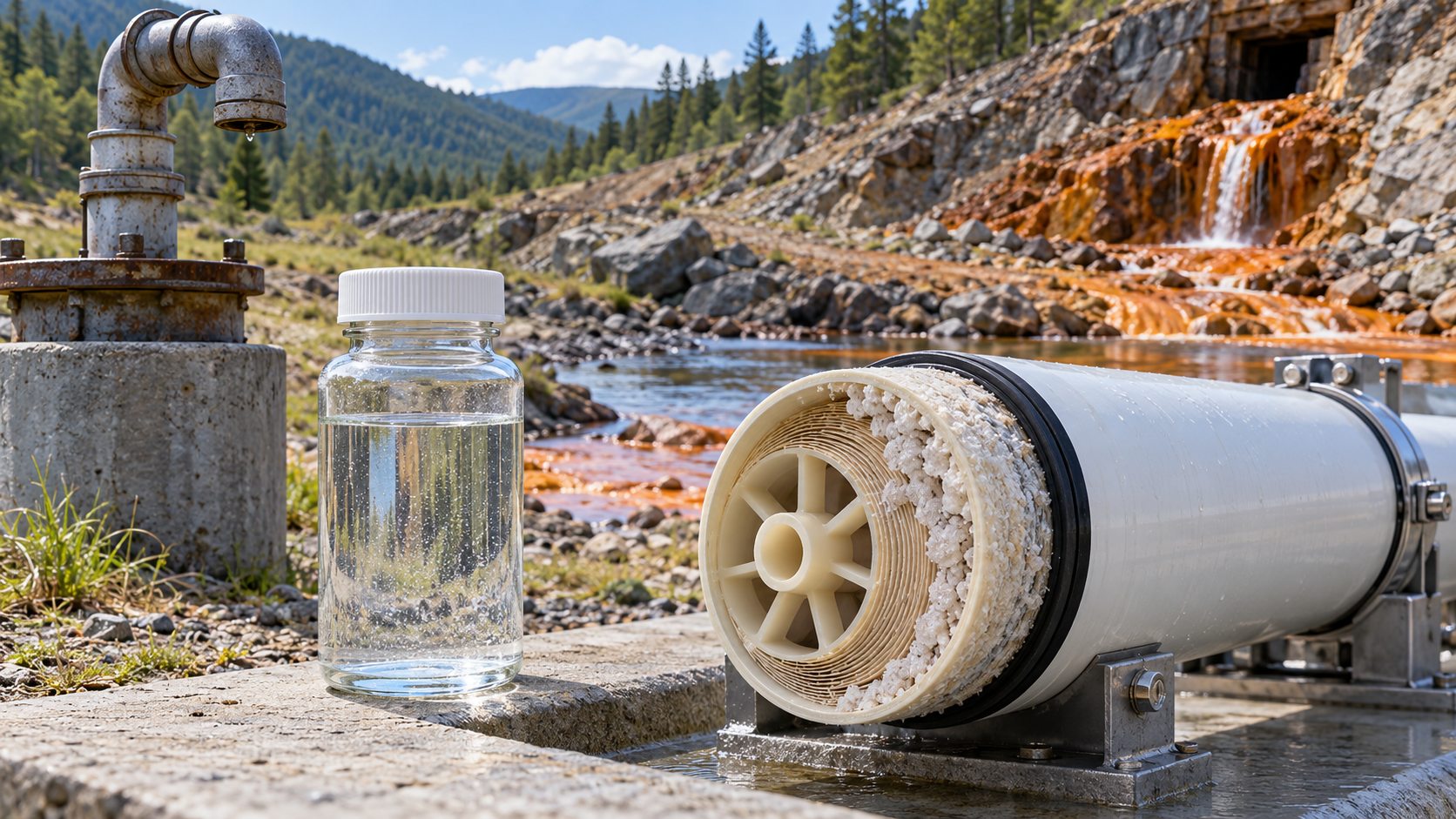
Sulfate is not the same as hydrogen sulfide. It is commonly dissolved in water and does not itself mean that scale will form. In reverse-osmosis systems, calcium sulfate precipitation can become a scaling risk when calcium and sulfate are concentrated in the reject stream beyond their solubility limit. Risk depends on feed-water composition, recovery, temperature and operating conditions. Water analysis and scale calculations inform pretreatment and operating choices.
Sulfur minerals and acid mine drainage
When sulfide minerals such as pyrite are exposed to air and water during mining or excavation, their oxidation can generate acidity and sulfate while mobilizing iron, aluminium and other metals. This process can produce acid mine drainage and degrade streams and groundwater. Assessment and remediation depend on site geology, water chemistry and the metals present.
Last reviewed: 31 October 2026 by Lenntech.