

Carbon and water
Carbon itself is not normally found dissolved in water as elemental carbon. Instead, water contains carbon in dissolved gases, carbonate minerals and organic compounds. The form and concentration matter because they influence alkalinity, pH, scaling, treatment performance and water quality.
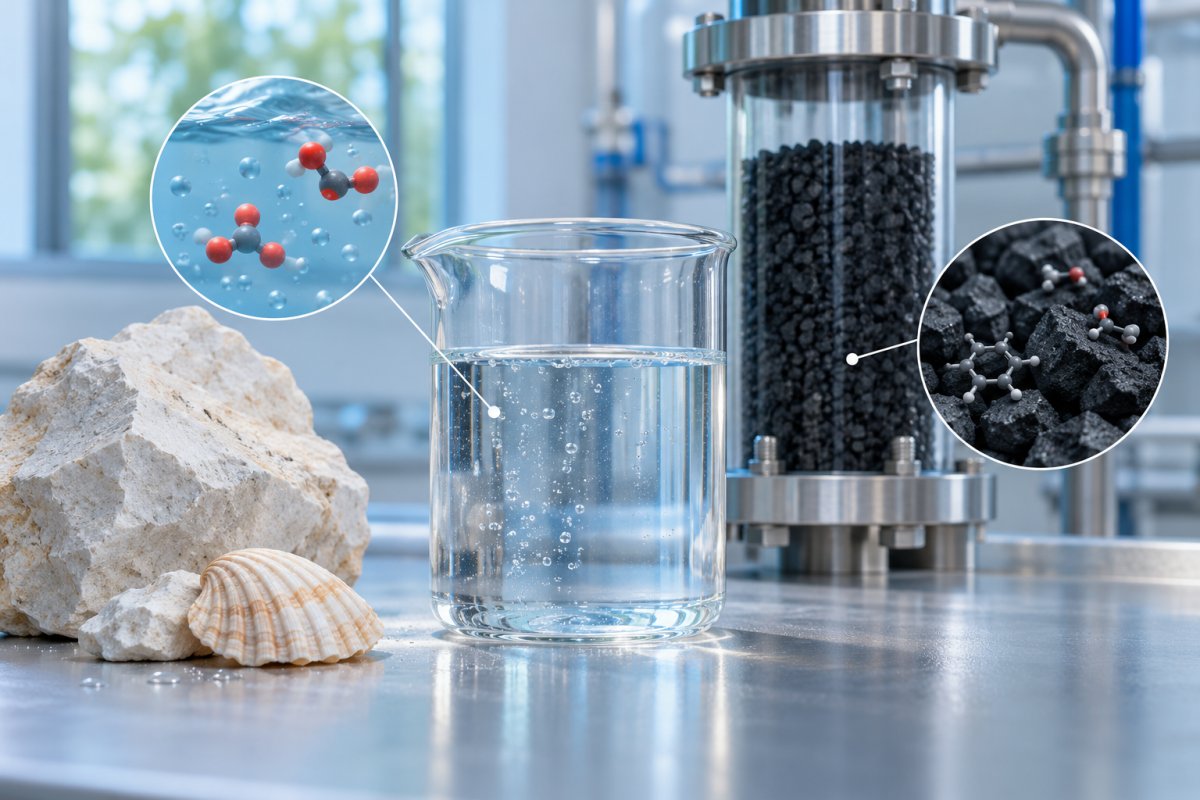
Carbon in water describes several different things. Dissolved inorganic carbon (DIC), organic carbon (DOC, POC or TOC), carbon dioxide gas and solid carbon adsorbents such as activated carbon must not be treated as interchangeable.
Inorganic carbon: carbon dioxide, bicarbonate and carbonate
In natural water, dissolved inorganic carbon occurs mainly as dissolved carbon dioxide (CO2), carbonic acid (H2CO3), bicarbonate (HCO3−) and carbonate (CO32−). Their relative proportions depend chiefly on pH, with temperature, pressure and the water’s composition also affecting equilibrium.
Carbon dioxide from air, soil respiration and biological activity can dissolve in water. When water contacts limestone and other carbonate minerals, mineral dissolution can add calcium, magnesium and bicarbonate to the water. In many freshwaters, bicarbonate is the main contributor to alkalinity. Alkalinity is the water’s capacity to neutralise acid; it is not the same as pH or hardness.
At higher pH, a greater fraction of inorganic carbon is present as carbonate. If calcium or magnesium concentrations and the carbonate balance reach supersaturation, carbonate minerals may precipitate and form scale. Changes in pH, temperature, pressure or dissolved CO2 can shift that balance.
Organic carbon and water-quality measurements
Natural organic matter enters water from soils, vegetation, algae and microbial activity. Wastewater and industrial processes can add other organic compounds. Laboratories may report dissolved organic carbon (DOC), particulate organic carbon (POC) or total organic carbon (TOC). TOC is a measure of organic carbon in a sample; it is not a measurement of all dissolved inorganic carbon.
Organic carbon includes compounds with widely different properties. Some are biodegradable, while others persist or affect colour, taste, odour, disinfection by-product formation or membrane fouling. A TOC result alone does not identify individual compounds or establish which treatment will work; the treatment target and water matrix should guide further analysis.
Carbon forms and water treatment
- Dissolved carbon dioxide: aeration or degassing can lower free CO2 where the process conditions and water chemistry permit. Degassing changes the carbonate equilibrium and can affect pH.
- Bicarbonate, carbonate and alkalinity: pH adjustment, lime softening, precipitation, nanofiltration or reverse osmosis may be considered for a defined objective. Selection depends on hardness, alkalinity, saturation, recovery and residuals.
- Organic compounds: biological treatment may reduce biodegradable organic matter. Activated-carbon adsorption can remove many selected organic compounds, but performance depends on the adsorbent, target contaminants and operating conditions.
Activated carbon is a porous treatment medium; it is not dissolved elemental carbon. Granular activated carbon is not a general method for removing bicarbonate or other dissolved inorganic carbon. Reverse osmosis and nanofiltration can reduce many dissolved ions and some organic substances, but neutral dissolved CO2 can pass through membranes and may require separate degassing or post-treatment.
For examples of carbonate and bicarbonate compounds, common industrial and natural-water streams, and relevant treatment routes, see common carbon-containing salts in water. Related information: activated carbon adsorption, carbonate and bicarbonate in irrigation water, and calcium in water.
Discuss a carbon-related water-treatment challenge
Assessment starts with the treatment objective and a suitable water analysis. Parameters may include pH, alkalinity, inorganic carbon, hardness, TOC or DOC, target organics, temperature and flow, as relevant to the case. These data help compare options; no single process is suitable for every carbon-containing stream.
Discuss a water-treatment challenge
Contact Lenntech at info@lenntech.com.
Last reviewed: by Lenntech.
Sources and further reading