

Mercury (Hg) and water
Mercury (Hg) and water: occurrence, chemistry and treatment
Mercury can enter water from natural mineral deposits and human activities. Its risk and treatability depend strongly on its chemical form: elemental mercury, inorganic mercury compounds and methylmercury behave differently. Testing and treatment decisions should therefore be based on the relevant mercury species as well as total mercury.
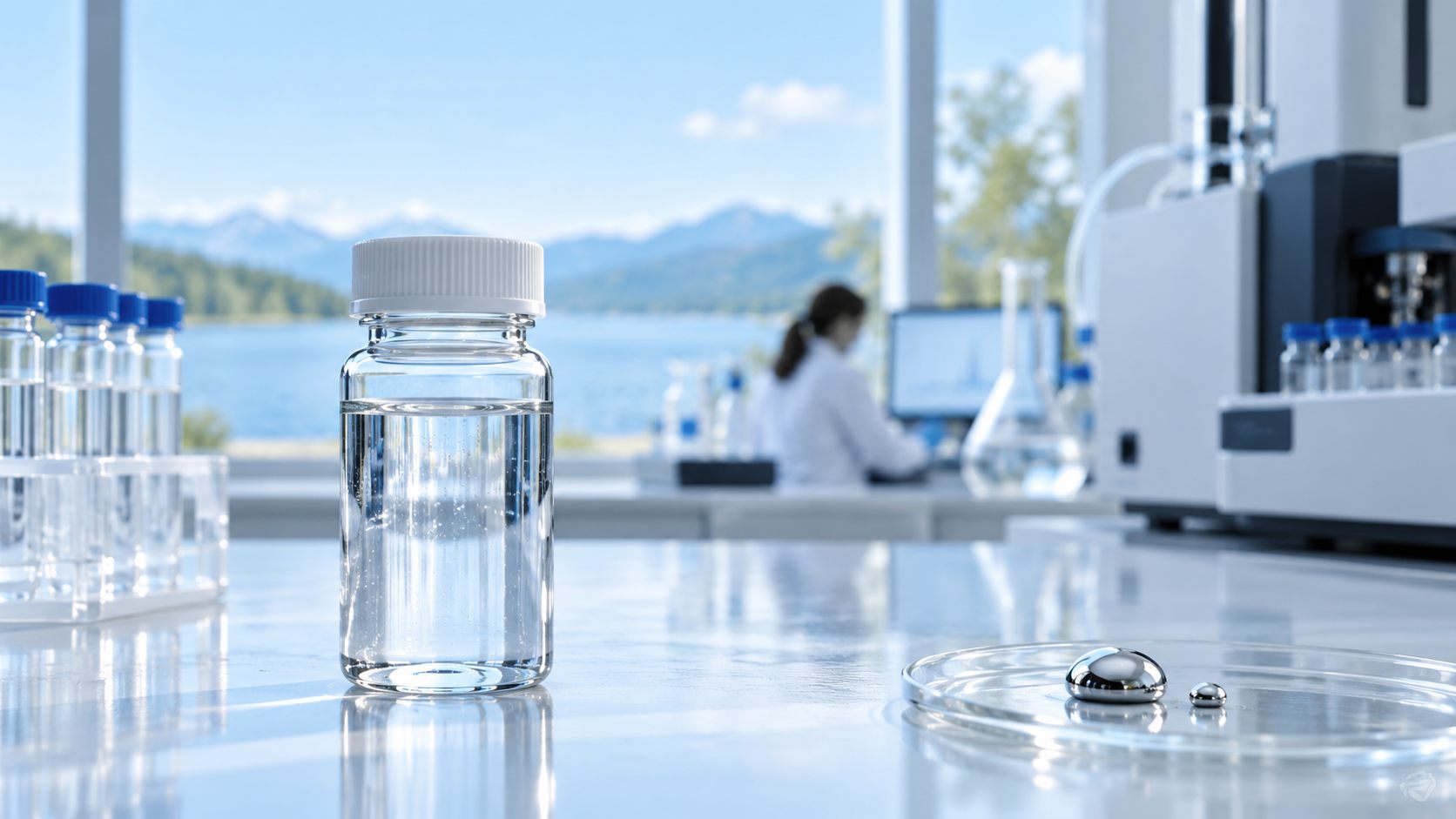
How does mercury enter water?
Mercury occurs naturally in the Earth's crust and can be released by weathering and volcanic activity. Mining, metal processing, combustion emissions, industrial discharges and runoff from contaminated sites can add mercury to surface water and sediments. In drinking water, concentrations are generally low, but local sources or contamination can produce elevated results.
Mercury can change form in the environment. Microorganisms in some aquatic sediments can convert inorganic mercury into methylmercury, which can accumulate in aquatic food webs. For most people, food—especially some fish and shellfish—is a more important methylmercury exposure route than drinking water. This distinction matters: the mercury measured in water is not automatically a direct measure of methylmercury in fish.
Mercury species and water chemistry
Elemental mercury (Hg0) is a liquid metal at room temperature and is only sparingly soluble in water. In ordinary natural waters, mercury is more commonly present as dissolved inorganic mercury species, including Hg2+ complexes, or attached to suspended particles, organic matter and sediments. Chloride, sulfide, dissolved organic matter, pH and redox conditions influence its distribution and mobility.
Methylmercury is an organic mercury compound formed mainly through environmental processes; it is not interchangeable with elemental or inorganic mercury. A sound assessment identifies what the analysis measures and whether the decision concerns drinking water, wastewater discharge, sediments or aquatic food webs.
Health and environmental considerations
Mercury compounds can harm the nervous system and kidneys, with sensitivity depending on the mercury form, exposure level and duration. Inorganic mercury in drinking water and methylmercury exposure through food are assessed differently. In water, mercury can also be toxic to aquatic organisms, and sediment can act as a long-term reservoir.
For context, the World Health Organization's guideline value for inorganic mercury in drinking water is 0.006 mg/L (6 µg/L). The U.S. Environmental Protection Agency's maximum contaminant level for inorganic mercury is 0.002 mg/L (2 µg/L). These are jurisdiction-specific benchmarks, not universal limits; always check the current requirements where the water is used.
How can mercury be removed from water?
First identify the source and, where relevant, mercury species. For raw waters that are not heavily contaminated, treatment approaches reported by WHO for inorganic mercury include coagulation, sedimentation and filtration, powdered activated carbon, and ion exchange. The chosen process depends on speciation, dissolved organic matter, competing ions, target concentration and whether the water is drinking water or wastewater.
For highly contaminated water, methylmercury, or complex industrial streams, standard drinking-water treatment assumptions may not apply. Bench or pilot testing, careful monitoring and a plan for managing mercury-bearing sludge, spent media or concentrate are important because treatment transfers mercury into a residual stream rather than destroying the element.
Read more about heavy metal removal, ion exchange and reverse osmosis.
Last reviewed: 31 October 2026 by Lenntech.
Sources and further reading
- World Health Organization: Mercury — chemical fact sheet for drinking-water.
- U.S. Environmental Protection Agency: National Primary Drinking Water Regulations.
- U.S. Environmental Protection Agency: Mercury science and research.
Read more about elements and their interaction with water.