

Indium (In) and water
Indium (In) and water: occurrence, chemistry and removal
Indium is a trace metal used in electronics and semiconductor technologies. It is usually recovered as a by-product of zinc processing, and can enter water from mining, smelting or industrial wastewater. Its mobility depends strongly on pH and water chemistry: acidic drainage can carry dissolved indium, while raising pH can transfer much of it to solids.
How does indium enter water?
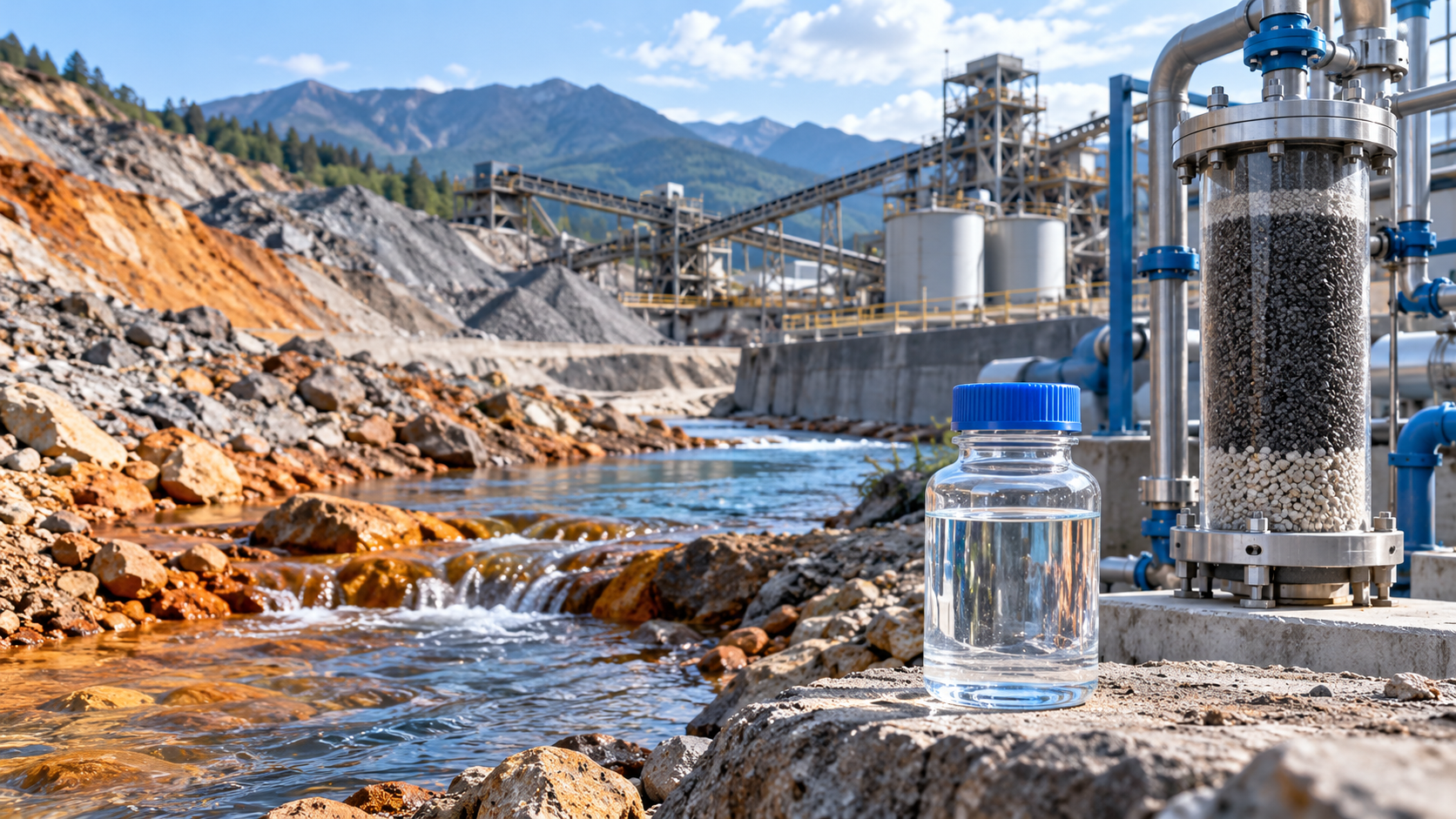
Indium occurs mainly in small amounts in zinc sulfide minerals such as sphalerite and is commonly recovered during zinc refining. Mining, ore processing and smelting can release it to drainage or process water. A U.S. Geological Survey study of Mineral Creek, Colorado, measured 6–29 µg/L of filterable indium in a stream at about pH 3. These are results from one acid-mine-drainage-affected stream, not typical background concentrations for rivers or mine water generally.
Indium chemistry in water
Indium is commonly present as In(III) in aqueous systems. In strongly acidic water, dissolved indium can remain mobile. As pH rises, hydrolysis, adsorption to iron-rich particles and precipitation of indium hydroxide can move it from the filterable fraction into suspended solids. In the Mineral Creek pH-adjustment experiment, more than 99% became associated with suspended solids after the pH was raised above 8. Chloride, sulfate, competing metals, organic matter and the quantity of iron solids can also affect its form and transport.
How can indium be removed or recovered?
For acidic mine drainage, controlled neutralization followed by settling or filtration can transfer indium to a metal-bearing sludge; the sludge then needs appropriate characterization and management. Laboratory studies have also examined cation-exchange resins for capturing In(III) from acidic solutions. Semiconductor wastewater may contain indium-bearing particles as well as dissolved species, so filtration or ultrafiltration can help with particles but should not be assumed to remove dissolved indium. The suitable treatment depends on the indium concentration, speciation, acidity and other metals in the actual water. Recovery processes concentrate indium into a secondary stream and require a separate residuals plan.
Analysis should distinguish total indium from dissolved or filterable indium and record pH, redox conditions, sulfate, chloride, iron and suspended solids. Read more about ion exchange and elements and their interaction with water.
Last reviewed: 31 October 2026 by Lenntech.
Sources and further reading
- U.S. Geological Survey: Indium precipitation in a stream affected by acid mine drainage (2017).
- U.S. Geological Survey: Indium deposits in the United States.
- Indium in ore deposits and mine-waste environments: geochemistry, mineralogy and recovery opportunities (2023).
- Revista de Metalurgia (CSIC): Indium(III) removal from aqueous solutions by ion-exchange resin (2020).
- Characterization and ultrafiltration of semiconductor indium phosphide wastewater for recycling (2005).