

Yttrium (Y) and water
Yttrium (Y) and water: occurrence, chemistry and removal
Yttrium is not a lanthanide, but geochemical studies often report it together with the rare-earth elements as REY. It can occur in natural surface water at trace levels and may be enriched in mine drainage or its treatment solids. Concentrations vary substantially with geology and treatment; no single pattern describes all waters.
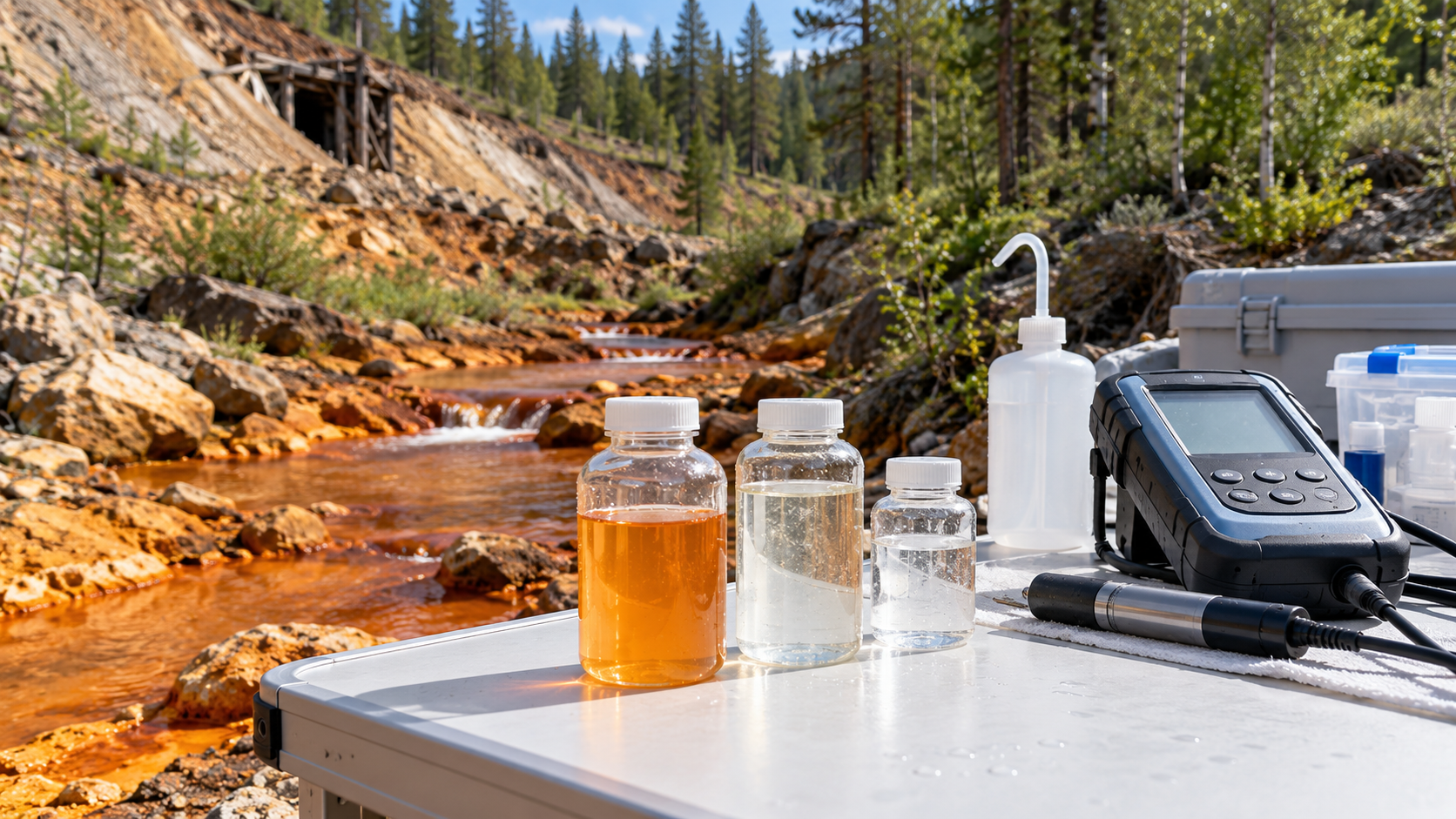
How does yttrium enter water?
Yttrium occurs in several rare-earth minerals and can be present in mining waste and drainage. Coal-mine drainage studies have measured REE plus yttrium in both water and precipitates; a U.S. Geological Survey study found some coal-mine precipitates enriched in total REE+Y. That result concerns solids and should not be confused with dissolved concentrations. Environment and Climate Change Canada's ambient-water dataset also shows that yttrium concentrations vary among monitored surface-water sites.
Y chemistry in water
Yttrium is most commonly present as Y(III) in natural water. Its mobility is influenced by pH, sulfate and carbonate complexation, organic ligands, and adsorption or coprecipitation with iron- and aluminium-rich solids. Acidic conditions can increase release from some minerals, while neutralization can shift it into solids. A claim that yttrium is consistently among the highest dissolved rare earths is not supported across sites; measurements are needed.
How can yttrium be removed or recovered?
For acidic mine drainage, neutralization and separation of metal-rich solids can lower dissolved yttrium while transferring it to sludge. Selective recovery schemes using ion exchange and staged precipitation have been studied for particular mine waters, usually recovering a mixed REY product rather than pure yttrium. Process selection depends on the full water analysis and residual-management requirements; pilot testing is needed before applying laboratory findings at full scale.
Assessment should distinguish dissolved material from suspended and settled solids and include pH, redox conditions, sulfate, carbonate, organic matter and other major ions where relevant. Read more about ion exchange and elements and their interaction with water.
Last reviewed: 31 October 2026 by Lenntech.
Sources and further reading
- Geological Survey of Sweden: Metals and minerals in mining waste.
- U.S. Geological Survey (2024): Evaluation of coal mine drainage and associated precipitates for radium and rare earth element concentrations.
- Stewart et al. (2017): Rare earth element resources in coal mine drainage and treatment precipitates in the Appalachian Basin.
- Environment and Climate Change Canada: Draft federal environmental quality guidelines for selected rare earth elements.
- Separation and Purification Technology (2024): Recovery of rare earth elements from acidic mine waters using selective precipitation and ion exchange.
- Cleaner Engineering and Technology (2026): Rare-earth recovery from acid mine water by ion exchange and oxalic-acid precipitation.