

Cerium (Ce) and water
Cerium (Ce) and water: occurrence, chemistry and removal
Cerium is the most abundant rare-earth element in the Earth's crust and can be released by weathering or mining. Its water chemistry is distinctive because cerium can occur as Ce(III) or Ce(IV). Acid mine waters can contain elevated dissolved cerium at some sites, while oxidation and particle formation can remove cerium from the dissolved phase elsewhere.
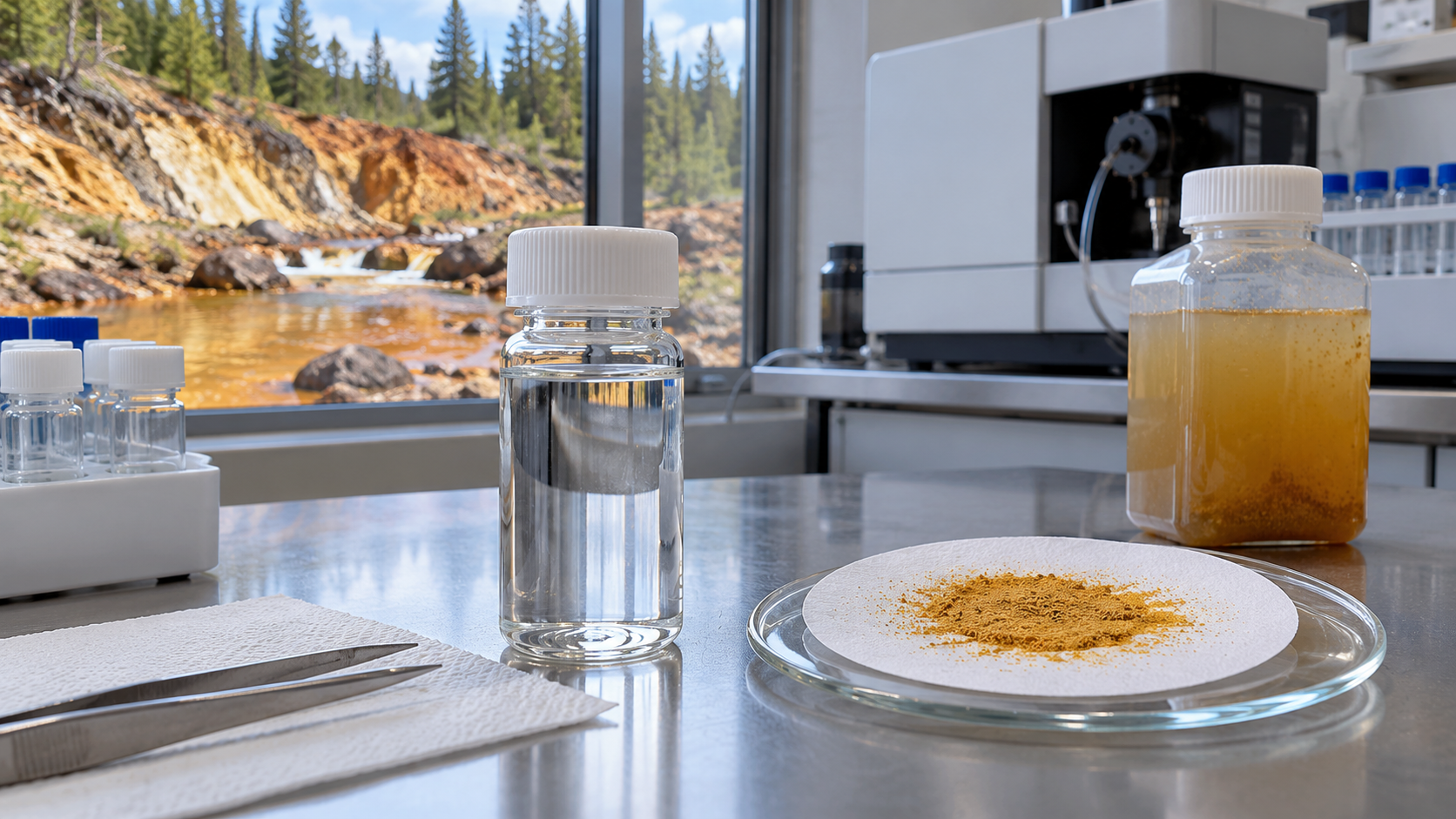
How does cerium enter water?
Cerium occurs in minerals such as monazite, bastnaesite and apatite, including rare-earth-bearing mining residues. Acidic drainage can dissolve cerium-bearing minerals. Studies of the Iberian Pyrite Belt reported a very broad range of rare-earth concentrations in mine waters, with cerium reaching high values at some sampled locations; this is evidence of site-specific conditions, not a general concentration expected in mine drainage. As water mixes and pH changes, cerium can redistribute to precipitates and sediments.
Ce chemistry in water
Cerium differs from most rare earths because both Ce(III) and Ce(IV) can be important. Under oxidizing conditions, Ce(III) may oxidize and Ce(IV) is strongly associated with particles and mineral surfaces; under acidic or reducing conditions, dissolved Ce(III) can be more persistent. pH, redox state, sulfate, organic ligands and iron/aluminium precipitates affect whether cerium is dissolved or particulate. Total and dissolved measurements can therefore tell different stories.
How can cerium be removed or recovered?
Mine-water neutralization and clarification may reduce dissolved cerium through sorption and coprecipitation with iron- and aluminium-rich solids, but the effect depends on redox state and water chemistry. Filtration separates particles; it does not remove cerium that remains dissolved. For mixed rare-earth recovery, research has used ion exchange and controlled oxalate precipitation after treatment or concentration. Site designs should test the actual dissolved and total fractions and manage resulting solids or eluates.
Assessment should distinguish dissolved material from suspended and settled solids and include pH, redox conditions, sulfate, carbonate, organic matter and other major ions where relevant. Read more about ion exchange and elements and their interaction with water.
Last reviewed: 31 October 2026 by Lenntech.
Sources and further reading
- Geological Survey of Sweden: Metals and minerals in mining waste.
- Valente et al. (2018): Mineralogical controls on mobility of rare earth elements in acid mine drainage environments.
- Stewart et al. (2017): Rare earth element resources in coal mine drainage and treatment precipitates in the Appalachian Basin.
- U.S. Geological Survey (2024): Evaluation of coal mine drainage and associated precipitates for radium and rare earth element concentrations.
- Separation and Purification Technology (2024): Recovery of rare earth elements from acidic mine waters using selective precipitation and ion exchange.
- Cleaner Engineering and Technology (2026): Rare-earth recovery from acid mine water by ion exchange and oxalic-acid precipitation.
- Environment and Climate Change Canada: Draft federal environmental quality guidelines for selected rare earth elements.