

Barium (Ba) and water
In natural and treated water, barium is found mainly as dissolved barium ions (Ba2+) or in sparingly soluble mineral particles. This is different from elemental barium metal, which reacts with water.
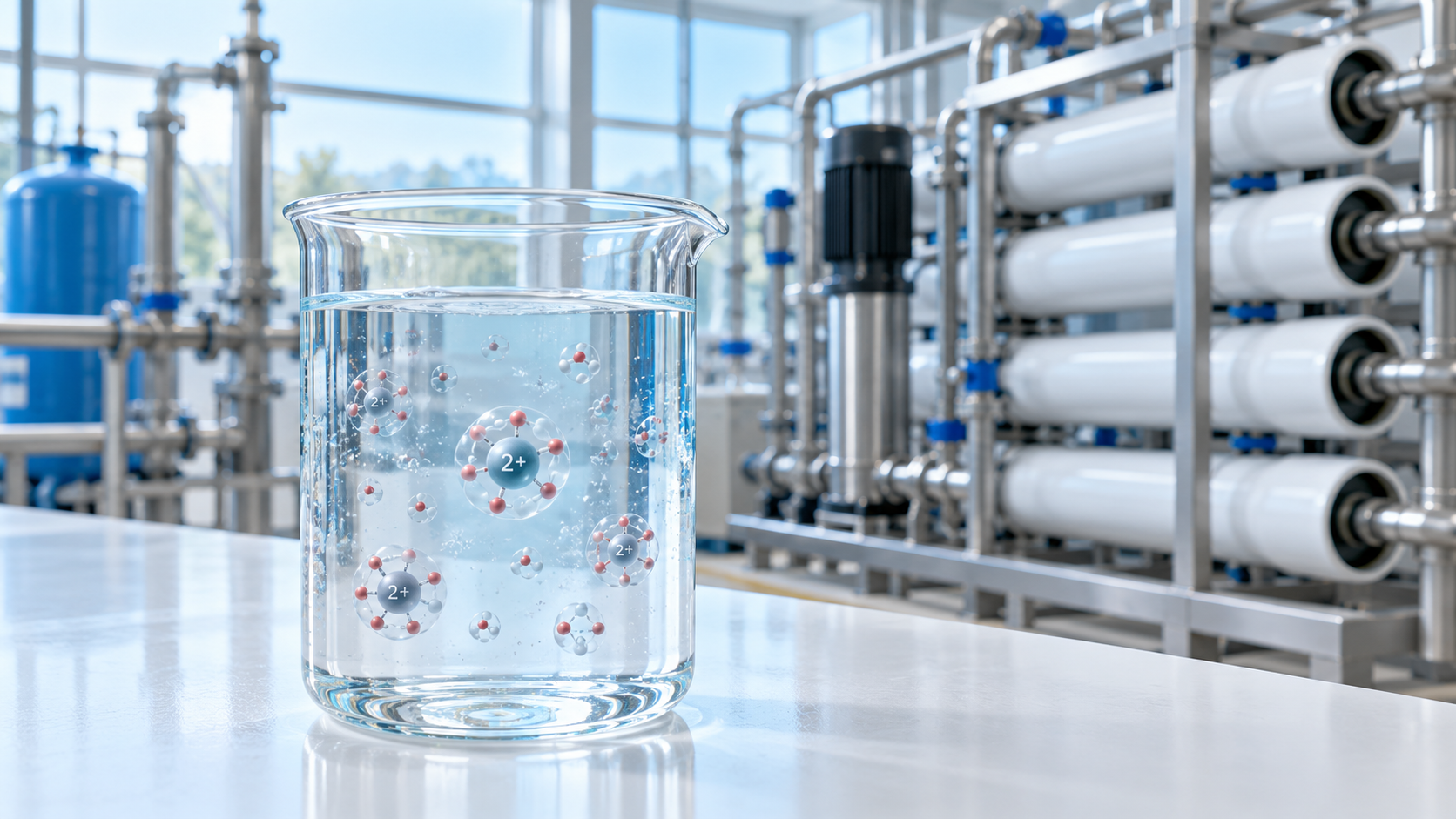
Barium in natural water
Barium occurs naturally in rocks and minerals, especially barite (barium sulfate, BaSO4) and witherite (barium carbonate, BaCO3). The amount that dissolves depends on the mineral form and water chemistry. The World Health Organization notes that drinking-water concentrations are generally below 100 µg/L, although higher levels have been measured in some groundwater. In seawater, barium is present mainly as Ba2+; a Monterey Bay Aquarium Research Institute reference lists a mean concentration of about 109 nmol/kg, equivalent to roughly 15 µg/kg. Concentrations vary with depth and ocean region.
How elemental barium reacts with water
Elemental barium metal reacts with water to form barium hydroxide and hydrogen gas:
Ba(s) + 2 H2O(l) → Ba(OH)2(aq) + H2(g)
This reaction releases heat and produces an alkaline solution as well as hydrogen, which can ignite. Elemental barium is not the form normally measured in natural water. The reaction is shown for chemical context only; it should not be attempted outside a properly equipped, controlled laboratory.
Barium compounds in water
Barium compounds differ greatly in solubility. Barium sulfate and barium carbonate dissolve only slightly, while compounds such as barium chloride and barium nitrate are much more soluble. Dissolved barium is generally present as Ba2+; sulfate and carbonate in the water can affect whether barium remains dissolved or forms a solid. Barium sulfate, also called barite, is especially sparingly soluble.
Environmental and health context
Barium can reach water through natural mineral dissolution and, in some locations, through industrial activities and waste. The concentration and chemical form are important when interpreting a result. For drinking-water, the World Health Organization’s guideline value for barium is 1.3 mg/L; local regulatory limits may differ.
Where water contains both barium and sulfate, barium sulfate may precipitate. This is relevant to reverse-osmosis systems because concentration in the brine stream can increase the risk of barite scale. Assess the water chemistry and operating conditions rather than relying on total barium alone.
Can barium be removed from water?
Yes. The World Health Organization identifies ion exchange, lime softening and direct filtration with chemical precipitation as treatment methods that can reduce barium. reverse osmosis and electrodialysis are also used for dissolved-ion removal. The suitable process and achieved concentration depend on the feed-water composition, pH, competing ions, treatment design and required water quality.
For membrane systems, evaluate barium together with sulfate and recovery to assess barium-sulfate scaling potential. For dilute freshwater within its stated input limits, the RO recovery and scaling-potential calculator can help screen the effect of recovery; it is not a validated membrane-design model or a seawater/brine calculator. antiscalant may help control precipitation under suitable conditions, but it does not remove dissolved barium from the water. Confirm treatment performance with representative feed-water data and operating conditions.
Sources and further reading
- World Health Organization: Barium guideline value and treatment performance in drinking-water.
- U.S. Agency for Toxic Substances and Disease Registry: Barium public health statement.
- Monterey Bay Aquarium Research Institute: Barium concentration and speciation in seawater.
- PubChem, citing the U.S. Department of Energy: Barium properties and reactions.
- Journal of Membrane Science: The scaling potential of barium sulphate in reverse osmosis systems.