

Tellurium (Te) and water
Tellurium (Te) in water: sources, chemistry and removal
Tellurium is a rare metalloid used in solar cells, thermoelectric materials and metal alloys. It is usually recovered as a by-product of copper refining. Naturally occurring concentrations in water are extremely low, but mining wastes, metallurgical process water and end-of-life materials can create localized sources. Assessment is challenging because environmental concentrations are low and tellurium speciation is not routinely measured.
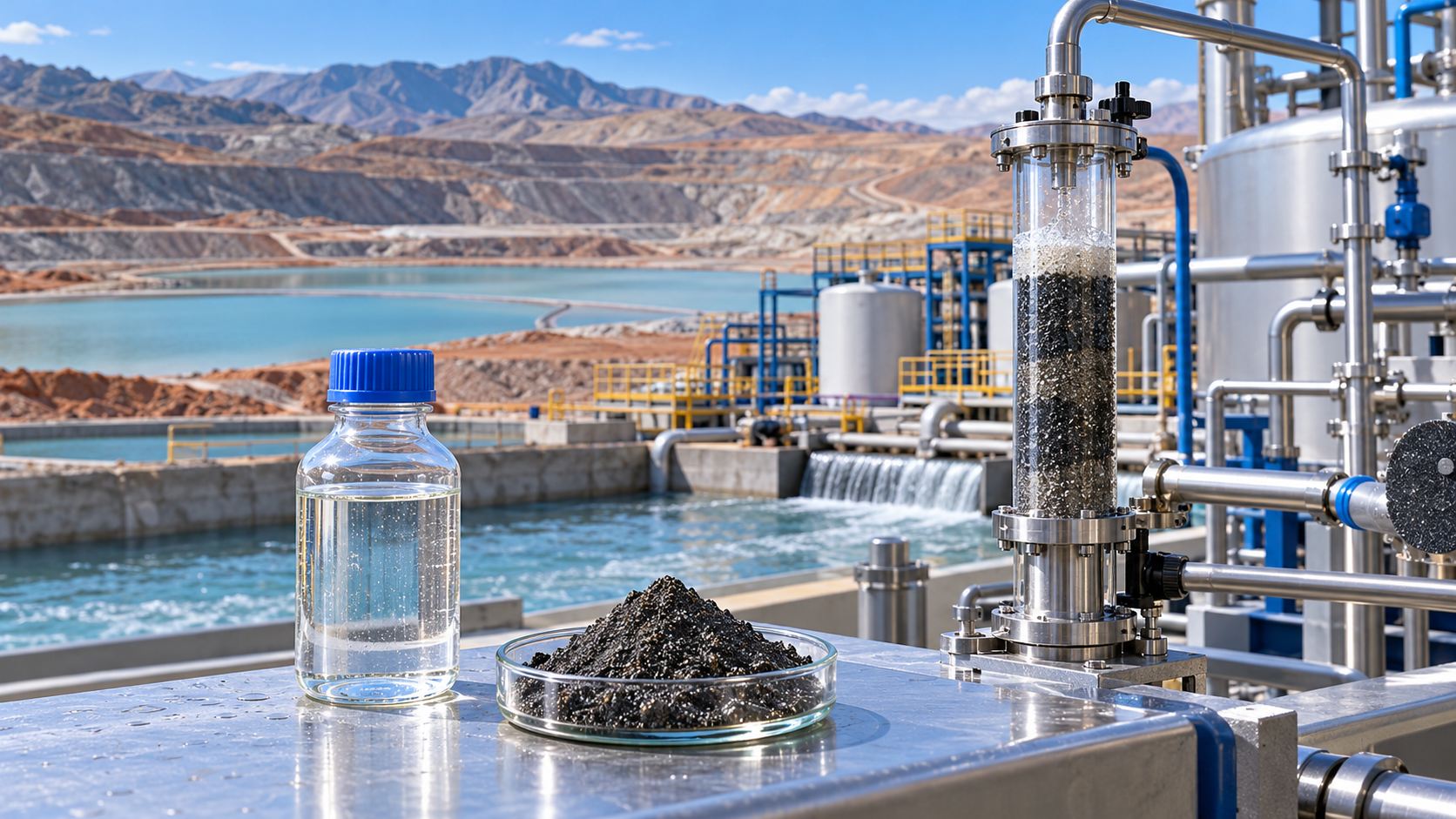
How does tellurium enter water?
Tellurium occurs in a small number of minerals and is commonly recovered from copper anode slimes produced during electrolytic copper refining. Mining and ore processing can also send tellurium-bearing mineral grains to tailings; the U.S. Geological Survey has documented this pathway at the Bingham Canyon mine in Utah. Leaching and residues from metallurgical operations, semiconductor manufacturing, and processing or disposal of tellurium-containing materials may be relevant sources in industrial water. The presence and amount depend on the material and process.
Tellurium chemistry in water
Tellurium can occur in several oxidation states. In water, tellurite (Te(IV)) and tellurate (Te(VI)) are important dissolved forms; reduced conditions can favor elemental tellurium or telluride-bearing solids. Distribution depends on redox conditions, pH, mineral surfaces and surrounding chemistry. Reviews report that dissolved tellurium in river water is commonly below 50 ng/L, but measurements are sparse, speciation is rarely determined and analytical methods at these levels have limitations. This reported range is not a universal background concentration.
How can tellurium be removed or recovered?
Tellurium treatment is most relevant to specific mine, metallurgical or manufacturing streams. The process must be selected after identifying whether tellurium is dissolved, particulate, or associated with other metals and process chemicals.
- Adsorption: Adsorbents can capture dissolved tellurium species, and selective materials have been investigated for tellurium recovery. Performance depends on oxidation state, pH and competing ions. See Lenntech’s overview of adsorption.
- Ion exchange: Resins may separate charged tellurium species from process liquors, but selectivity and resin regeneration depend on the actual solution. The regeneration stream becomes a concentrated residual or recovery feed. Read about ion exchange.
- Reverse osmosis or nanofiltration: Membranes may separate dissolved tellurium-bearing species from water, but do not destroy tellurium; it is transferred into a concentrate requiring further treatment or recovery. See Lenntech’s reverse osmosis information.
- Coagulation, precipitation and solids separation: Where tellurium is particulate or can be converted into a solid under controlled conditions, coagulation and flocculation followed by settling and filtration may separate the solids. Confirm the chemistry with treatability tests. See coagulation and flocculation.
- Biological reduction of tellurite: A research-scale anaerobic granular-sludge reactor converted tellurite to elemental tellurium and retained it in biomass, from which some tellurium was subsequently recovered. This result applies to the tested synthetic wastewater and tellurite conditions; it does not establish a universal full-scale process or equal performance for tellurate.
For process evaluation, measure total and dissolved tellurium, identify its chemical form where methods allow, and characterize pH, redox conditions, suspended solids and competing metals. Concentrates, spent adsorbents, regenerated brines and tellurium-bearing sludge need a defined residuals or recovery route.
Last reviewed: 31 October 2026 by Lenntech.
Sources and further reading
- U.S. Geological Survey: Critical minerals in mine waste (2025).
- Tellurium in the environment: current knowledge and identification of gaps (2019).
- Metal contaminants of emerging concern in aquatic systems (2022).
- Continuous removal and recovery of tellurium in an upflow anaerobic granular sludge bed reactor (2017).
- Advances in tellurium recovery and purification: a comprehensive review (2025).