

Dysprosium (Dy) and water
Dysprosium (Dy) and water: occurrence, chemistry and removal
Dysprosium is a heavy rare-earth element used in high-performance permanent magnets and other technologies. It is generally present at low levels in ordinary natural waters, but selected acidic mine waters and mining residues can contain enriched rare earths, including dysprosium. The evidence is site-specific and does not imply widespread contamination.
How does dysprosium enter water?
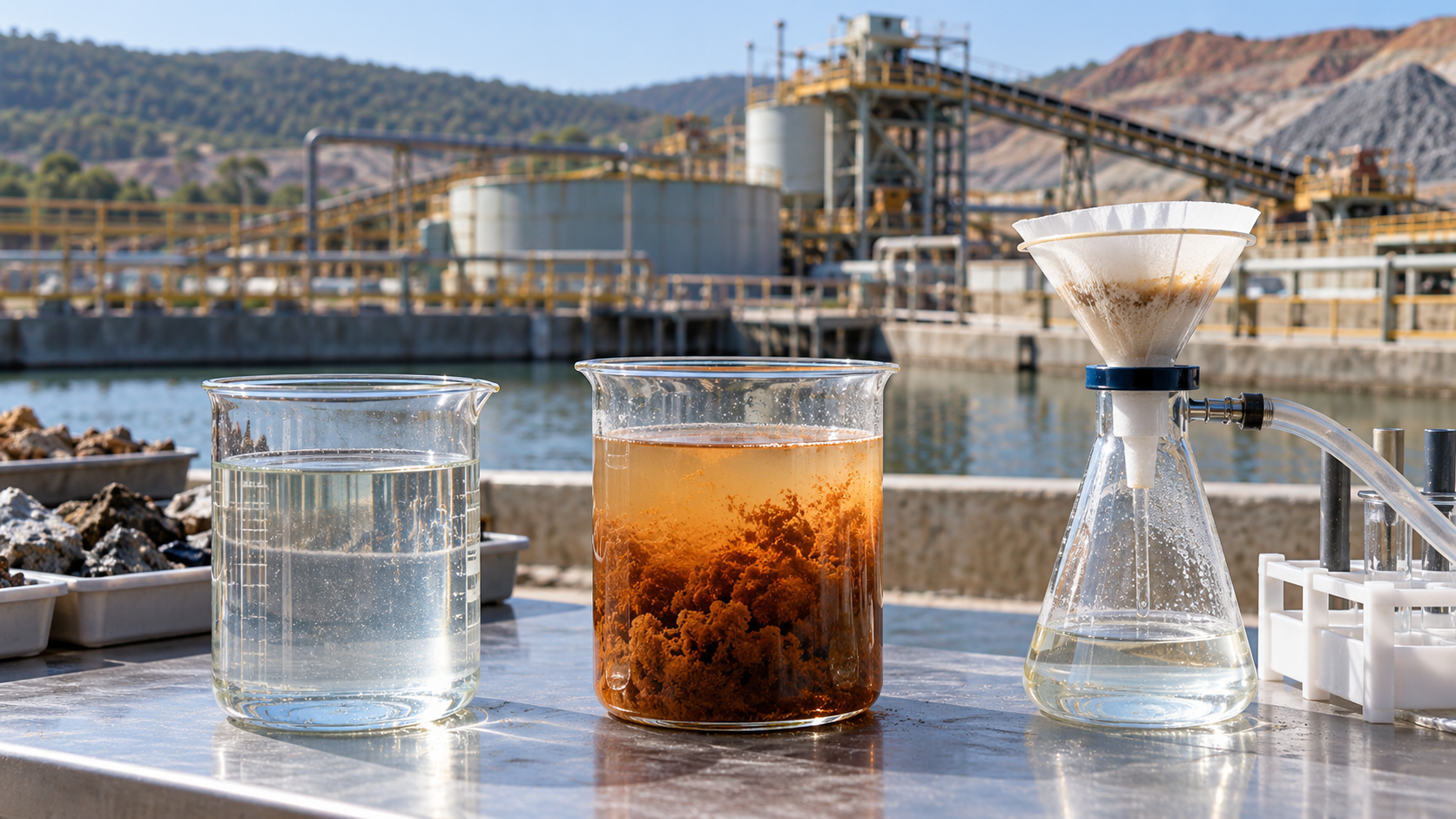
Dysprosium occurs in rare-earth-bearing ores and can accompany mineral-processing residues. It has been reported among the critical rare earths in studies of coal-mine drainage in the Appalachian Basin and in research on acidic mine-water resources. Weathering and low pH can mobilize some mineral-bound dysprosium; concentrations depend on source rock, mine waste, ligands and secondary mineral formation. Sampling at an individual site is needed to establish whether dysprosium is present in dissolved water, suspended particles or settled solids.
Dy chemistry in water
Dysprosium is typically present as Dy(III) in natural water. Its mobility changes with pH, sulfate and carbonate complexes, organic ligands, and adsorption onto iron- and aluminium-rich precipitates. Acidic water can promote release from some solids, whereas neutralization may transfer dysprosium to precipitates. The amount removed from the dissolved phase is not necessarily the amount recovered as a pure product; coprecipitation usually brings a mixture of elements.
How can dysprosium be removed or recovered?
Treatment of acidic mine drainage can use pH adjustment and solids separation to remove acidity and co-remove dissolved metals and rare earths. This creates sludge that may retain dysprosium and other elements. Research into selective recovery uses ion exchange and staged precipitation, including oxalate crystallization, to concentrate mixed rare-earth fractions. Results from specific mine waters or laboratory eluates are not a universal guarantee and do not mean that precipitation alone selectively recovers dysprosium. Test the actual water and plan for the concentrated residual stream.
Assessment should distinguish dissolved material from suspended and settled solids and include pH, redox conditions, sulfate, carbonate, organic matter and other major ions where relevant. Read more about ion exchange and elements and their interaction with water.
Last reviewed: 31 October 2026 by Lenntech.
Sources and further reading
- Geological Survey of Sweden: Metals and minerals in mining waste.
- Stewart et al. (2017): Rare earth element resources in coal mine drainage and treatment precipitates in the Appalachian Basin.
- U.S. Geological Survey (2024): Evaluation of coal mine drainage and associated precipitates for radium and rare earth element concentrations.
- Separation and Purification Technology (2024): Recovery of rare earth elements from acidic mine waters using selective precipitation and ion exchange.
- Cleaner Engineering and Technology (2026): Rare-earth recovery from acid mine water by ion exchange and oxalic-acid precipitation.
- Valente et al. (2018): Mineralogical controls on mobility of rare earth elements in acid mine drainage environments.