
Electrodialysis (ED)
How electrodialysis works
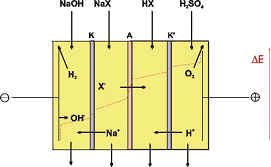
Electrodialysis (ED) is an electrically driven membrane process used to separate dissolved ions from water. An alternating arrangement of cation-exchange and anion-exchange membranes forms adjacent channels. When direct current is applied, cations and anions migrate through membranes that permit their respective charge, creating a lower-salinity product stream (diluate) and a more concentrated stream (concentrate).
Because water does not pass through the membranes as it does in pressure-driven membrane filtration, ED primarily separates charged dissolved species. It does not by itself remove suspended particles, microorganisms or most uncharged dissolved compounds; pretreatment and polishing depend on the feedwater and product-water target.
Electrodialysis reversal (EDR)
EDR periodically reverses electrical polarity and the direction of ion migration. This can help limit some scale and deposit formation on the membranes, but it does not eliminate fouling or replace feed-specific pretreatment and cleaning.
Feedwater and process design
ED is used for applications such as brackish-water desalination, selective demineralisation, and recovery or concentration of ionic constituents. Performance depends on feed composition, target removal, current efficiency, membrane selection, scaling limits and concentrate management. A representative feed analysis is needed to assess a particular application.
For a description of electrodialysis reversal in brine-treatment systems, see ED / EDR.