

Uranium (U) and water
Uranium (U) and water: occurrence, chemistry and treatment
Uranium can occur naturally in groundwater when water interacts with uranium-bearing rocks and sediments. Concentrations depend on geology and aquifer chemistry; elevated levels are not present in every well. Uranium is both a radioactive element and a chemical toxicant, so testing and treatment should address the measured concentration and the applicable drinking-water requirements.
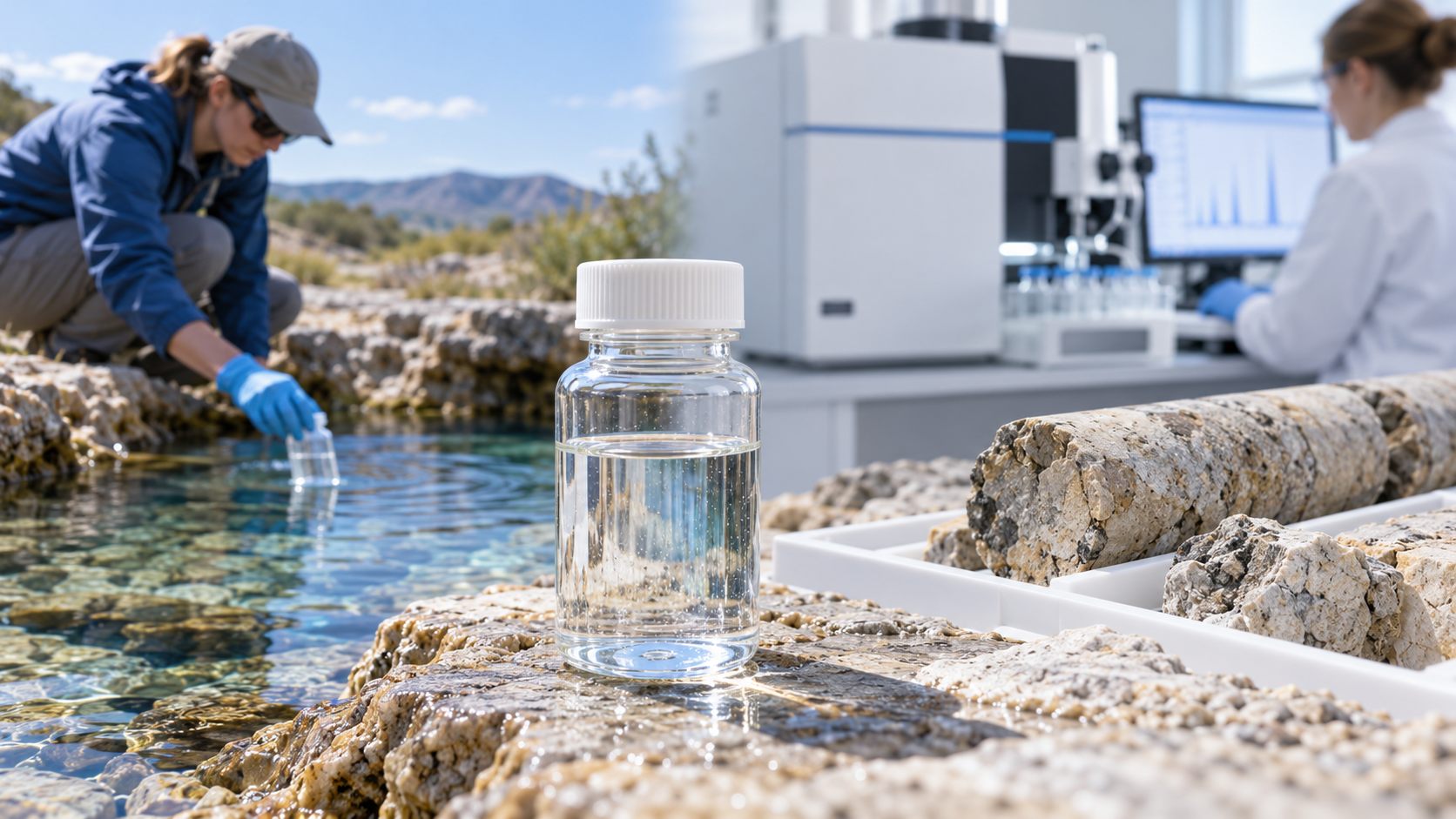
How does uranium enter groundwater?
Uranium is present in some rocks and sediments and may dissolve during water-rock interaction. Geogenic uranium is therefore an important groundwater concern in some aquifers. Mining, ore processing and other industrial activities can also affect local water quality, but naturally occurring uranium is often the primary source in groundwater.
Groundwater conditions matter. Oxidation-reduction potential, pH, carbonate, alkalinity and mineral composition influence uranium's solubility and chemical form. As a result, concentrations can vary greatly between wells, even within the same region. A sample from one well should not be used to infer the quality of another.
Uranium species and water chemistry
Uranium does not normally occur in water as pieces of uranium metal. In oxygenated waters, uranium is commonly in the U(VI) oxidation state and can form soluble uranyl-carbonate complexes. Under reducing conditions, U(IV) phases are generally less soluble. Carbonate and calcium can affect speciation and treatment response, while particles and iron oxides may carry adsorbed uranium.
Because speciation varies, a total uranium result is essential for comparison with a drinking-water limit, while additional chemistry data can help engineers select treatment. Useful supporting measurements include pH, alkalinity, carbonate, calcium, sulfate, nitrate, iron and total dissolved solids.
Health and radiological considerations
Uranium has chemical toxicity as well as radioactivity. Long-term ingestion can affect the kidneys; the radiological contribution depends on isotope composition and activity. The World Health Organization sets a provisional drinking-water guideline value of 0.03 mg/L (30 µg/L), and the U.S. EPA maximum contaminant level is also 0.030 mg/L. WHO describes its value as provisional because of scientific uncertainties about uranium toxicity. Local requirements may differ and should be checked.
How can uranium be removed from water?
Depending on uranium's chemical form and the water matrix, treatment may use anion exchange, coagulation or adsorption, lime softening, or reverse osmosis. Anion-exchange resins may be useful when uranium is present as negatively charged uranyl-carbonate complexes; cation-exchange softening alone may not reliably remove those species. Competing anions such as sulfate, nitrate and carbonate can affect resin capacity and breakthrough.
Reverse osmosis can reduce dissolved uranium but also produces a concentrate. Every process must be selected and verified for the specific water, target level and operating conditions. Monitor treated water and manage spent resin, sludge and membrane concentrate in accordance with applicable requirements, because these residuals may contain concentrated uranium.
Read more about ion exchange and reverse osmosis.
Last reviewed: 31 October 2026 by Lenntech.
Sources and further reading
- World Health Organization: Uranium — chemical fact sheet for drinking-water.
- U.S. Environmental Protection Agency: National Primary Drinking Water Regulations.
- U.S. Geological Survey: Status of water-quality conditions in the United States, 2010–20.
- U.S. Environmental Protection Agency: Drinking-water treatment residuals and naturally occurring radionuclides.
Read more about elements and their interaction with water.