

Lead - Pb
Lead — chemical properties and water context
Lead is a soft, dense, bluish-grey metal. In drinking water, lead most often enters from corrosion of plumbing materials and service lines, so distribution-system conditions can matter as much as treatment at the plant.
| Atomic number | 82 |
|---|---|
| Standard atomic weight | [206.14, 207.94] g/mol |
| Density | 11.3 g/cm3 |
| Melting point | 327.462 °C |
| Boiling point | 1749 °C |
| Electron configuration | [Xe] 4f14 5d10 6s2 6p2 |
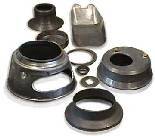
Chemical properties
Lead is in Group 14 and Period 6 and commonly forms +2 compounds, with some +4 chemistry. Its solubility depends on pH, alkalinity, oxidation conditions and ligands. Some lead compounds are poorly soluble, while others can remain dissolved; particles and pipe scale can also contribute to total lead measurements.
Uses and applications
Lead is still used in some batteries, radiation shielding and specialized alloys. Many former uses have been restricted or phased out because of health concerns. Lead-containing pipes, solder, fittings and fixtures can be sources of lead in drinking water where they are present.
Lead in water treatment
For drinking-water systems, corrosion control is central because lead can leach from plumbing after water leaves the plant. U.S. EPA describes corrosion-control treatment and tap monitoring under its Lead and Copper Rule. Where lead is present in source water, treatment options can include coagulation and filtration, ion exchange, reverse osmosis or lime softening; performance and finished-water stability must be verified for the specific system.
Environmental and health context
Lead is toxic and can harm the nervous system, especially in children. The standard atomic weight is shown as a range because natural lead isotope composition varies among materials. Drinking-water requirements and compliance approaches differ by jurisdiction; use the applicable local rules and monitoring protocol.
Back to the periodic table of elements
Sources and further reading
- CIAAW: Standard atomic weights
- Royal Society of Chemistry: Lead properties and uses
- U.S. EPA: Basic information about lead in drinking water
- U.S. EPA: Lead and Copper Rule
Lead page last reviewed: by Lenntech.