

Cerium - Ce
Cerium (Ce)
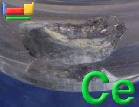
Cerium is a soft, silvery lanthanide metal. It tarnishes in air and reacts with water, with the rate increasing as the water becomes warmer. Cerium occurs naturally in minerals such as monazite and bastnäsite; it is not found as a free metal in nature.
| Atomic number | 58 |
|---|---|
| Relative atomic mass | 140.116 |
| Electron configuration | [Xe] 4f1 5d1 6s2 |
| Density | 6.77 g/cm3 |
| Melting point | 799 °C |
| Boiling point | 3443 °C |
| Common oxidation states | +3 and +4 |
Uses and applications
Cerium compounds are used in glass polishing and in catalysts. Cerium oxide can store and release oxygen under changing conditions, which is useful in automotive exhaust catalysts. Cerium-containing materials are also used to polish optical glass and in some glass formulations.
Cerium and water treatment
Cerium is not a routine reagent for drinking-water treatment. Cerium-bearing minerals and residues may be encountered during rare-earth mining and processing; management of associated process water and tailings depends on the material’s composition and site-specific conditions.
Occurrence and environmental context
Cerium is the most abundant lanthanide in the Earth’s crust. Its environmental presence is primarily associated with minerals, mining, refining, and the use or disposal of cerium-containing products. Environmental behaviour depends on chemical form, solubility, and local water and soil chemistry.
Health and safety
Health risks depend on the cerium compound, particle size, route, and duration of exposure. Avoid inhaling dust and consult the relevant safety data sheet and occupational controls when handling cerium compounds or powders.
Back to the periodic table of elements
Sources and further reading
Element page last reviewed: 24 October 2026 by Lenntech.