

Hydrogen - H
Hydrogen (H) is the lightest chemical element. At ordinary temperatures and pressures, elemental hydrogen is a colourless, odourless gas made of H2 molecules.
Properties and reactions · Uses and production · Health and safety · Environment and water
| Atomic number | 1 |
|---|---|
| Standard atomic weight | [1.00784, 1.00811]; approximately 1.008 for general calculations |
| Molar mass of H2 | Approximately 2.016 g mol−1 |
| Electronegativity (Pauling scale) | 2.20 |
| Gas density at 20 °C and 1 atm | Approximately 0.0838 g L−1 (ideal-gas estimate for H2) |
| Melting point of H2 | −259.16 °C |
| Boiling point of H2 | −252.879 °C |
| Non-bonded atomic radius | 0.110 nm |
| Stable isotopes | 1H (protium) and 2H (deuterium) |
| Radioactive isotope | 3H (tritium) |
| Electron configuration of H | 1s1 |
| First ionization energy | 1312.1 kJ mol−1 |
| Discovery | Henry Cavendish, 1766 |
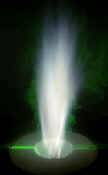
Property sources: Royal Society of Chemistry and CIAAW. Phase-change temperatures refer to molecular hydrogen near atmospheric pressure. Gas density was calculated from ρ = pM/(RT), using 20 °C, 101.325 kPa and M = 2.016 g mol−1. Actual density depends on temperature, pressure and gas composition.
Properties and reactions of hydrogen
A neutral hydrogen atom has one proton and one electron. Protium and deuterium are stable; tritium is radioactive. Isotope abundances vary between materials, so the mass of one isotope must not be confused with hydrogen's standard atomic weight.
Hydrogen occurs in water and organic compounds and is the most abundant element in the universe. The gas is much less dense than air. Atomic hydrogen (H) and molecular hydrogen (H2) have different reactivities; descriptions of atomic hydrogen do not apply automatically to ordinary hydrogen gas.
Hydrogen reacts with oxygen to form water, releasing energy. A spark, heat or suitable catalyst can initiate the reaction, and hydrogen–air mixtures can ignite or explode:
2H2 + O2 → 2H2O
Uses and production
Hydrogen is used in petroleum refining, ammonia and other chemical production, metal treatment and food processing. Refineries use it to reduce sulfur in fuels and in hydrocracking. It is also used as rocket fuel and in fuel cells that generate electricity.
Hydrogen is an energy carrier: energy is needed to produce it from feedstocks such as natural gas or water. Water electrolysis uses electricity to split water into hydrogen and oxygen:
2H2O → 2H2 + O2
A fuel cell supplied with hydrogen produces electricity, water and heat without combustion. This point-of-use result does not describe the full environmental footprint. Emissions depend on hydrogen production, electricity supply and the wider supply chain. Burning hydrogen in air can also produce nitrogen oxides (NOx), even though hydrogen itself contains no carbon.
Explore hydrogen production by water electrolysis for Lenntech’s overview of electrolyser technologies and their water-supply requirements.
Health effects and safe handling of hydrogen
Hydrogen gas is extremely flammable and can displace oxygen. Although it is not chemically toxic, a leak in a confined space can create an oxygen-deficient atmosphere and cause unconsciousness or death. Its lack of smell provides no warning.
Hydrogen ignites readily, and its flame can be difficult to see. Ventilation, suitable hydrogen leak detection and appropriate flame detection are important engineering controls. Oxygen monitoring assesses a different hazard and must not be treated as a substitute for hydrogen detection.
Compressed gas introduces pressure hazards; liquid hydrogen and very cold gas can cause frostbite. Some metals can become embrittled by hydrogen, making material compatibility important in storage vessels, pipes and process equipment.
Handling and emergency arrangements should follow the supplier's safety data sheet and the site's procedures. Do not enter a suspected oxygen-deficient area to attempt an unprotected rescue. Seek emergency assistance following significant exposure or cold-contact injury.
Hydrogen in the environment and water
Hydrogen bound in water or organic matter is different from free H2 gas. Hydrogen production is not automatically carbon-free: fossil-fuel pathways and electricity generation can contribute substantial emissions. Leaked hydrogen can also affect other atmospheric gases and indirectly contribute to warming, so leakage control matters.
Relevance to water treatment
pH concerns hydrogen ions, not dissolved hydrogen gas. It is defined in terms of hydrogen-ion activity in solution. H+ is shorthand for hydrated hydrogen ions in water; adding or removing H2 gas is not equivalent to dosing an acid or alkali.
Water electrolysis is a direct connection between water supply and hydrogen production. The reaction consumes approximately 9 kg of water per kg of hydrogen on a stoichiometric basis, calculated from molar masses. This is the reaction requirement, rather than a complete plant water-consumption figure: it excludes treatment losses, cooling and other site uses.
For aquatic systems, assess the actual substance and water conditions. Effects associated with pH, oxygen availability or contaminants cannot be inferred from the element name alone.
Related element profiles: silver, copper, lead, bismuth, mercury, sodium, platinum and nickel.
Hydrogen page last reviewed: by Lenntech.
Back to the periodic table of elements.
Sources and further reading
- RSC: hydrogen properties, isotopes and history.
- CIAAW: hydrogen atomic weight and isotope composition.
- US EIA: industrial uses and fuel cells.
- US Department of Energy: hydrogen production by electrolysis.
- US Department of Energy: hydrogen use and nitrogen oxide emissions.
- IEA: greenhouse-gas emissions of hydrogen production.
- ILO/WHO: International Chemical Safety Card 0001 — hydrogen.
- US Department of Energy: safe use of hydrogen.
- US Department of Energy: hydrogen safety, embrittlement and leakage.
- IUPAC Gold Book: definition of pH.