

Cadmium - Cd
| Atomic number | 48 |
|---|---|
| Group / period / block | 12 / 5 / d |
| Relative atomic mass | 112.414 |
| Density at 20 °C | 8.69 g/cm3 |
| Melting point | 321.069 °C |
| Boiling point | 767 °C |
| Electron configuration | [Kr] 4d10 5s2 |
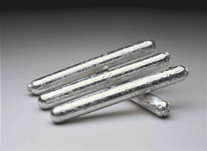
Cadmium
Cadmium is a soft, silvery-white metal usually obtained as a by-product of zinc, lead and copper processing. It has been used in nickel-cadmium batteries, pigments, coatings and alloys. Exposure to cadmium and its compounds should be controlled.
In water, cadmium commonly occurs in the +2 oxidation state. Its dissolved concentration and mobility depend on pH, alkalinity, dissolved organic matter, chloride, sulfate and other constituents. It can associate with particles and mineral or organic surfaces, or form carbonate, hydroxide or sulfide solids under suitable conditions.
Cadmium in water treatment
Water-treatment context: Cadmium removal is matrix-dependent. Chemical precipitation followed by solids separation, adsorption and ion exchange may be considered for particular wastewaters, but pH, competing ions, ligands and target concentration affect performance. Characterize both treated water and cadmium-bearing residuals; a universal treatment setpoint cannot be inferred from total cadmium alone.
Elemental metals and dissolved metal species behave differently in water. Water chemistry and the exact compound or complex must be considered when assessing treatment.
Back to the periodic table of elements
Sources and further reading
Cadmium page last reviewed: by Lenntech.