

Copper - Cu
Copper (Cu) is a reddish, readily worked metal with high electrical and thermal conductivity. It is used in wiring, plumbing, heat exchangers and alloys, and is an essential nutrient. In water systems, copper is important both as a construction material and as a substance that may need to be controlled.
Chemical properties · Applications · Copper in water and treatment · Health effects · Environmental effects
| Symbol / atomic number | Cu / 29 |
|---|---|
| Standard atomic weight | 63.546(3) |
| Group / period / block | 11 / 4 / d |
| Electron configuration | [Ar] 3d10 4s1 |
| Electronegativity (Pauling) | 1.90 |
| Density | 8.96 g cm−3 at room temperature |
| Melting point | 1084.62 °C |
| Boiling point | 2560 °C |
| Covalent radius | 0.122 nm |
| Non-bonded radius | 0.196 nm |
| Common oxidation states in compounds | +1 and +2 |
| Naturally occurring isotopes | 63Cu and 65Cu |
| First ionisation energy | 745.5 kJ mol−1 |
| Discovery | Known since antiquity |
Physical and atomic data follow the Royal Society of Chemistry; atomic weight and natural isotopes follow CIAAW. Atomic weight is dimensionless; the corresponding molar mass is approximately 63.546 g mol−1. The number in parentheses indicates uncertainty in the final digit. Ionic radii depend on oxidation state and coordination.
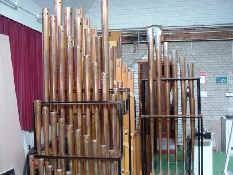
Copper: properties and occurrence
Copper is malleable and ductile, allowing it to be shaped and drawn into wire. It belongs to group 11 of the periodic table, alongside silver and gold. Surface films can develop during exposure to the environment; their composition and protective behaviour depend on conditions.
Copper occurs as native metal and in minerals such as chalcopyrite (CuFeS2) and bornite. Extraction can involve concentration, smelting and refining, or leaching routes, depending on the ore. Recycling is an important source of copper. Its use extends back to prehistoric times.
Applications of copper
- Electrical equipment: wiring, motors and other components make use of copper's conductivity.
- Buildings and industry: applications include plumbing, roofing, heat exchangers and machinery.
- Alloys: brass combines copper with zinc; bronze commonly combines copper with tin. Alloy composition affects strength, corrosion resistance and suitability for service.
- Chemicals: copper compounds have applications in catalysts, pigments and some biocidal products. Such uses need to be distinguished from uncontrolled release to water.
Copper in water and water treatment
See Lenntech's heavy metal removal overview for related treatment processes.
Sources and corrosion
Copper can enter water through natural weathering, mining, industry and agricultural runoff. In drinking-water systems, corrosion of copper-containing pipes and fittings can be a major source. Concentrations at the tap can therefore differ from those at the treatment plant.
Release depends on water chemistry, stagnation, temperature and the condition of surfaces. Corrosion control requires assessment of the whole system; simply describing copper as corrosion resistant does not establish its suitability for every water. Changes in treatment can alter corrosion and should be evaluated accordingly.
Forms and removal options
Copper may be dissolved as ions or complexes, or associated with suspended particles. Characterising these forms helps select treatment and interpret total-copper results.
- Precipitation and solids separation: pH adjustment can form copper-containing solids, followed by clarification or filtration. Complexing agents can hinder removal, so actual wastewater needs testing.
- Adsorption and ion exchange: appropriate media can capture dissolved copper. Selection depends on feed-water chemistry, competing substances and the target residual.
- Reverse osmosis: suitable systems can reduce copper at the point of use. Membrane performance, pretreatment, maintenance and concentrate management all matter.
Where copper is released by downstream plumbing, removal at a central plant alone may not solve the problem. Sampling should reflect the intended assessment, including any specified stagnation or flushing conditions. Verify treated-water performance rather than relying only on appearance or taste.
Treatment transfers copper into sludge, spent media, regenerant or concentrate. Plan for these streams alongside the required water quality.
Health effects of copper
Nutrition and excessive exposure
Copper supports enzymes involved in energy production, iron metabolism and other functions. Foods such as shellfish, nuts, seeds, whole grains and organ meats supply copper. The US recommended dietary allowance for adults is 900 µg/day (0.9 mg/day), with different values for pregnancy and lactation. This is a nutritional reference value, not a drinking-water limit.
Excessive copper exposure can cause gastrointestinal symptoms such as nausea, vomiting, abdominal pain and diarrhoea. Prolonged high exposure can damage the liver. Risk depends on dose, duration, chemical form and individual susceptibility; copper's essential nutritional role does not make every exposure safe.
For general nutritional context, see recommended daily intake of vitamins and minerals. Dietary reference values and water-quality requirements serve different purposes.
Wilson disease
Wilson disease is an inherited genetic disorder that impairs removal of excess copper, allowing it to accumulate in organs. It is not caused by ordinary chronic copper exposure. People with the condition need medical management specific to their disorder.
Occupational exposure
Breathing copper fumes can cause respiratory irritation and metal fume fever, an illness with flu-like symptoms. Workplace assessment should consider the form of copper and other substances present. Safety information and controls need to match the actual process.
Environmental effects of copper
Copper enters ecosystems through natural processes and human activities. It is an element and is not destroyed by conventional treatment. It can move between dissolved forms, particles, sediments and organisms.
Copper is needed in small amounts by organisms, but elevated bioavailable concentrations can harm aquatic life, affecting survival, growth and reproduction. Total copper alone does not fully describe toxicity: dissolved organic carbon, pH and hardness influence bioavailability.
Soil binding can reduce mobility without making copper permanently immobile. Environmental assessment should consider site conditions, chemical form and exposure rather than assuming that copper will always remain fixed in sediment or soil. Control of discharges and appropriate management of copper-bearing residuals help limit harmful exposure.
Copper page last reviewed: by Lenntech.
Back to the periodic table of elements.
Sources and further reading
- RSC: copper properties and applications.
- CIAAW: copper atomic weight and isotopes.
- USGS: copper minerals, processing and recycling.
- NIH: copper nutrition and excessive intake.
- NIDDK: Wilson disease and its genetic cause.
- UKHSA: copper exposure and health effects.
- Health Canada: copper in drinking water, corrosion and treatment.
- EPA: copper and aquatic life.
- EPA: metals wastewater treatment and precipitation (PDF).