

Ultrafiltration (UF) Operation &Troubleshooting
Ultrafiltration (UF) systems are widely used as a pretreatment barrier for reverse osmosis (RO) or as a standalone treatment step for suspended solids, colloids, and microorganisms. Stable UF operation is essential to maintain consistent water quality and protect downstream processes. General information about the UF technology and Lenntech solutions are available here:
When UF systems experience performance decline, indicators such as transmembrane pressure (TMP), permeability, and cleaning frequency provide valuable insight into the type of fouling occurring and the corrective actions required.
Key Performance Indicators (KPIs) in UF operation
UF system performance is typically evaluated using several normalized operational parameters:
- Transmembrane Pressure (TMP) – pressure difference across the membrane required to maintain filtration flow
- Flux – permeate flow rate per membrane area
- Permeability – normalized ratio between flux and TMP
Monitoring these indicators helps operators detect fouling early and determine when cleaning actions are necessary.
Understanding TMP increase
A gradual increase in TMP is one of the most common indicators of UF fouling.
Possible causes include:
- Accumulation of suspended solids and colloids on the membrane surface
- Organic fouling from natural organic matter or industrial process water
- Biofouling due to microbial growth
- Insufficient or ineffective backwash or air scour
If TMP continues to increase despite regular backwash cycles, the fouling layer may be becoming compacted or partially irreversible.
Hydraulic vs chemical cleaning procedure
UF systems typically rely on periodic backwashing to remove accumulated solids from the membrane surface. Backwash frequency and intensity must be properly adjusted to maintain permeability without excessive water or energy consumption.
When hydraulic backwash alone is insufficient, Chemical Enhanced Backwash (CEB) or Mini-CIP (Cleaning-In-Place) may be required. CEB introduces small doses of cleaning chemicals during backwash to help dissolve organic deposits, biological layers, or inorganic particles, while Mini-CIP is a shorten CIP procedure allowing a chemical cleaning with hot water (30-35°C) to enhance the cleaning effect during a short soaking period in a hot chemical solution.
Typical CEB and Mini-CIP chemicals may include:
- Oxidants for biofilm control
- Alkaline solutions for organic fouling removal
- Acid solutions for mineral deposits
Optimizing the frequency and chemistry of chemical cleaning helps maintain stable operation while reducing the need for full chemical cleaning.
Interpreting TMP and flux trends
The relationship between TMP and flux provides important information about membrane condition.
- Stable flux with rising TMP may indicate progressive fouling buildup.
- Flux decline at constant TMP may suggest feedwater quality variations or operational limitations.
- TMP increases that are not reversed by backwash or CEB may indicate irreversible fouling.
Tracking normalized permeability trends allows operators to distinguish between normal operational fluctuations and true membrane deterioration.
Below an example of restored normalized TMP after a CIP:
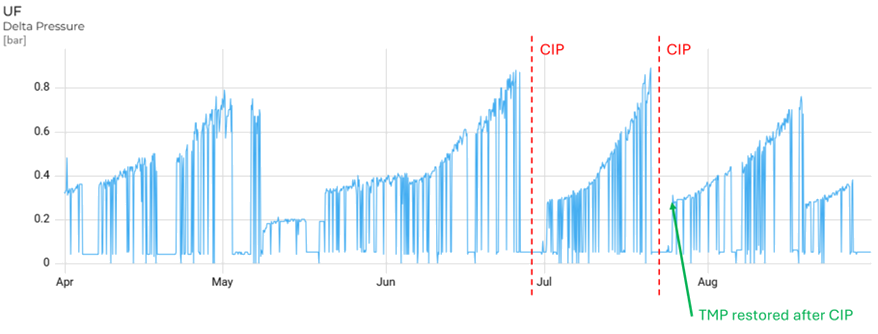
Other variations on the above diagram are due to the varying operating conditions and start/stops over the months.
Impact of UF integrity on downstream RO
In many industrial systems, UF serves as a pretreatment step for reverse osmosis. When UF integrity is compromised, feedwater quality to the RO system may deteriorate.
Potential impacts include:
- Increased silt density index (SDI) entering the RO system
- Higher levels of colloids or suspended solids
- Increased risk of RO fouling and cleaning frequency
Monitoring the UF integrity through its normalized KPI’s is therefore critical for protecting downstream membrane processes and ensuring overall system reliability.
Detecting irreversible UF fouling
Not all fouling can be removed by routine backwash or CEB/Mini-CIP cycles. When the TMP limit of the UF limit is reached, a complete CIP is required. Indicators of irreversible fouling may include:
- Continuous TMP increase despite optimized cleaning
- Progressive decline in permeability after each cleaning cycle
- Increasing frequency of chemical cleaning
When these trends appear, further investigation may be required to determine whether fouling originates from feedwater composition, pretreatment limitations, or operational conditions.
Advanced diagnostics for UF systems
If cleaning no longer restores performance, additional diagnostic steps may be required. These may include:
- Detailed analysis of feedwater quality and fouling potential
- Review of operating conditions such as flux and recovery
- Inspection of membrane modules or fibers
- Laboratory analysis of fouling deposits
These diagnostics help identify the root cause of performance decline and guide corrective actions such as pretreatment adjustments, operational changes, or membrane replacement planning.
How Lenntech can support
Lenntech supports industrial operators in maintaining reliable UF operation through performance analysis, troubleshooting support, and optimization of cleaning strategies.
Our expertise covers UF pretreatment systems, integration with downstream RO processes, and long-term operational monitoring to ensure stable water treatment performance.
Lenntech can deliver UF systems with integrated UF normalized performance parameter trends, to support operation and early intervention.
For more information or quotation, please contact us:  Feedback Form or call us on +31 152 610 900