
Integrated Troubleshooting & Optmization Across Membrane Systems
Many industrial water treatment plants combine several technologies, including pretreatment systems such as multimedia filtration (MMF) and softening, together with membrane processes like ultrafiltration (UF) and reverse osmosis (RO), in order to achieve reliable water quality for process use, reuse, or discharge. While each technology has its own operational indicators, troubleshooting must often be performed at system level rather than at individual unit level. A disturbance in one part of the treatment train may propagate downstream and affect the performance of other membrane stages.
Understanding how the different technologies interact helps operators identify the true origin of performance decline and implement corrective actions efficiently.
Comparing performance across membrane technologies
In multi-stage membrane systems, raw operating data alone often does not provide a reliable basis for comparison. Variations in temperature, feedwater salinity, or operating pressure can significantly influence performance indicators.
For this reason, normalized data analysis is essential when evaluating system performance. By normalizing parameters such as permeate flow, pressure drop, and salt passage, operators can compare current performance with the original system baseline and identify long-term trends.
Normalized performance analysis allows operators to:
- Identify gradual fouling or scaling development
- Compare performance between different membrane stages
- Detect deviations that may originate from upstream treatment units
- Separate normal operating fluctuations from true performance decline
This approach is particularly important in integrated UF–RO systems, where changes in pretreatment efficiency can strongly influence downstream RO operation.
Importance of water quality monitoring across the treatment train
Operational data should always be supported by regular water quality analysis before and after each treatment step. Monitoring water parameters relevant to each membrane technology helps verify that pretreatment units are operating correctly and that membranes receive water within their design specifications.
Typical examples include:
- TSS and turbidity at the UF or MMF inlet, indicating the particulate load entering the membrane system.
- Hardness, alkalinity, and scaling indicators at the RO inlet, which determine the scaling potential of the feedwater.
- Organic content or bacteria indicators, which may influence biofouling risks.
Regular analysis of these parameters helps detect pretreatment performance loss, sudden feedwater quality changes, or conditions that may lead to fouling or scaling. Monitoring trends over time can therefore provide early warning of an upcoming need for chemical cleaning (CIP) or process adjustments before significant performance decline occurs.
Coordinating cleaning and maintenance
In plants where UF and RO operate in series, cleaning and maintenance strategies should be coordinated across the entire treatment line.
For example:
- Reduced UF efficiency may increase fouling potential entering the RO system.
- Increased RO cleaning frequency may indicate insufficient pretreatment performance.
- Changes in operating conditions such as recovery or flux may affect both technologies simultaneously.
Coordinated maintenance planning helps avoid situations where localized adjustments create problems elsewhere in the treatment train.
Monitoring both systems together enables operators to maintain stable overall performance and extend membrane lifetime.
Identifying system bottlenecks
When system production declines or operating pressure increases, the limiting factor may not always be located in the most visible part of the plant.
Typical bottlenecks in integrated membrane systems may include:
- Pretreatment limitations affecting downstream membranes
- Fouling accumulation in specific membrane stages
- Hydraulic restrictions causing excessive pressure drop
- Operational conditions exceeding recommended membrane limits
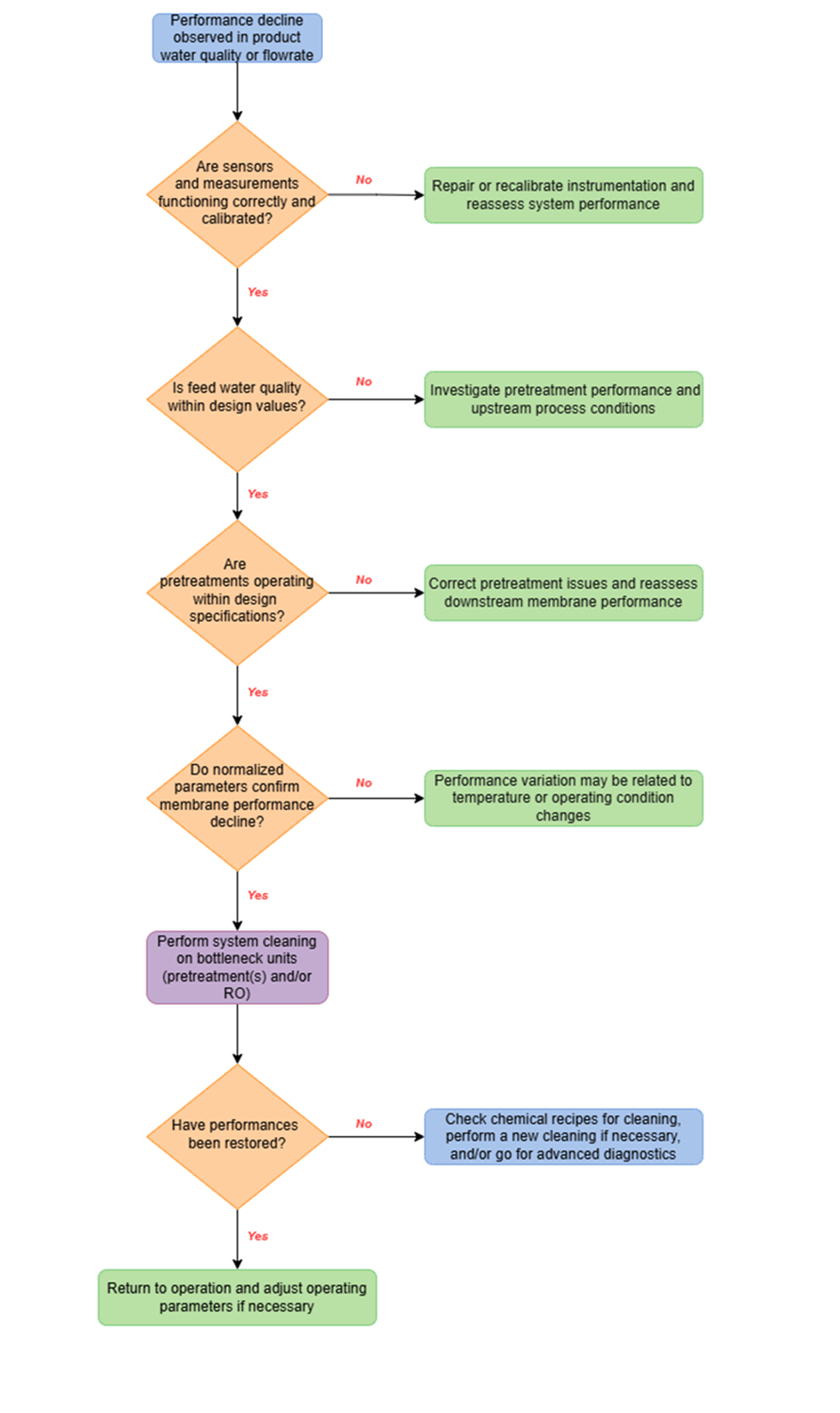
A structured troubleshooting approach, combining operational data analysis and system inspection, helps identify the true origin of the problem and prevents repeated corrective actions that do not address the underlying cause.
Below an example of flowchart for troubleshooting a multiple-units system.
Membrane autopsy and advanced diagnostics
When performance issues persist despite cleaning and operational adjustments, advanced diagnostic tools may be required.
One of the most reliable methods for identifying the root cause of membrane failure is membrane autopsy, where a used membrane element or module is analyzed under controlled laboratory conditions. Autopsy investigations can reveal:
- The type of fouling or scaling present on the membrane surface
- Evidence of chemical damage or membrane degradation
- The presence of biological growth or particulate deposits
These findings provide valuable information for improving pretreatment design, cleaning strategies, and operating conditions, helping prevent recurrence of the same issue in the future.
Complementary advanced diagnostics can be suggested depending on the troubleshooting, such as deposit analysis on SDI filter coupled with the membrane autopsy.
How Lenntech can support
Lenntech supports industrial operators with integrated troubleshooting of membrane treatment systems, combining operational data analysis, process evaluation, and advanced diagnostics.
Our expertise covers most of the technologies implemented in water treatment systems, coordinated cleaning strategies, and system optimization, helping identify performance-limiting factors and improve the long-term reliability of industrial water treatment installations.
For more information or quotation, please contact us:  Feedback Form or call us on +31 152 610 900