

TOP 50 Questions Reverse Osmosis Operation & Troubleshooting
Industrial reverse osmosis systems often operate under changing feedwater conditions, production demands, and regulatory requirements. This page addresses the most common operational and troubleshooting questions, sorted by theme, providing practical guidance to help operators identify performance issues, understand possible causes, and determine appropriate corrective actions.
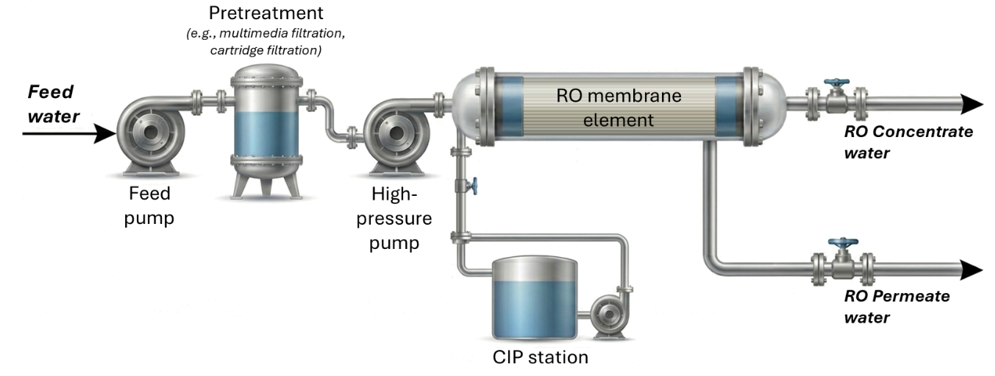
A. PERMEATE FLOW & PRODUCTION ISSUES
1. Why has permeate flow decreased over time?
Permeate flow may decrease due to membrane organic fouling, inorganic scaling, biological growth, membrane compaction or lower feedwater temperature. Always verify normalized permeate flow to distinguish real performance loss from temperature effects.
2. Why did permeate flow not recover after CIP?
This may indicate irreversible fouling, incorrect cleaning chemistry, insufficient cleaning conditions (pH, temperature, contact time), or permanent membrane damage.
3. Can I increase permeate flow by increasing operating pressure?
Increasing pressure may temporarily increase flow, but it may also accelerate organic fouling, biofouling, inorganic scaling and membrane compaction, leading to faster long-term performance loss.
4. Should I install a bigger high-pressure pump to increase production?
A larger pump may exceed membrane flux limits, causing rapid fouling or mechanical stress. Production increases should be achieved through system redesign, not pressure increase alone.
5. Why is permeate flow unstable during operation?
Unstable flow may be caused by feedwater quality fluctuations, inconsistent pretreatment performance, air entrainment, or hydraulic instability.
6. Why do fouling risks differ between lead and tail RO elements?Lead (first) membrane elements operate at higher flux and see the full particulate, organic, and biological load, making them more prone to fouling. Tail (last) membrane elements operate at higher salinity and concentration factors, which increases the risk of scaling and osmotic stress rather than particulate fouling.
7. Why is RO production lower in winter than in summer?
Lower feedwater temperature reduces membrane permeability. Normalization should be used before concluding that fouling is occurring.
B. Salt Rejection & Permeate Quality
8.Why has permeate conductivity increased gradually?
This may be caused by fouling, scaling, membrane aging or operation at higher recovery than design.
9.Why did salt passage increase after CIP?
Salt passage may increase due to improper cleaning chemistry, excessive temperature or pH, oxidant exposure that cause membrane damage during cleaning.
10.Can CIP damage RO membranes?
Yes. CIP may damage membranes if chemical compatibility, temperature limits or cleaning duration are exceeded.
11.Why does rejection differ between pressure vessels of the same stage?
This may result from uneven fouling, poor flow distribution or damaged O-rings.
12.Why does rejection drop suddenly?
A sudden drop may indicate mechanical damage, membrane rupture, seal failure or accidental oxidant exposure.
13.Does higher recovery always improve water quality?
No. Higher recovery increases salt concentration at the membrane surface, which may increase salt passage and fouling/scaling risk.
C. Differential Pressure & Hydraulic Issues
14. Why is differential pressure increasing across the RO?
Differential pressure may increase due to particulate fouling, organic fouling, biofouling or inorganic scaling.
15. How much is pressure drop increase considered abnormal?
A normalized increase of more than 15–20% may indicate fouling requiring corrective action.
16. Why does pressure drop recover only partially after CIP?
This may indicate residual fouling, incomplete cleaning, or irreversible fouling.
17. Can fouling occur even with good pretreatment?
Yes. Seasonal feedwater changes, organic load or biological activity may still cause fouling.
18. Why does fouling accelerate at higher flux?
Higher flux increases concentration polarization and compresses fouling layers, making cleaning less effective.
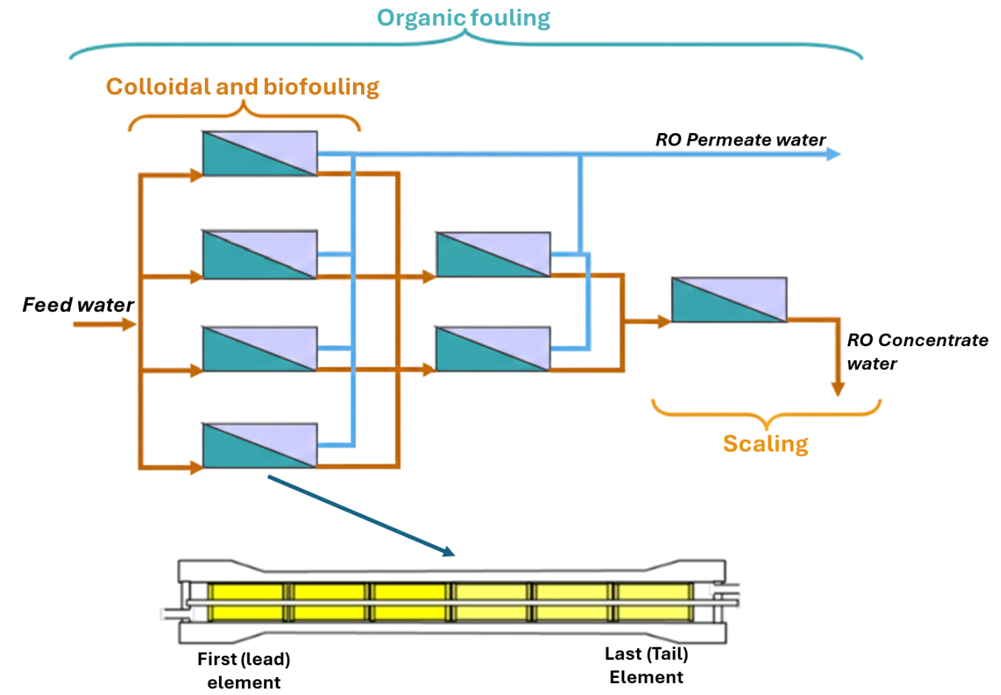
D. Fouling, Scaling & Biofouling
19. How can I differentiate fouling from scaling?
Scaling mainly shows as reduced permeate flow and salt rejection with little change in delta pressure, leading to a higher feed pressure and higher permeate conductivity. Fouling mainly shows as a strong increase in delta pressure across the stage and a lower permeate flow, often with only small initial changes in permeate conductivity.
20. What typically causes biofouling?
Biofouling may result from insufficient pre-treatment (for example disinfection), nutrient presence, stagnant zones or inadequate CIP.
21. Why does fouling return quickly after cleaning?
Main causes can be insufficient pretreatment, excessive recovery or inappropriate operating conditions.
22. Can antiscalant prevent all scaling?
Antiscalant may delay scaling but cannot compensate for excessive recovery or unsuitable feedwater conditions.
23. Why is silica scaling difficult to clean?
Silica forms hard deposits that may be partially or fully irreversible, requiring strict recovery control.
24. When should recovery be reduced?
Recovery may need reduction when scaling or fouling persists despite correct pretreatment and cleaning.
E. CIP (Cleaning-in-Place) Questions
25. When should CIP be performed?
CIP is typically required when normalized flow drops 10–15% or pressure drop increases 15–20%.
26. Why does CIP sometimes worsen performance?
This may occur if wrong chemicals are used, cleaning conditions are too aggressive, or fouling is misidentified.
27. Should I clean more frequently to avoid fouling?
Excessive cleaning may shorten membrane life. Addressing possible causes for fouling such as pretreatment improvement is more effective.
28. Why does CIP restore pressure but not salt rejection?
Salt rejection loss may be due to membrane damage or aging rather than removable fouling.
29. Can I combine cleaning chemicals to save time?
No. Mixing chemicals may cause precipitation or membrane damage.
30. How long should CIP typically last?
CIP duration may vary but usually ranges from 4 to 8 hours depending on fouling severity.
F. Operating Conditions & Design Limits
31. What happens if membranes operate above design flux?
Excessive flux may lead to accelerated fouling and reduced membrane life.
32. Why does high recovery increase fouling risk?
Higher recovery increases concentration at the membrane surface, promoting scaling and fouling.
33. Can RO systems operate under variable flow rate?
They may depending on the initial system design, but frequent start/stop cycles can accelerate (bio)fouling development and also cause mechanical stress or damage.
34. Why is air harmful to RO systems?
Air may cause membrane drying, oxidation or mechanical damage.
35. In case of performance loss, why is increasing pressure not the right solution?
Increasing pressure may temporarily increase flow but does not address the underlying cause of performance loss, such as fouling, scaling, or poor pretreatment. It can even accelerate membrane damage by increasing concentration polarization and operating stress.
G. Monitoring & Performance Evaluation
36. Which parameters should be monitored daily?
Flow, pressure, conductivity, temperature and recovery should be monitored consistently.
37. Why is normalization essential?
Normalization removes temperature and salinity effects, revealing true membrane condition.
38. Why do actual KPIs differ from design values?
Design assumptions may differ from real feedwater quality and operating conditions.
39. How can early problems be detected?
Trending normalized data allows early detection before severe fouling occurs.
H. Membrane Damage & Autopsy
40. When should membrane autopsy be considered?
Autopsy may be considered when CIP does not restore performance or when failures reoccur.
41. What information can membrane autopsy provide?
It may identify fouling type, scaling composition, biological growth, chemical attack or mechanical damage.
42. Can membrane autopsy prevent repeated failures?
Yes. It may confirm root causes and guide corrective actions before redesign or replacement.
43. Is autopsy useful before replacing membranes?
Yes. It may avoid replacing membranes without addressing underlying issues.
I. Retrofit, Upgrade & Support
44. Should membranes be replaced or pretreatment improved?
This depends on root cause. Replacing membranes alone does not solve recurring problems.
45. Can Lenntech support systems not originally supplied by them?
Yes. Lenntech supports troubleshooting, retrofits and optimization of third-party systems.
46. When is system redesign preferable compared to repeated troubleshooting?
Redesign your RO system over repeated troubleshooting is recommended when chronic performance issues persist despite fixes, or the design no longer matches changed feedwater quality or production needs.
47.Can monitoring upgrades improve RO reliability?
Yes. Improved monitoring may enable earlier intervention and reduced cleaning frequency.
J. Common Misconceptions
48. Higher pressure always increases production – true or false?
False. It may increase short-term output but often shortens membrane life.
49. More chemicals always solve fouling – true or false?
False. Chemical treatment must be matched to the actual fouling mechanism.
50. RO systems are “set and forget” – true or false?
False. Continuous monitoring and adjustment are essential for stable operation.
How Lenntech Supports Your Project
When operational data and routine corrective actions do not fully explain performance changes, a deeper technical review can help identify contributing factors and define effective next steps. Lenntech provides comprehensive support covering:
- Process and system engineering
- System assembly, on-site integration and automation
- Installation, commissioning and operational training
- Long-term and after-sales service, monitoring and optimization
This support helps industrial operators maintain reliable water treatment performance while meeting sustainability targets, regulatory requirements, and long-term cost objectives.
For more information or quotation, please contact us:  Feedback Form or call us on +31 152 610 900