

Electrodialysis and Electrodialysis Reversal (ED/EDR) for Brine Treatment

Introduction
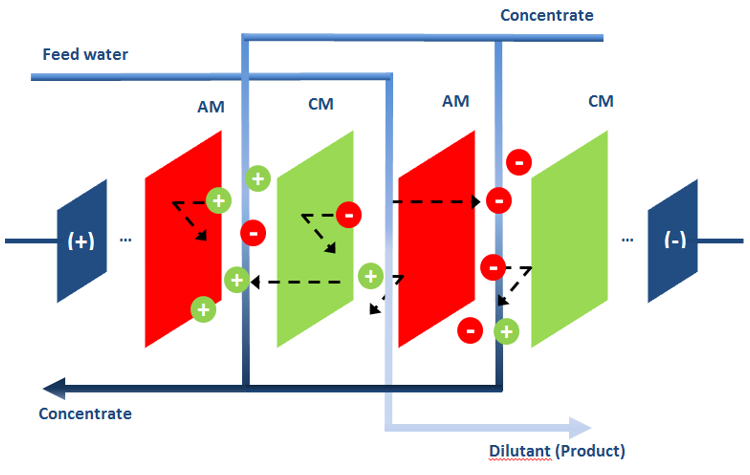
Electrodialysis (ED) separates dissolved ions using an electric field and alternating cation-exchange and anion-exchange membranes. The membranes are arranged so ions move from some channels into adjacent channels, producing a lower-salinity diluate stream and a concentrate stream.
Electrodialysis reversal (EDR) periodically reverses the electrical polarity and direction of ion movement. This can reduce the build-up of some scale-forming or charged deposits on membrane surfaces. Reversal does not eliminate fouling, and it does not remove the need for suitable pretreatment, monitoring or cleaning.
Process function
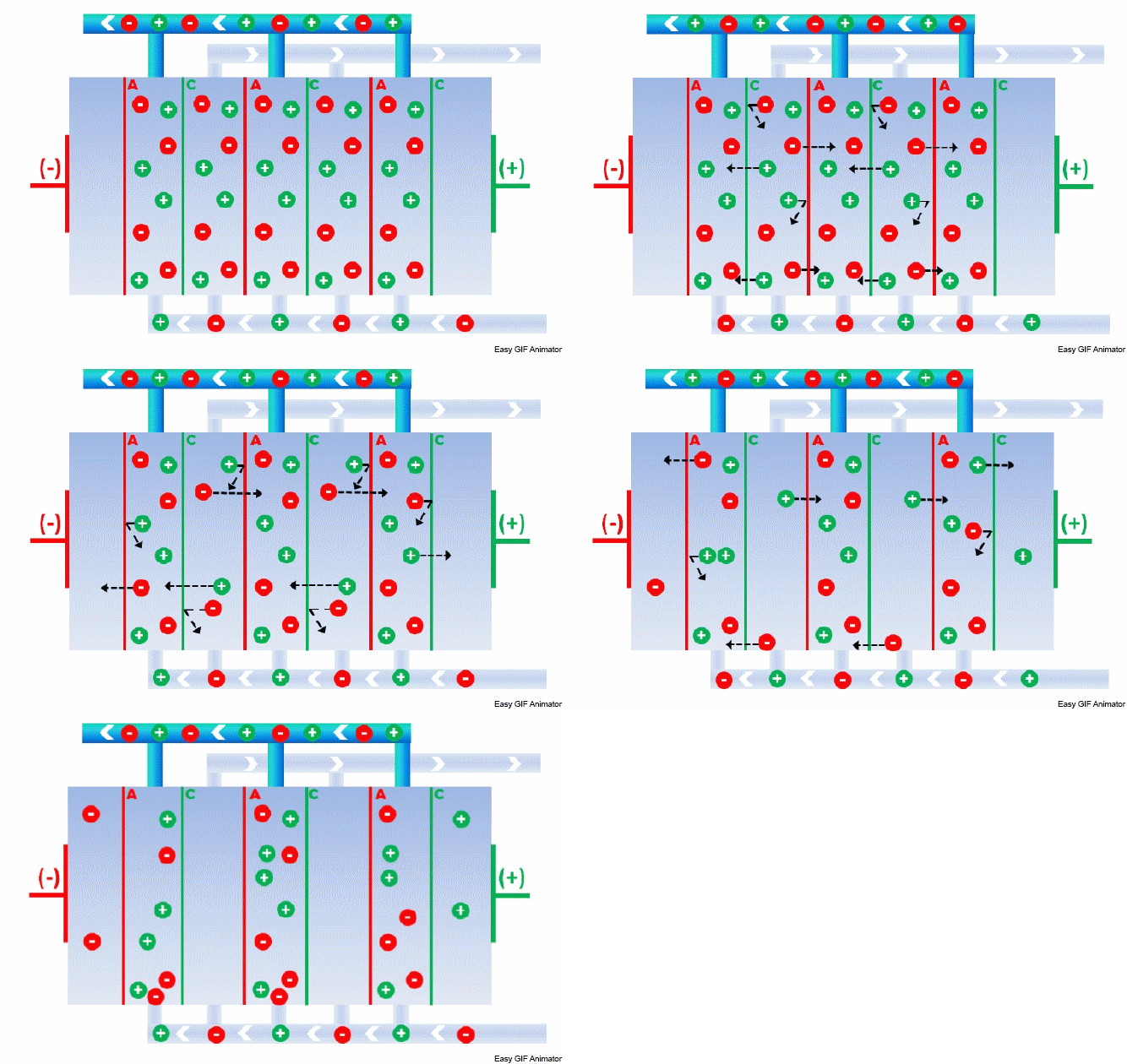
Feedwater flows through alternating diluate and concentrate channels in a membrane stack. Under direct current, cations migrate toward the cathode and pass through cation-exchange membranes; anions migrate toward the anode and pass through anion-exchange membranes. The membrane arrangement restricts their movement into the next channel, so ions accumulate in the concentrate while the diluate loses dissolved salts.
In an EDR system, the polarity-reversal interval is set by equipment design and operating conditions; it is not a universal fixed value. Reversal changes the direction of ion transport and can help manage deposits, while suspended solids, colloids, oils and other feed constituents may still require pretreatment. Membrane service life also depends on feed quality, operation, cleaning and maintenance, so a single lifetime figure should not be assumed for every installation.
Advantages and limitations
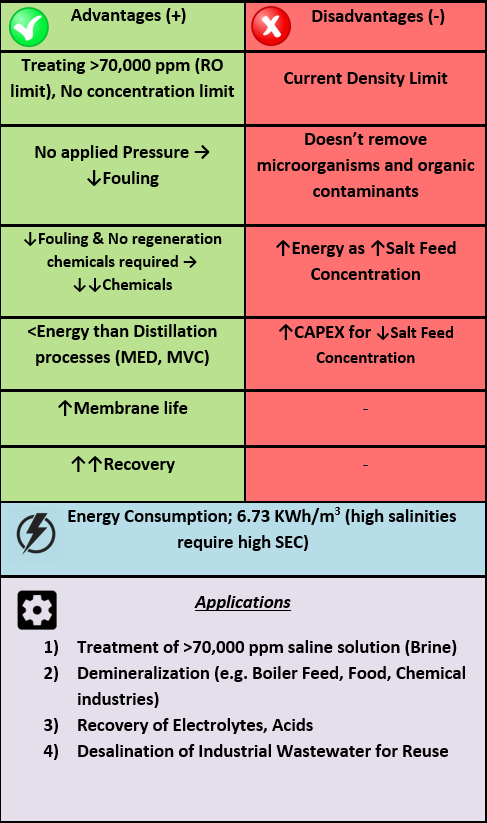
- Ion-selective separation: ED/EDR can reduce dissolved ionic constituents while allowing the process to be tailored to feed composition and the required product quality.
- Recovery and concentrate: Water recovery depends on feed chemistry, target salt removal, scaling or precipitation limits, and the concentrate-management strategy. High recoveries are not guaranteed by polarity reversal alone.
- Operating limits: Current density must be controlled. At or beyond the limiting current, water splitting can occur, reducing current efficiency and changing local pH.
- Non-ionic contaminants: ED/EDR is not a general barrier for suspended solids, microorganisms or most uncharged dissolved compounds. Additional treatment is needed when these are relevant to the product-water specification.
- Residuals: The concentrate stream requires a suitable reuse, treatment or disposal route. Brine handling can be a major part of project design.
Process-industry applications
- Brackish-water desalination and demineralisation
- Brine concentration and water reuse
- Industrial wastewater desalination
- Demineralisation of food products
- Recovery of valuable electrolytes or acids from rinsing baths
- Removal or concentration of dissolved ions in chemical and other process industries
ED/EDR and zero-liquid-discharge systems
ED/EDR can be one step in a brine-concentration or water-reuse train. It does not by itself guarantee zero liquid discharge (ZLD). ZLD depends on the whole treatment scheme, including downstream concentration or solids-management steps and a defined route for all residual streams.
For a broader overview of electrodialysis, see Electrodialysis (ED).
 Electrodialysis / ED Reversal information sheet