

Capacitive Deionization (CDI)
CAPACITIVE DEIONIZATION (CDI); Basic Principles and Applications
- Introduction
Capacitive Deionization (CDI) is a process system that removes charged species from water using an electrical potential difference (electrical driving force on the ions) between a pair of electrodes made often of porous carbon. One electrode which is positively charged adsorbs anions (negatively charged ions) and the other electrode which is negatively charged adsorbs cations (positively charged ions).
The absence of hydraulic pressure means that OPEX can be reduced and fouling can be controlled in contrast to pressure-driven membrane processes. What’s more, a relatively low voltage is required (< 1.8 V) which means significant advantages in terms of low energy requirements with substantial water recovery.
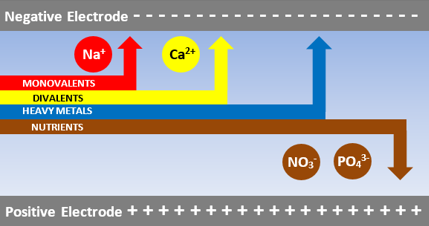
Fig.1, Possible application areas of CDI technology and practical strategies to improve selectivity. Cations (Na+, Ca2+, Mg2+, and heavy metal ions) and anions (PO4 3− and NO3 −) are electrosorbed in the negatively and positively charged electrodes respectively.
The removal selectivity of Capacitive Deionization processes is governed by the characteristics of the feed contaminant (e.g., ionic charge, hydrated radius, and initial concentration of ions), operating conditions (e.g., applied voltage), and electrode properties (e.g., pore size, pore size distribution, and structure).
- Capacitive Deionization Operation Cycles; Adsorption & Desorption
A typical Capacitive Deionization system cycles between two phases: a) Adsorption, where ions are removed from the water and b) Desorption, where the electrodes are regenerated.
- a) A potential difference is applied over the two electrodes and ions from the water are adsorbed. If we have porous carbon electrodes then the ions are transported through the interparticle pores to the intraparticle pores, where the ions are electrosorbed in the so-called electrical double layers (EDLs).
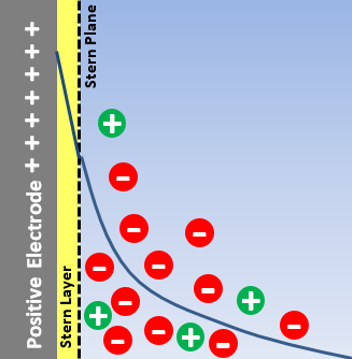
An EDL is a structure that appears on the surface of an object when it is exposed to a fluid. It comprises of two parallel layers of charge surrounding the object. The first layer, the surface charge (either positive or negative), consists of ions adsorbed onto the object due to chemical interactions. The second layer is composed of ions attracted to the surface charge via the Coulomb force, electrically screening the first layer. This second layer is loosely associated with the object. It is made of free ions that move in the fluid under the influence of electric attraction and thermal motion rather than being firmly anchored. It is thus called the "diffuse layer" (Fig.2).
a)
b)
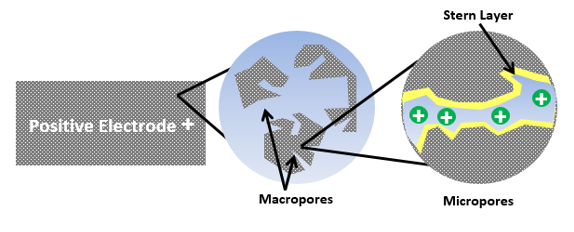
Fig.2, Models for charge and ion storage in porous CDI electrodes. (a) Structure of the electrical double layer (EDL) according to the Gouy–Chapman–Stern theory for a single planar EDL (ions do have finite size, so cannot approach the surface closer than a few nm). (b) Two-porosity-model for the electrode
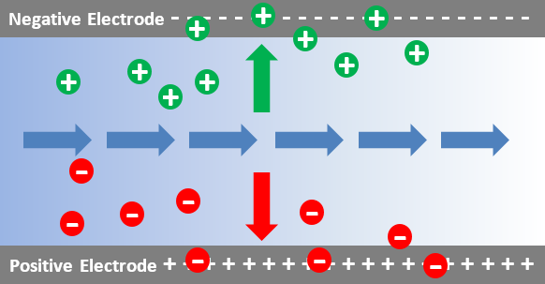
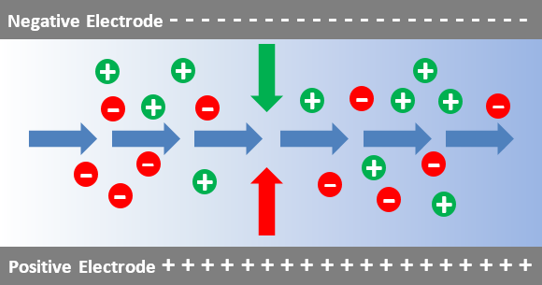
Fig.3, Adsorption-Desorption mechanism in Capacitive Deionization. During the adsorption step (a) the ions are removed from the brackish water and in the desorption step (b) the ion are released from the electrodes to regenerate the latter.
- Constant voltage vs. constant current operation mode
A Capacitive Deionization cell can be operated in either the constant voltage or the constant current mode.
- a) Constant voltage operation
When using constant voltage operation during the adsorption phase of a CDI the EDLs (carbon-based system) are uncharged at the beginning of an adsorption step, which results in a high potential difference over the two electrodes and the effluent concentration to decrease. When more ions are adsorbed in the EDLs, the EDL potential increases and the remaining potential difference between the electrodes decreases. Because of the decreasing ion removal rate, the effluent ion concentration increases.
- b) Constant current operation
Due to the ionic charge transported into the electrodes being equal to the applied electric current, by using a constant current allows for a better control on the effluent salt concentration. In order to have a stable effluent, salt concentration membranes should be used in the CDI cell (MCDI), as this operation mode does not only induce counter-ion adsorption, but co-ion depletion as well.
- System Advantages
Capacitive Deionization it has some unique advantages. First it enables salt removal at low (sub-osmotic) pressures and room temperatures, with the primary input being a small cell voltage (∼1 V) and an electric current whose magnitude depends on the system size. So, CDI does not need to be coupled to high pressure pumps or heat sources, which means that the system gets only superficial scaling.
Secondly the ions are directly transported out of the feed water which allows for potentially highly energy efficient desalination of low salinity feed waters (brackish water).
Thirdly CDI can store energy (similarly to a supercapacitor) and desalinate water upon being charged. Even if this energy storage capacity is not utilized, the once invested charge for ion removal is almost fully recovered during discharging of the electrode material, using the very high Coulombic efficiency of the EDL technologies.
- Capacitive Deionization System Applications
- Water softening
- Heavy metal removal
- Phosphate and nitrate removal
- Water softening
Water hardness which is caused by minerals such as calcium and magnesium in the water, creates scaling problems in industrial equipment. Among the processes that are used to remove these scaling ions and thus ‘soften’ the water, are chemical precipitation, ion exchange (IX), NF, RO, and ED which consume either a lot of energy or require an excessive use of chemicals. So given that CDI has distinct advantages for water softening, because of its low energy consumption and being a chemical-free process.
- Heavy metal removal
Industrial wastewaters often contain toxic heavy metals, such as lead, cadmium, and chromium, are being increasingly released to the environment. Treatment technologies include chemical precipitation, IX, adsorption, membrane processes, coagulation and flocculation, and electrochemical processes which suffer from certain disadvantages. Chemical precipitation for example produces large volumes of sludge and secondary waste, and they are applied only for high concentrations of ions. IX methods generate also secondary waste during the regeneration of resin which limits their large-scale applicability. Pressure-driven membrane processes are known to be efficient for heavy metal removal, but they have high OPEX. Electrochemical processes also have both high CAPEX and OPEX. Capacitive Deionization processes, on the other hand, may offer a viable technical option for heavy metal removal due to their good energy efficiency without using chemicals or producing waste.
- Phosphate and nitrate removal
Phosphates and nitrates are contained mainly in agricultural and industrial applications and they need to be removed in order to preventing environmental damage, such as the eutrophication of water sources. Nutrients, particularly phosphorus, are also an essential element for food production, are becoming sparser worldwide and recovering them is also a priority.
Processes for phosphorus removal and recovery from wastewater are struvite precipitation and sludge incineration but they require a high investment due to high chemical and energy demand.
Furthermore, full-scale technologies have been already applied for nitrate removal with biological process followed by membrane process, such as RO, ion-exchange, and chemical processes. Despite the excellent removal efficiencies there still remains the issues of OPEX, the requirement of pre-treatment and post-treatment, and the generation of secondary pollution.
A commercial CDI unit has reported nitrate removal of 88–98% from wastewater.
- Coupling Reverse Osmosis with Capacitive Deionization
RO technology is the most widespread desalination process mainly due to its very high salt rejection but it still has some disadvantages such as membrane fouling & scaling and high energy consumption. CDI can potentially compliment RO and help with its limitations with RO-CDI hybrid systems achieving increased performance and higher energy efficiency.
There are two main RO-CDI hybrid systems:
- the RO-CDI pass system (CDI to treat RO permeate) for ultrapure water (UPW) production
- the RO-CDI stage system (CDI to treat RO brine) for maximizing water recovery rate in wastewater treatment.
- RO-CDI pass system
Due to tight drinking water regulations there’s am increased demand of highly purified water from high-tech industries and auxiliary processes. UPW is used in many industries, such as pharmaceutical, electronic and power plants. Conventionally the main process of the UPW production scheme is the two-pass RO system. Despite the high removal efficiency of the two-pass RO system, which is typically composed of a first-pass RO process and a second-pass brackish water RO (BWRO) process (Fig. 4(a)), its high energy consumption has led to the exploration of new systems. As a result, the RO-CDI pass system has been suggested to replace the conventional two-pass RO system (Fig. 4(b)).
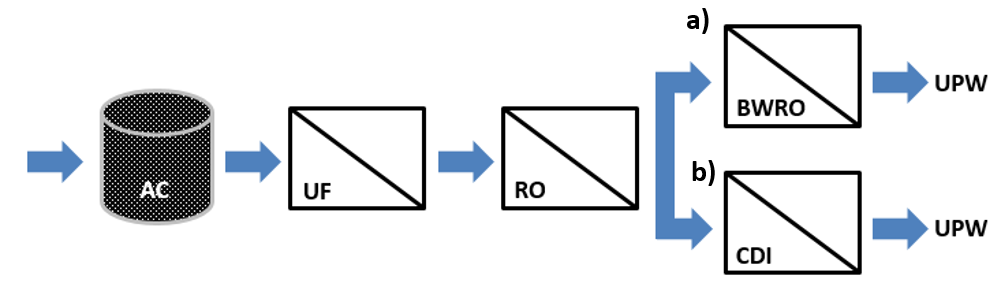
Fig.4, Schematic of the typical two pass RO system and the RO-CDI for production of UPW. In the RO-CDI the RO permeate is further treated to achieve the very high quality standards required for UPW.
Several studies have demonstrated the application potential of Capacitive Deionization for high-quality water production. The introduction of CDI as an RO permeate polishing step can be an alternative solution due to its great energy efficiency. There are, however, some concerns on organic or inorganic fouling, which are the two main pollutant groups in the water fed to CDI systems. Therefore, the performance of the CDI process could be maximized by controlling fouling or scaling. In this respect, the RO-CDI pass system has been investigated for producing not only drinking water but also highly purified water, such as UPW
By optimizing the configuration of the system and improving CDI performance, the total dissolved solids (TDS) concentration of UPW was drastically lowered to 0.035 mg/L (its resistivity was 18.8 MΩ/cm), which could be used in semiconductor industries requiring the highest level of purity. It was also reported that with a feed TDS concentration of 10 mg/L, UPW with a resistivity ranging from 2 to 9 MΩ/cm was produced under an applied voltage of 1.5 V
Recent advanced researches exhibited the great potential of the ROCDI pass system for substituting the conventional RO-EDI system with satisfactory product water quality and energy efficiency. EDI, which combines ED and ion exchange resin, is currently the most common process employed in UPW production systems. Although EDI can provide highly purified product water, the specific energy consumption (SEC) of EDI processes (0.39–2.11 kWh/m3) is relatively higher than that of CDI processes (0.02–0.22 kWh/m3) depending on the applied voltage, flow rate, and feed TDS concentration.
Another possible application of the RO-CDI pass system could be bromide removal during seawater desalination. A recent study reported that adopting CDI instead of the conventional BWRO as the second-pass process could decrease the energy consumption up to 40% when treating the first-pass RO permeate, proving the feasibility of the RO-CDI pass system for seawater desalination.
- RO-CDI stage system
Besides seawater desalination, RO recently broadened its application to industrial and municipal wastewater treatment. However, the production of RO brine is unavoidable during the RO process. The treatment of RO brine is a critical challenge for enhancing the overall water recovery rate of RO systems and, thus, RO-CDI hybrid systems have been recently proposed.
When treating municipal wastewater with high organic concentration, pretreatment is normally adopted before the CDI process, because organic fouling in the CDI process can not only significantly deteriorate removal efficiency but also increase energy consumption. Therefore, various pretreatment processes for removing organic matter have been applied.
The RO-CDI stage system has been proposed for treating industrial wastewater and improving water recovery. Simulated results have shown that the CDI process produced a final water quality of 497 mg/L when a RO brine of 1,686 mg/L was used as the feed solution to the CDI system, satisfying the drinking water regulations from the World Health Organization (WHO). Furthermore, the energy consumption of this ROCDI stage system was approximately 19% less compared to that of the two-stage RO system, depending on the efficiency of the energy recovery device (ERD). An experimental verification was also conducted, which demonstrated the feasibility of using the RO-CDI stage system for industrial wastewater treatment.
In addition to industrial wastewater treatment, the RO-CDI stage system has extended its applications to domestic wastewater reclamation, even in major cities such as Barcelona, Tokyo, and Singapore. Under the NEWater system in Singapore, for instance, the RO brine from municipal water reclamation facilities contains an extremely high organic concentration (TOC: 15.0–31.1 mg/L). Because organic matter in the RO brine can cause severe fouling in CDI cells, several pretreatment procedures, such as ozone, biological activated carbon (BAC), microfiltration (MF), and ultrafiltration (UF), are applied before the CDI process. The desalting efficiency and water recovery of such CDI processes ranged from 86 to 92% and from 78 to 89%, respectively. Moreover, the water recovery of the RO-CDI stage system was over 90%, with an approximately 15% lower energy consumption compared to that of the conventional two-stage RO system, even when considering the energy consumption for the BAC pretreatment. In that study, the SEC of the pilot-scale CDI process with a BAC pretreatment was 0.85 kWh/m3.