
Bipolar Membrane Electrodialysis (EDBM)
How EDBM works
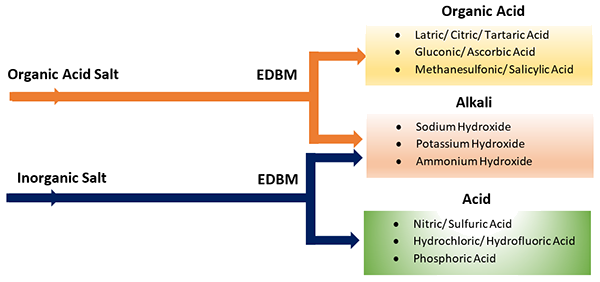
Electrodialysis with bipolar membranes (EDBM), also called bipolar membrane electrodialysis (BMED), combines ion transport with water dissociation to convert dissolved salts into their corresponding acids and bases.
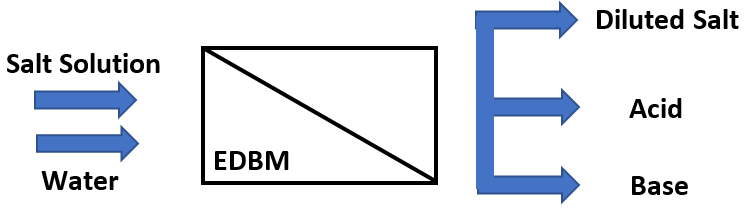
A bipolar membrane consists of a cation-exchange layer and an anion-exchange layer. Under the appropriate direct-current polarity, water dissociates at their junction. Hydrogen ions pass through the cation-exchange layer, while hydroxide ions pass through the anion-exchange layer.
The reaction can be written using hydronium ions:
2H2O ⇄ H3O+ + OH−
H+ is commonly used as shorthand for the hydrated hydrogen ion. In a three-compartment stack, bipolar membranes operate together with anion-exchange and cation-exchange membranes to separate the salt, acid and base streams.
Example: sodium sulfate to sulfuric acid and sodium hydroxide
Sodium sulfate contains sodium cations (Na+) and sulfate anions (SO42−). Sulfate has a negative two charge.
| Ion | Membrane crossed | Destination and role |
|---|---|---|
| SO42− | Anion-exchange membrane | Moves from the salt compartment into the acid compartment, where H+ supplied by a bipolar membrane acidifies the sulfate stream. |
| Na+ | Cation-exchange membrane | Moves from the salt compartment into the base compartment, where OH− supplied by a bipolar membrane produces a sodium hydroxide solution. |
The ideal overall material balance is:
Na2SO4 + 2H2O → H2SO4 + 2NaOH
This balance describes the net conversion, rather than the individual species present in solution. In the acid stream, the proportions of sulfate and hydrogen sulfate (HSO4−) depend on acidity.
Water dissociation and electrode reactions
Water dissociation inside the bipolar membrane generates ions, not hydrogen or oxygen gas. However, the EDBM stack still requires an anode and a cathode to carry the electrical current. Electrode reactions occur in the end compartments and can generate gases, depending on the electrode system and electrolyte. A separate electrode pair is not required for every repeating membrane unit.
Performance and operating considerations
- Membrane performance: desirable properties include a low voltage drop during water dissociation, high ion selectivity, chemical stability and mechanical strength.
- Energy use: practical consumption depends on feed composition, product concentration, current density, membrane resistance and current efficiency. Voltage alone does not specify energy consumption; comparisons need a stated basis, such as kWh per kilogram of product.
- Product quality: salt leakage and water transport can limit acid and base purity and concentration.
- Resource recovery: suitable salt streams can provide reusable acids and bases. Waste reduction and economics depend on the specific feed and reuse requirements.
- Continuous operation: EDBM does not use the cyclic chemical regeneration of an ion-exchange resin bed. Feed treatment, cleaning and membrane maintenance still depend on operating conditions.
Applications
- Production of inorganic acids and bases from their corresponding salts.
- Recovery of acids and bases from suitable salt-containing waste streams.
- Production of organic acids from organic acid salts.
- Production of amino acids from their salts.