|
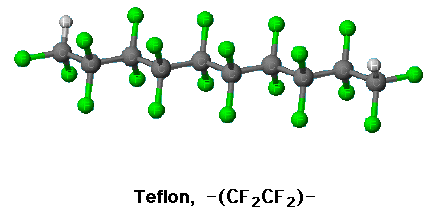
Teflon was first discovered by Roy J. Plunkett (1910-1994) in 1938 and introduced as a commercial product in 1946.
Below you can find the most uprising characteristics of this material which makes it useful for tons of industrial and domestic applications in our daily life:
- Resistant to many chemicals
This includes ozone, chlorine, acetic acid, ammonia, sulfuric acid and hydrochloric acid. The only chemicals known to affect these coatings are molten alkali metals and highly reactive fluorinating agents.
- Weather and UV resistance
- Non stick
Very few solid substances will permanently adhere to a Teflon coating. While tacky materials may show some adhesion, almost all substances release easily.
- Outstanding performance at extreme temperatures
In fact it can temporarily withstand temperatures of 260C and cryogenic temperatures of -240C and still have the same chemical properties.
It has an initial melting point of 342C (+- 10C) and a secondary melting point of 327C (+- 10C).
- Low coefficient of friction.
It is the ratio of the force required to make two surfaces slide over each other. A low number equals low resistance and smooth operation. This indicates the difficulty in sliding one surface against another. The coefficient of friction is generally in the range of 0.05 to 0.20, depending on the load, sliding speed, and type of Teflon coating used.
- Non wetting
Teflon finishes are both hydrophobic and oleophobic, cleanup is easier and more thorough.
- Exceptional dielectric properties
Teflon has a high dielectric strength over many different frequencies, low dissipation factor and high surface resistivity. Dielectric strength is the high voltage that the insulating material can withstand before it breaks down. In addition it has a low dissipation factor; this is the percentage of electrical energy absorbed and lost when current is applied to an insulating material. A low dissipation factor means that the absorbed energy dissipated as heat is low.
The high surface resistivity refers to the electrical resistance between opposite edges of an unit square on the surface of an insulating material.
- Excellent optical properties
|





 - Electrical and electronic industry.
 tovoltaic cell glazing, etc.