
Scaling and Antiscalants
|
Scaling means the deposition of particles on a membrane, causing it to plug. Without some means of scale inhibition, reverse osmosis (RO) membranes and flow passages within membrane elements will scale due to precipitation of sparingly soluble gas, such as calcium carbonate, calcium sulfate, barium sulfate and strontium sulfate. Most natural waters contain relatively high concentrations of calcium, sulfate and bicarbonate ions. In membrane desalination operations at high recovery ratios, the solubility limits of gypsum and calcite exceed saturation levels leading to crystallization on membrane surfaces. The surface blockage of the scale results in permeate flux decline, reducing the efficiency of the process and increasing of operation costs.
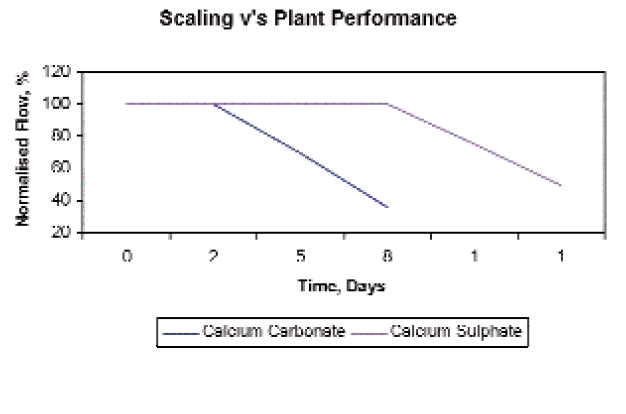
As it is evident from the graph, the induction period for calcium carbonate is much shorter than that for sulfate scales, such as calcium sulfate. It is economically preferable to prevent scaling formation, even if there are effective cleaners for scale. Scale often plugs RO element feed passages, making cleaning difficult and very time consuming. There is also the risk that scaling will damage membrane surface. There are three methods of scale control commonly employed:
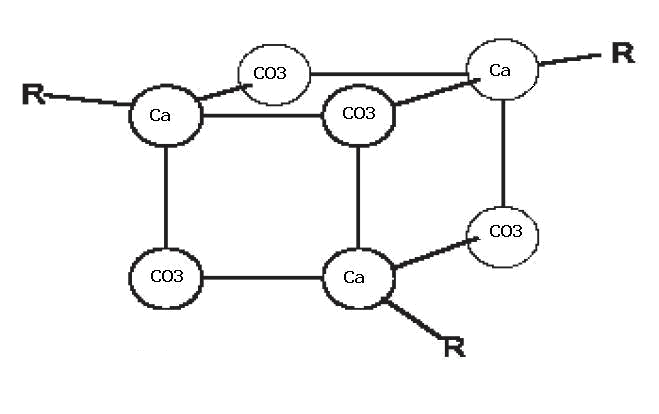
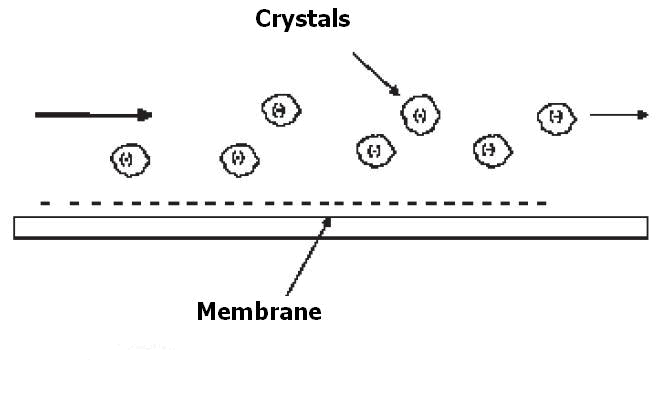
Acidification: acid addiction destroys carbonate ions, removing one of the reactants necessary for calcium carbonate precipitation. This is very effective in preventing the precipitation of calcium carbonate, but ineffective in preventing other types of scale. Additional disadvantages include the corrosivity of the acid, the cost of tanks and monitoring equipment and the fact that acid lowers the pH of the RO permeate. Ion exchange softening: this method utilizes the sodium which is exchanged for magnesium and calcium ions that are concentrated in the RO feed water, following the chemical equations: Ca2+ + 2NaZ => 2Na+ + CaZ2 (NaZ represents the sodium exchange resin). Antiscalants: they are surface active materials that interfere with precipitation reactions in three primary ways:
|
|
Threshold Mechanism |
Dispersancy |
| During the past two decades new generations of antiscalants have emerged commercially, in which the active ingredients are mostly proprietary mixtures of various molecular weight polycarboxylates and polyacrylates.
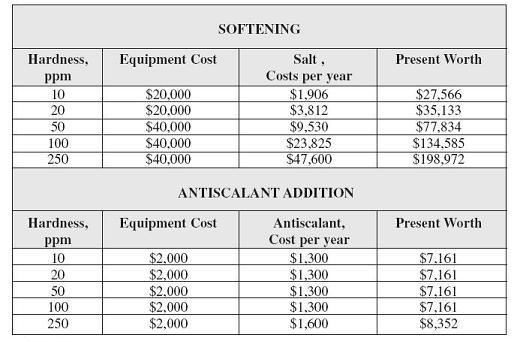
Calculation procedures exist for predicting the likelihood of scale formation. Use of these predictors depends upon an up-to-date water analysis and a knowledge of system design parameters. The ions contained in the feed water concentrate though the RO system, the point of maximum scale potential is the concentrate stream. Antiscalant type and dosage is therefore based upon the mineral analysis at this point. Lenntech can help you in the selection of the best antiscalant for your particular application. Economical analysis Acid addition is not very cost effective because of the cost of acid, tanks and monitoring equipment. Unless removed by degasification, excess of carbon dioxide contained in the permeate of acid-fed systems increases the cost of ion exchange regeneration.
Footnote
Contact us for more information about antiscalants. |
|