

Reverse Osmosis Plants
Lenntech designs, builds and commissions reverse osmosis (RO) systems for tap water, brackish water and seawater desalination, for applications including drinking water, irrigation and process water.
RO uses pressure to drive water through a semipermeable membrane, producing a lower-salinity permeate and a concentrate stream containing much of the rejected salt. A suitable RO membrane can substantially reduce sodium, but no single rejection value applies to every installation: performance depends on feed composition, membrane selection and condition, operating pressure, temperature and recovery. Confirm expected results with a complete water analysis and current membrane-design projections.
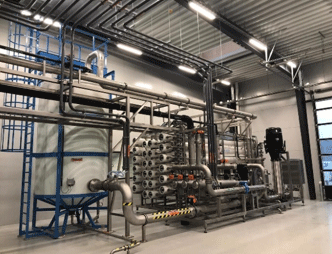
Lenntech provides pre-engineered as well as custom designed turnkey plants covering several flows. The systems can be skid mounted and containerized. Capacities above 100 m3/h usually require multiple skids.
| Model reference | Flow |
| LT-RO1-htec-5 | 2-5 m3/h |
| LT-RO1-htec-10 | 5-10 m3/h |
| LT-RO1-htec-20 | 10-20 m3/h |
| LT-RO1-htec-40 | 20-40 m3/h |
| LT-RO1-htec-60 | 40-60 m3/h |
| LT-RO1-htec-100 | 60-100 m3/h |
When a higher removal of salts is required a double-pass RO can be implemented, where the permeate of the first pass RO is treated in a second RO system.
| Model reference | Flow |
| LT-RO2-htec-5 | 2-5 m3/h |
| LT-RO2-htec-10 | 5-10 m3/h |
| LT-RO2-htec-20 | 10-20 m3/h |
| LT-RO2-htec-40 | 20-40 m3/h |
| LT-RO2-htec-60 | 40-60 m3/h |
| LT-RO2-htec-100 | 60-100 m3/h |
Please check Reference projects for detailed information on Lenntech running plants.
Large size BWRO plant < 70 m3/h
Smaller capacity systems:
Small size BWRO plant < 1500L/h
An innovative RO technology offered by Lenntech deviating from the traditional RO configuration is the Desalitech Closed Circuit Reverse Osmosis (CCRO). This is used when high recovery is needed.
RO systems generally require pretreatment selected for the feed-water analysis and membrane limits. Pretreatment may control suspended solids, scaling, organic fouling and biological growth. Oxidants such as free chlorine must be managed according to the selected membrane’s compatibility because many common RO membranes can be damaged by chlorine. RO also produces a concentrate stream that requires appropriate management.
RO permeate water is often more acidic than the feed water due to dissolved carbon dioxide. Common post-treatment steps include pH adjustment and remineralisation.
When an additional polishing step is required after the RO treatment to reach extra pure water quality Electrodeionization (EDI) and Ion exchange (IX) can be added as treatment steps.
General design data for Reverse Osmosis Plants:
The values in the following table are indicative design ranges, not guaranteed operating results. Actual flux, recovery, pressure, energy use and salt rejection depend on the feed-water analysis, temperature, selected membranes, pretreatment, system configuration and operating conditions; confirm them for each project.
|
TWRO Tap water |
BWRO Brackish water |
SWRO Sea water |
|
| Salinity | < 1500 ppm | < 8000 ppm | 35,000–45,000 ppm |
| Recovery | 80% | 65-80% | 35-45% |
| Working pressure |
< 15 bar | 15-25 bar | 50-75 bar |
| Membrane types | Tap / Brackish 4" or 8" | Seawater 4" or 8" | |
| Flux | 30-35 l/h.m2 | 25-30 l/h.m2 | 15-20 l/h.m2 |
| Specific energy at 25°C |
< 0.75 kWh / m3 | < 1.5 kWh / m3 | < 5 kWh / m3 with energy recovery |
| Configuration |
Skid mounted or containerized 10 to 40 ft |
||
What is reverse osmosis?
Seawater desalination
Reverse Osmosis membranes
Reverse Osmosis membrane cleaning
For more information or quotation, please contact us:  Feedback Form or call us on +31 152 610 900