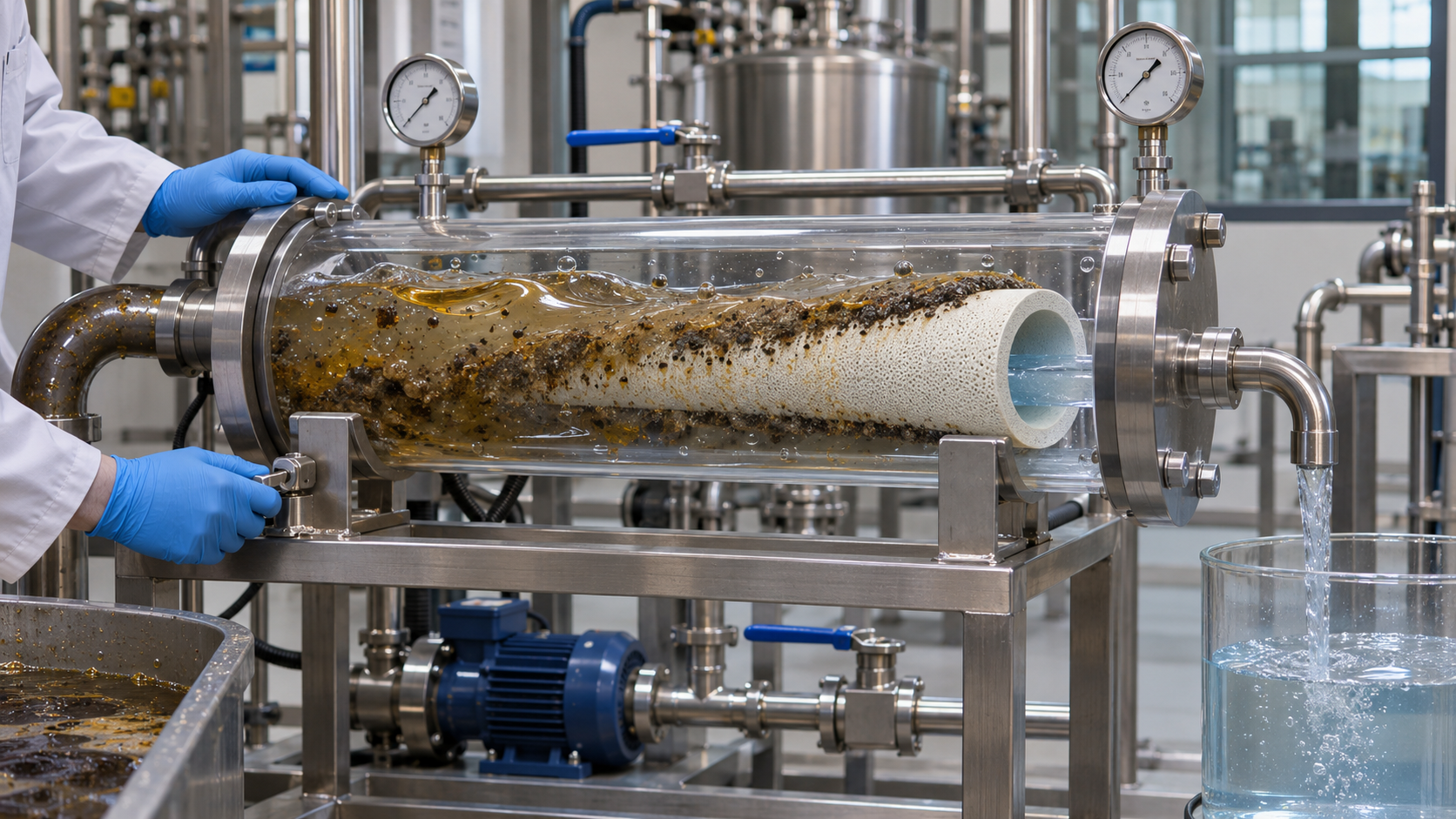
Treatment Challenges & Applications for Tubular Pressurized Ceramic UF Membranes
Tubular pressurised ceramic ultrafiltration (UF) is a crossflow membrane process for streams that contain suspended solids, oil droplets, colloids or larger molecules. Feed flows through membrane channels; part of the liquid passes through the membrane as permeate, while retained material leaves in a concentrate stream.
The fit depends on the membrane cut-off, feed composition, temperature, pressure, pretreatment and cleaning regime. UF generally does not remove dissolved salts or small dissolved ions. Dissolved metals therefore require another treatment step unless they are first converted to a retainable particulate or sufficiently large complex.
Industrial wastewater and resource recovery
- Oily wastewater and process-water pretreatment: UF can retain emulsified oil droplets and suspended solids in suitable streams. It may be used ahead of further treatment, including reverse osmosis, when pretreatment and operating conditions are properly designed. It does not remove every dissolved organic compound or eliminate all downstream fouling risk.
- Metalworking fluids and wash baths: UF can separate oil emulsions and suspended material from selected cleaning streams, potentially enabling reuse of part of the liquid. Dissolved metal ions are not removed by UF alone; precipitation, complexation, ion exchange or another suitable process may be needed. Confirm detergent compatibility and product quality before reuse.
- Catalysts and powdered activated carbon: Particles larger than the effective membrane cut-off can be concentrated and retained, including some catalyst or carbon solids. Retention, catalyst recovery and solvent compatibility must be confirmed for the specific membrane, seals, housing and process conditions.
Food, beverage and life sciences
- Juices, extracts and fermentation broths: Ceramic crossflow membranes can clarify selected beverage, food and fermentation streams by retaining suspended solids and larger components. Product yield, sensory quality, fouling and cleaning requirements need application trials.
- Whey proteins and dairy streams: UF is used to concentrate proteins and separate components in dairy processing. Ceramic elements may be considered where their chemical, temperature and cleaning characteristics suit the process; hygienic design and applicable food-contact requirements must be verified for the complete installation.
- Biomass and cell harvesting: UF can retain cells or biomass when the selected cut-off and operating regime provide the required retention. Product-specific tests should assess cell breakage, fouling, recovery and the quality of the permeate.
Energy, mining and produced water
- Produced water and oily process streams: Ceramic MF/UF has been evaluated and used in oil-containing wastewater treatment. A suitable system can reduce suspended solids and dispersed oil, often as one step in a larger treatment train. Dissolved salts and many low-molecular-weight compounds pass through and need other treatment if removal is required.
- Mining and metallurgical wastewater: Where metals have first been oxidised or precipitated, UF may separate the resulting metal-bearing solids. It will not by itself remove dissolved metal ions. Low-pH operation and cleaning compatibility are product- and module-specific and must be confirmed with the supplier.
Ceramic or polymeric tubular UF?
Neither material is the best choice for every duty. Ceramic elements can offer strong mechanical and chemical resilience in demanding applications, while polymeric elements may suit streams with milder operating and cleaning conditions. Comparisons should use the complete module and plant specification rather than generic lifetime, pH or temperature figures.
| Selection factor | Ceramic tubular UF | Polymeric tubular UF | What to confirm |
|---|---|---|---|
| Chemical and temperature exposure | Some ceramic products tolerate broad chemical and temperature conditions. | Limits depend on polymer type and module construction. | Check the membrane, seals, housing and cleaning chemicals against the supplier’s operating envelope. |
| Solids, oil and abrasion | Often considered for high-solids or challenging crossflow duties; not immune to wear or fouling. | May be suitable where solids loading and cleaning conditions are within the element’s limits. | Test the actual particle size, oil stability, viscosity, crossflow velocity and cleaning procedure. |
| Retention and product quality | Available cut-offs vary by product and determine what is retained. | Available cut-offs also vary by product and membrane chemistry. | Set targets for permeate quality, concentrate recovery and retention using representative samples. |
| Capital and operating cost | Initial equipment cost may be higher; lifecycle economics depend on service life, cleaning, energy, yield and residuals. | Initial cost may be lower for some installations; replacement and operating costs are duty-specific. | Compare total cost for the required service, including pretreatment, cleaning, downtime and waste handling. |
How to assess an application
- Characterise the feed: Measure suspended solids, particle-size distribution, oil content and stability, organics, metals, pH, temperature and variability.
- Define the separation objective: Specify permeate quality, target retention, recovery, and whether the concentrate will be reused, treated or disposed of.
- Select and test the membrane: Compare cut-offs and materials, then run representative trials to evaluate flux, fouling, cleaning and product quality.
- Check the complete system: Confirm pump and module pressure limits, seals, instrumentation, pretreatment, cleaning, backwash and residuals management.
For more background, see Lenntech’s technical features of ceramic membranes and R&D pilot testing capabilities.
Discuss your tubular ceramic UF application
If you are evaluating membrane treatment for a specific industrial stream, contact Lenntech to discuss the water composition and separation objective.
To start a discussion:
email info@lenntech.com