

Overcoming the RO Wall: Salt Solubility and Advanced Brine Treatment
Salt solubility describes the equilibrium limit at which a solid phase can dissolve in water under specified conditions. It is a useful starting point for treatment design, but industrial brines are not pure-water laboratory solutions: temperature, pH, ionic strength, dissolved gases and the activities of co-existing ions all affect whether minerals remain dissolved or precipitate.
As recovery increases, reverse osmosis (RO) removes water while retaining much of the dissolved salt. The rising salinity increases osmotic pressure and the pressure required to continue separation. At the same time, sparingly soluble minerals may become supersaturated and form scale on membranes or equipment. Engineers sometimes call this combined operating boundary the “RO wall”. It is not one fixed salinity value: the practical limit depends on membrane and equipment pressure ratings, water chemistry, pretreatment and operating conditions.
1. Salt solubility: a benchmark, not a design limit
Solubility values measured in pure water at a stated temperature help compare salts, from highly soluble compounds such as calcium chloride to sparingly soluble minerals such as barium sulfate. They should not be used alone to set an RO recovery target. In a concentrated, mixed-ion brine, non-ideal solution behaviour means that concentration is not the same as chemical activity; reliable assessment requires the full water analysis and an appropriate thermodynamic model.
For a comparative table of common salts at 20 °C, see Maximum solubility of salts. Its pure-water values provide context; actual process streams can behave differently.
2. Mixed-ion interactions and supersaturation
Scaling risk is assessed by comparing a mineral’s ion activity product with its equilibrium solubility under the conditions in the system. A supersaturated solution may precipitate, although nucleation and crystal growth also depend on kinetics, surfaces and operating conditions. Several interactions matter in recovery systems:
- Sodium chloride (NaCl): As water is recovered, retained salts raise salinity and osmotic pressure. The resulting pressure demand and equipment limits can constrain RO operation; there is no single TDS threshold that applies to every feed and system.
- Calcium, alkalinity and carbonate: pH, temperature, alkalinity, dissolved carbon dioxide and degassing influence calcium carbonate saturation. Changes along the process can therefore alter scaling risk.
- Calcium sulfate and barium sulfate: These sparingly soluble salts can precipitate when their activities exceed the relevant saturation condition. Their risk should be assessed with the complete ionic composition, not from one ion concentration in isolation.
- Magnesium, sulfate and other ions: Their effects depend on the water matrix and treatment sequence. At high concentration, mixed salts may alter both precipitation behaviour and downstream crystallisation.
3. Treatment options for scaling control and brine concentration
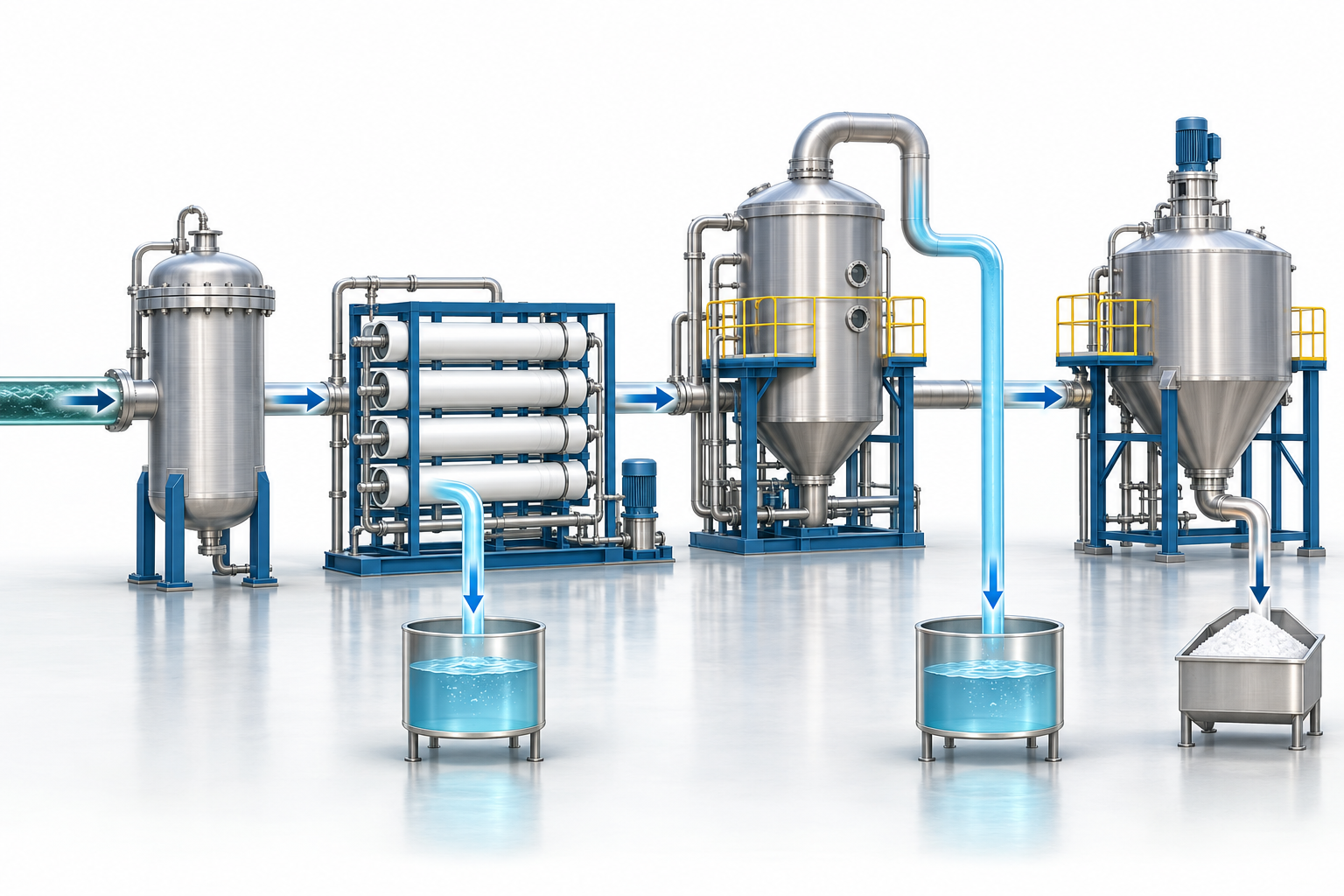
There is no single technology that bypasses solubility limits for every stream. A project may combine pretreatment, selective ion removal, membrane concentration and crystallisation. Selection should follow water analysis, modelling and testing on representative samples.
- Antiscalant dosing and pH control can reduce the likelihood or rate of selected scale formation within a defined operating envelope. These measures do not remove dissolved salts and must be matched to the mineral risks and downstream process.
- Softening or selective ion exchange can reduce specific scale-forming ions, for example calcium or barium, before a membrane or thermal step. Capacity, regeneration and waste streams need to be included in the design.
- Precipitation with solids separation can remove selected constituents by forming a solid phase under controlled conditions, followed by clarification or filtration. Reagent demand, sludge handling and residual concentrations matter.
- Electrodialysis (ED/EDR) and other selective separation methods may help with particular feed compositions or recovery objectives. Their suitability depends on salinity, ion selectivity, pretreatment needs and the properties of the concentrate.
- High-recovery RO configurations, including specialised high-pH approaches, may be considered where the feed chemistry and materials allow. They require specific scaling assessment and validated operating limits.
- Evaporation and crystallisation can concentrate brines beyond membrane-system limits and recover solids. Heat integration, corrosion, mixed-salt product quality and solid handling affect feasibility.
- Membrane distillation or forward osmosis may be evaluated for selected brines and heat or draw-solution conditions; they are not universal replacements for RO or thermal systems.
4. From solubility constraints to resource recovery
Where the composition and market justify it, process design can aim to recover water and selected salts rather than treating all concentrate as waste. Fractional crystallisation may separate mineral phases under carefully controlled conditions. Bipolar membrane electrodialysis can produce acid and base streams from suitable salt solutions, but performance and product quality depend on feed composition and process configuration.
These options are assessed case by case, with mass balances that account for water, salts, reagents, energy, residuals and any recovered products.
5. De-risking a brine project: from concept to pilot
- Characterise the stream: Obtain a representative sample and analyse major ions, alkalinity, silica, metals, organics and relevant operating conditions.
- Model the chemistry: Evaluate osmotic pressure and mineral saturation using a model appropriate for the brine’s ionic strength and temperature range.
- Test the process: Run laboratory trials on representative samples to check separation performance, precipitation, fouling and residuals.
- Validate at pilot scale: Where warranted, use pilot operation to assess variability, cleaning needs, control strategy and practical performance before scale-up.
Discuss your brine treatment challenge
Lenntech’s engineering team can assess separation and concentration options for a specific water or brine composition.
To start a discussion:
email info@lenntech.com.
Sources and further reading
- U.S. Department of Energy: Desalination basics
- U.S. Department of Energy: Reverse osmosis optimization
- ACS Omega: Thermodynamic modelling of scale formation in complex brines
- U.S. EPA: Reverse osmosis treatment and scaling considerations
- U.S. Department of Energy: Desalination and water-reuse technology projects