Primary Scale-Forming Salts and Compounds
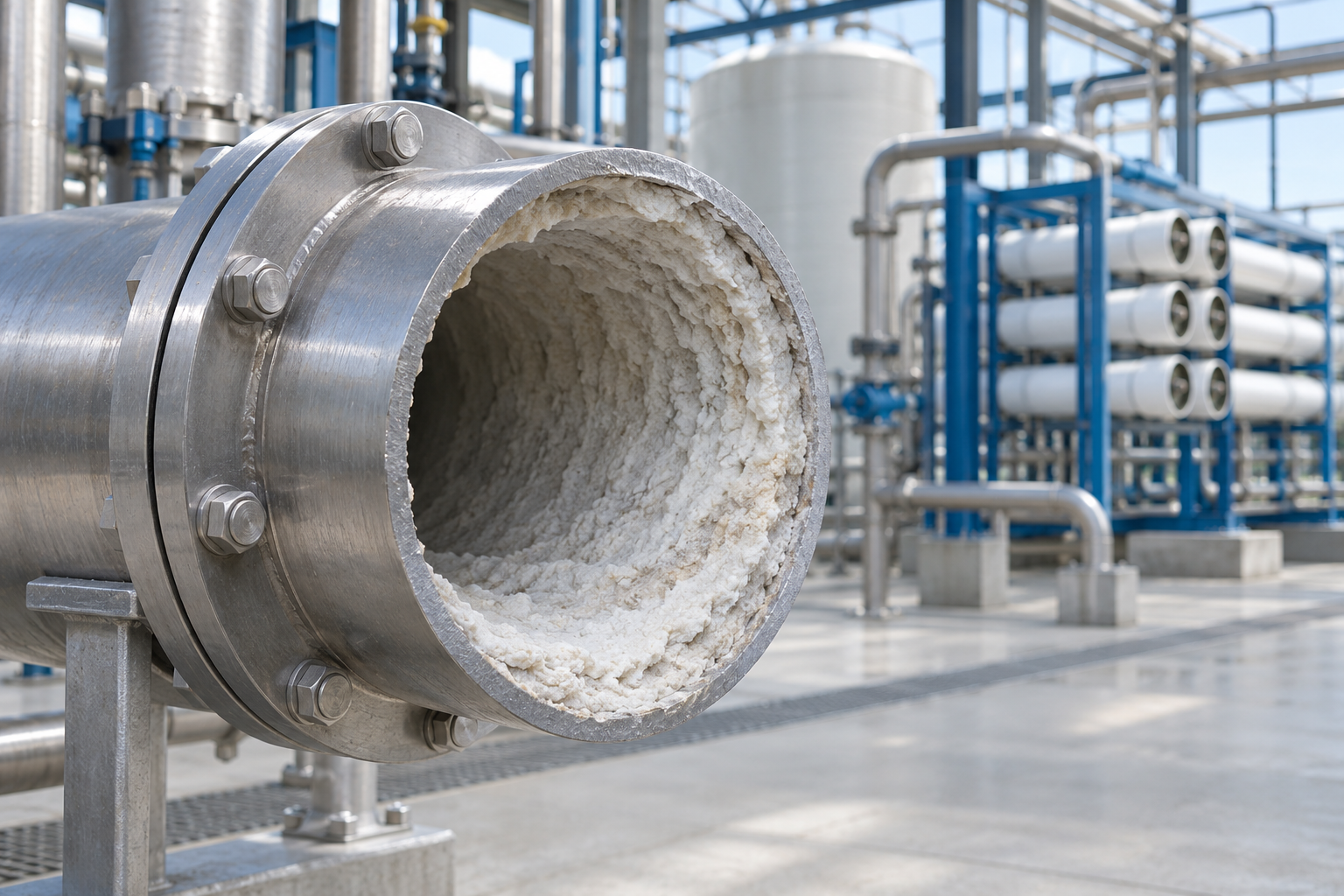
Scale is a deposit of sparingly soluble substances that form when dissolved minerals reach conditions favouring precipitation. Which solids form depends on the full water composition, temperature, pH, pressure, concentration and process conditions.
Reverse osmosis (RO), evaporation, boilers and cooling systems can all concentrate ions or create local conditions that favour scale. A deposit may form in the bulk liquid or on a surface. The examples below are common compounds; real deposits can be mixtures and should be confirmed by analysis.
Primary scale-forming salts and compounds
| Mineral group | Compound | Where it may occur | Why it matters |
|---|---|---|---|
| Carbonates | Calcium carbonate (CaCO3) | Boilers, heat exchangers, cooling systems, RO concentrates, evaporators | A common scale former when calcium and carbonate alkalinity are present. pH, dissolved carbon dioxide, temperature and concentration affect saturation. |
| Carbonates | Magnesium carbonate (MgCO3) and other magnesium-bearing deposits | Alkaline waters, boilers, cooling systems, evaporators | Magnesium may occur in carbonate, hydroxide or silicate deposits, depending on chemistry; hardness alone does not identify the solid phase. |
| Sulfates | Calcium sulfate (CaSO4) | High-recovery RO, brine concentration, evaporators, some boiler or cooling systems | Gypsum, hemihydrate or anhydrite may form. The stable phase and solubility depend on temperature, salinity and other ions. |
| Sulfates | Barium sulfate (BaSO4, barite) | RO concentrates, oilfield waters, industrial brines containing barium and sulfate | Its very low solubility can make deposits persistent and difficult to clean, particularly after aging. |
| Sulfates | Strontium sulfate (SrSO4, celestite) | RO concentrates and brines containing strontium and sulfate | Concentration may raise saturation; assess with the full ionic composition and recovery. |
| Silica and silicates | Amorphous silica (SiO2) | RO concentrates, geothermal waters, boilers, brine evaporators | Silica can polymerize or deposit as the stream concentrates. Silica-rich deposits can resist conventional acid cleaning. |
| Silica and silicates | Magnesium silicate deposits (composition varies; MgSiO3 is a simplified representation) | Some boiler waters and black-liquor evaporators | These deposits can impair heat transfer; their composition and behaviour vary with process chemistry. |
| Hydroxides | Magnesium hydroxide (Mg(OH)2) | High-pH waters, alkaline evaporator streams, precipitation-softening systems | May precipitate when magnesium-bearing water becomes sufficiently alkaline. Solids carryover can contribute to downstream deposits. |
| Phosphates | Calcium phosphate phases (e.g. Ca3(PO4)2) | Boilers, cooling systems, phosphate-bearing process waters | Several phases are possible when calcium and phosphate are present and conditions favour precipitation. |
| Double salts | Burkeite (Na2CO3·2Na2SO4) | Concentrated black liquor in pulp and paper recovery evaporators | This sodium carbonate–sulfate double salt can crystallize at high solids concentration and contribute to evaporator deposits. |
| Organic salts | Calcium oxalate (whewellite; CaC2O4·H2O) | Sugar, juice, and some fermentation or ethanol concentration processes | Low-solubility crystals can deposit on process surfaces; occurrence depends on calcium and oxalate levels. |
Conditions that promote scale
- Temperature: Some minerals are less soluble at higher temperatures, so deposits can form near hot surfaces. The trend is compound- and phase-specific; calcium sulfate, for example, can occur in several phases.
- Evaporation and membrane concentration: Evaporation removes water; RO retains much of the dissolved salt in the concentrate. Both can raise ion concentrations and saturation. Scaling depends on speciation, activities and operating conditions.
- pH and dissolved gases: Higher pH shifts carbonate chemistry toward carbonate ions and can increase calcium carbonate saturation. Carbon dioxide loss during aeration, pressure reduction or boiling may raise pH and change scaling tendency.
- Surface and flow conditions: Hot surfaces, concentration polarization, low-flow areas and existing deposits can affect nucleation and crystal growth.
Methods for preventing or managing scale
Control options should match the stream and the target mineral. A representative analysis and, where needed, saturation modelling help guide selection.
- Antiscalants and dispersants: Can delay crystal nucleation or growth and help keep fine particles dispersed within a defined operating range. They do not remove dissolved salts; suitability depends on the water and downstream process.
- Ion-exchange softening: Sodium-cycle softening exchanges calcium and magnesium for sodium. This reduces hardness-related scale potential but does not make all concentrated waters scale-free. Regeneration and brine handling also matter.
- Nanofiltration pretreatment: Depending on membrane type and operation, nanofiltration can reject part of the multivalent ions such as calcium, magnesium and sulfate. Rejection is selective, not absolute, and should be evaluated for the specific feed.
- Precipitation softening: Lime and soda ash can precipitate selected hardness as solids in a reactor or clarifier, followed by clarification or filtration. Sludge handling and residual concentrations are part of the design.
- Seeded crystallisation: Purpose-designed crystallisation systems can use seed particles as surfaces for crystal growth, directing precipitation toward suspended solids rather than equipment. This is not suitable for every evaporator or brine.
Compare common salt solubilities in Maximum solubility of salts, and read about mixed-ion scaling and brine-treatment options in Overcoming the RO wall: salt solubility and advanced brine treatment.
Discuss your water scaling challenge
Lenntech’s engineering team can assess separation and concentration options for a specific water scaling challenge.
To start a discussion:
email info@lenntech.com