

Evaporation for brine concentration (ZLD)
Evaporation concentrates dissolved and suspended constituents by transferring water from a liquid feed to vapour. In a brine-management train, the vapour is usually condensed and recovered as distillate; the remaining liquid is a more concentrated brine. Evaporation alone does not necessarily achieve zero liquid discharge (ZLD): the concentrate may still need crystallization, drying or another permitted residual-management route.
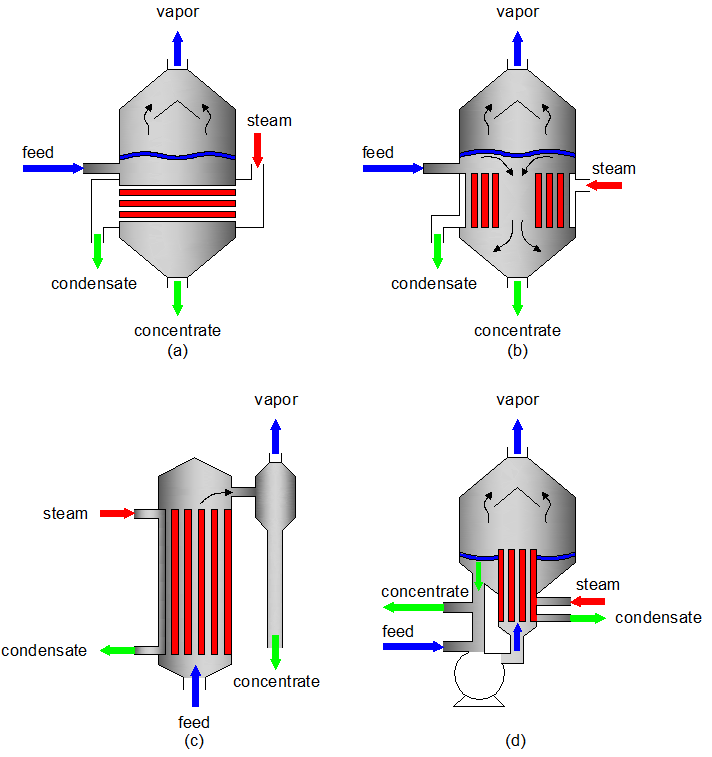
How an evaporator works
Heat brings part of the water in the feed to its boiling condition. Lowering the operating pressure can lower the boiling temperature, while the evaporator vessel separates vapour from concentrated liquid. The vapour may be condensed to produce distillate. A demister and careful operation limit liquid-droplet carryover, but condensate quality must be checked: volatile compounds and entrained droplets can affect it. Additional treatment may be needed before reuse.
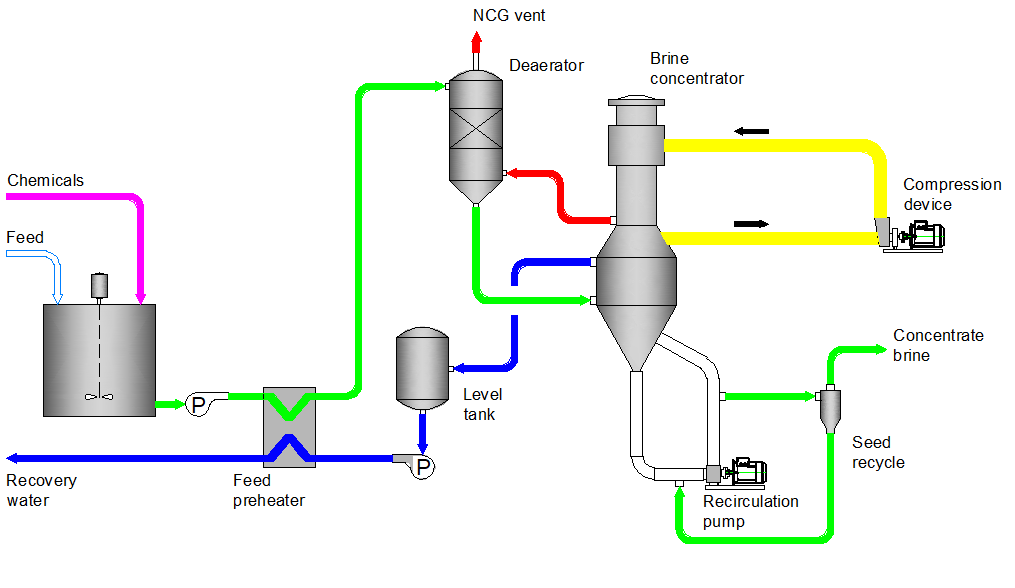
A typical brine-concentration train may include feed conditioning, heat recovery or preheating, evaporation, vapour separation and condensation, followed by concentrate management. Pretreatment is selected from the actual analysis; acid, antiscalant or seed crystals are not universal requirements and should not be dosed without a chemistry and materials assessment.
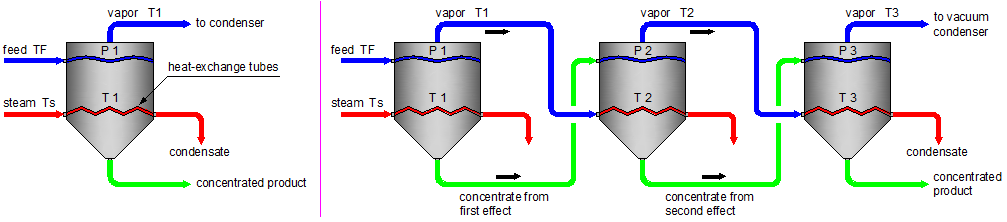
Evaporator configurations and energy use
Evaporators can use a single effect, multiple effects, thermal vapour recompression (TVR), or mechanical vapour recompression (MVR/MVC). In multiple-effect systems, vapour from one effect supplies heat to a later effect operating at a lower pressure. Recompression raises vapour pressure and temperature so that its latent heat can be reused. These arrangements can reduce external steam demand, but they have different balances of electricity, heat, equipment complexity and operating constraints.
Specific energy use and water recovery are project-specific. They depend on feed composition and flow, target concentration, boiling-point elevation, temperature limits, heat integration, cleaning frequency and the energy source. A single steam-economy value or recovery percentage should not be used as a design guarantee.
Mechanical vapour compression
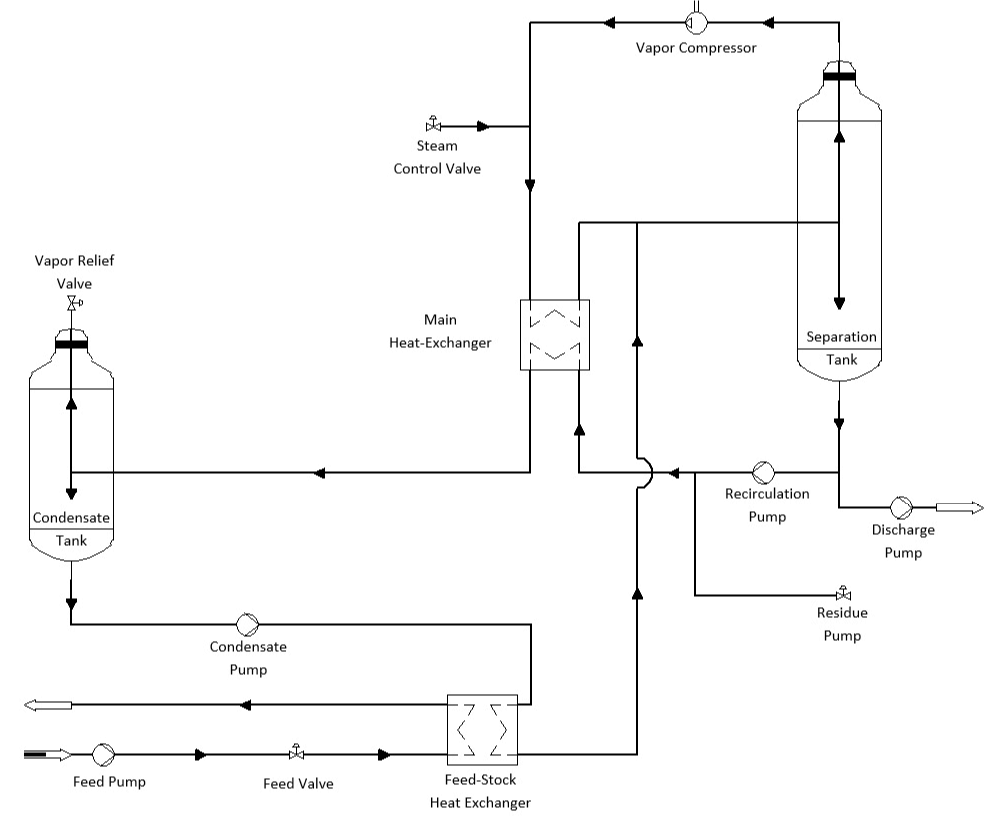
In an MVC system, water vapour produced in the evaporator is compressed. The pressure increase raises its saturation temperature, allowing the vapour to condense in a heat exchanger and return much of its latent heat to the circulating process stream. Electricity for the compressor and circulation pumps remains an important part of the energy balance.
The operating pressure, temperature lift, compressor range, heat-transfer area, scaling tendency and required turndown all need to be evaluated for the particular brine.
Design considerations
- Feed characterisation: measure major ions, alkalinity, silica, suspended solids, organics and relevant trace constituents across expected operating conditions.
- Scale and fouling control: assess saturation and precipitation throughout the train. Seeded crystallization or chemical conditioning can be useful in selected cases, but neither eliminates the need to manage deposits and clean equipment.
- Corrosion and materials: evaluate temperature, chloride and other salts, pH, oxidants, crevices and cleaning chemicals together when selecting metallurgy and materials.
- Water and residual quality: test condensate before reuse and characterise the concentrate or solids for handling, recovery and disposal requirements.
- Whole-system cost: compare capital, energy, chemicals, labour, cleaning, downtime and residual-management costs against alternative concentration and disposal routes.
Place in a ZLD system
Evaporation is often used after membrane or other pre-concentration when the remaining brine is too concentrated for the selected upstream process. A final crystallizer or solids-handling step may be needed to meet a defined no-liquid-discharge boundary. The boundary, water-reuse specification and destination of every residual stream should be stated for each project. See Zero liquid discharge (ZLD) and crystallization.
Further reading
- U.S. Department of Energy: Industrial heat pumps for steam and fuel savings — background on multiple-effect evaporation and mechanical vapour compression.
- U.S. Department of Energy: Desalination basics — energy recovery and thermal desalination context.
- U.S. EPA: Detailed study of centralized waste treatment — evaporation, crystallization and treatment considerations for high-TDS wastewater.
 Brine Treatment Technology Map (PDF)