

Crystallization for brine treatment (ZLD)
Crystallization separates dissolved salts from a liquid by creating supersaturation and allowing crystals to nucleate and grow. In a zero-liquid-discharge (ZLD) train, an evaporative crystallizer commonly treats concentrated brine after upstream water recovery. The resulting crystals, mother liquor and recovered condensate each need a defined quality and management route.
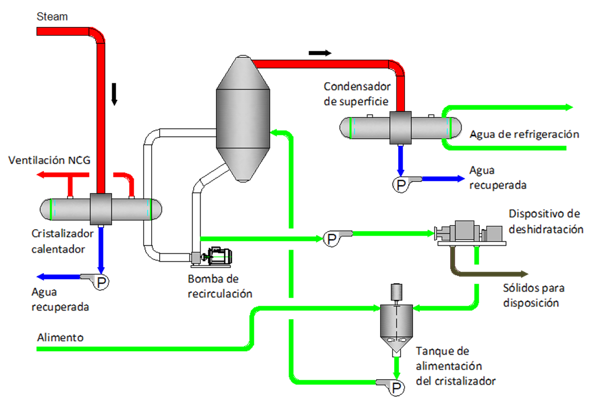
How evaporative crystallization works
As water evaporates, dissolved-ion concentrations rise. When the solution becomes supersaturated with respect to a solid phase, crystals can form and grow. A forced-circulation crystallizer keeps slurry moving through a heat exchanger and crystallizer vessel; solids are then separated, for example by a centrifuge or filter. The mother liquor may be returned to the process, purged or treated further according to its composition and the process balance.
Supersaturation can also be produced by cooling, evaporation, or a combination of both. The appropriate route depends on salt solubility, temperature, pressure and the presence of competing ions. Real brines are mixtures: salts can co-precipitate, form hydrates or scale on equipment, so pure-salt solubility data alone do not predict product quality or operability.
Why concentration becomes more difficult
At high dissolved-solids concentrations, a solution’s boiling temperature can rise above that of pure water at the same pressure. This boiling-point elevation varies with composition, concentration and pressure and affects heat-transfer design and energy demand. Solubility limits and scale formation also constrain how far a stream can be concentrated.
Claims about one universal recovery, steam requirement or salt-purity value are not appropriate for all crystallizers. Performance depends on the actual feed, pretreatment, operating conditions, materials, cleaning strategy and product specification.
Design and operation
- Characterise the feed: include major ions, alkalinity, silica, suspended matter, organics and trace contaminants. Model relevant precipitation over the full concentration and temperature range.
- Control supersaturation: manage evaporation, circulation, seeding and residence time to promote crystal growth while limiting uncontrolled nucleation and deposition.
- Manage corrosion and deposits: select materials and cleaning methods for the actual chemistry and temperature. Chloride-rich, hot brines can be corrosive; do not assume that chloride salts uniformly release hydrochloric acid by hydrolysis.
- Check all outputs: condensate may need polishing; crystals may need washing or further separation; mother liquor may contain concentrated contaminants and require a purge or additional treatment.
- Assess product use cautiously: recovered salts are not automatically saleable. Composition, impurity limits, consistency, applicable regulations, logistics and a viable local buyer must be established.
Role in ZLD
A crystallizer can convert a concentrated liquid stream into separated solids and condensate, helping a system meet a defined ZLD boundary. It does not by itself make all residuals harmless or guarantee that the water or salts meet reuse or product requirements. The complete train must include residual characterisation and a practical management route. See Zero liquid discharge (ZLD) and evaporation.
Further reading
- U.S. EPA: Detailed study of centralized waste treatment — crystallization principles and high-TDS wastewater management.
- U.S. Department of Energy: Desalination basics — context for thermal separation and water recovery.
 Brine Treatment Technology Map (PDF)