
Substances removal by zeolites
|
Removal of ammonia/ammonium The most important property of zeolites is the removal of ammonia (NH3) and ammonium (NH4+). In aquaculture ammonia is very toxic for fish and small concentrations of it will already lead to diseases and inhibition of growth. In higher concentration ammonia can be lethal to fish. In swimming pools, ammonium ions are brought in the water by swimmers. It often reacts with the free chlorine to form chloramines. They are irritating to the eyes and skin. |
|
|
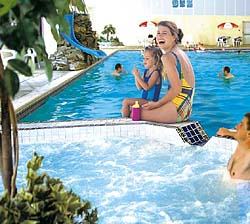
Use of zeolites in swimming pools filters Changing to zeolites in your swimming pool is simple: remove the old media and fill the filter with zeolite to the indicated height. No changes to the vessel, valves or pipe work are needed. The pH of water should be maintained at 7.2 – 7.6. Chemical, except flocking agents, should be dosed post filter. During operation a decrease in chemicals consumption will be observed. As the dirt holding capacity of zeolites is large, the frequency of backwashing is reduced, thereby saving on water. Zeolite is characterized by an high purity. Due to its highly porous structure, zeolite is much less dense than sand and therefore less zeolite is needed by weight. The use of zeolites results in a lower chlorine consumption and a better swimming environment in pools
|
|
|
Removal of heavy metals The adsorption of heavy metals by zeolites is largely analogous to the removal of ammonia. The individual dynamic adsorption capacities for different heavy metals are: If there are a number of different cations present in the wastewater, the adsorption capacity per ion will be lower as a consequence of competition between the different cations. The adsorption will depend on relative selectivity of zeolites for the different ions, the composition of water and the temperature. The relative selectivity is determined by the hydrated diameter, the charge and the mobility of the ions. This property enables zeolites to exchange harmful ions present in the water for harmless ions present in its structure. Carrier material in biological waste treatment The structure of the inner surface makes zeolites suitable as a carrier material in both aerobic and anaerobic biological waste treatment installations. An advance using them is that a number of substances, which are being metabolized by bacteria, are also adsorbed by zeolites. This causes for example ammonium to be removed from the first moment and it is thus not necessary to wait until a stable bacteria column has formed. Further to this the zeolite acts as a buffer for ammonium ions; in case of a large ammonia production, part of the ammonia is adsorbed by zeolite and if the ammonia concentration is low, the bacteria metabolize part of the adsorbed ammonium. Removal of organic substances Zeolites adsorb a number of organic substances. The mineral has the largest affinity for polar organic components, for example chlorinated hydrocarbons. Depending on the diameter of the molecules, these are either adsorbed in the micro or mesopores. The capacity of the adsorption is strongly dependent on the circumstances at which the adsorption is performed. At the moment, further investigations are still being performed in this field of interest. Removal of solids As zeolites are a granular material, solid and suspended particles are trapped between the grains. The porous structure also causes colloid particles from both organic and mineral origin to be removed from the water. The capacity for the removal of solid particles is up to 45% greater than the capacity of sand with an equivalent particle size distribution. Click here for an introduction to zeolites or find more information about zeolite structure and types or zeolites applications. Contact us for further details concerning zeolites.
|
|