|
1.1 What is hard water?
When water is referred to as 'hard' this simply means, that it contains more minerals than ordinary water. These are especially the minerals calcium and magnesium. The degree of hardness of the water increases, when more calcium and magnesium dissolves.
Magnesium and calcium are positively charged ions. Because of their presence, other positively charged ions will dissolve less easily in hard water than in water that does not contain calcium and magnesium.
This is the cause of the fact that soap doesn't really dissolve in hard water.
1.2 Which industries attach value to hardness of water?
In many industrial applications, such as the drinking water preparation, in breweries and in sodas, but also for cooling- and boiler feed water the hardness of the water is very important.
2.1 What is water softening?
When water contains a significant amount of calcium and magnesium, it is called hard water. Hard water is known to clog pipes and to complicate soap and detergent dissolving in water.
Water softening is a technique that serves the removal of the ions that cause the water to be hard, in most cases calcium and magnesium ions. Iron ions may also be removed during softening.
The best way to soften water is to use a water softener unit and connect it directly to the water supply.
2.2 What is a water softener?
A water softener is a unit that is used to soften water, by removing the minerals that cause the water to be hard.
2.3 Why is water softening applied?
Water softening is an important process, because the hardness of water in households and companies is reduced during this process.
When water is hard, it can clog pipes and soap will dissolve in it less easily. Water softening can prevent these negative effects.
Hard water causes a higher risk of lime scale deposits in household water systems. Due to this lime scale build-up, pipes are blocked and the efficiency of hot boilers and tanks is reduced. This increases the cost of domestic water heating by about fifteen to twenty percent.
Another negative effect of lime scale is that it has damaging effects on household machinery, such as laundry machines.
Water softening means expanding the life span of household machine, such as laundry machines, and the life span of pipelines. It also contributes to the improved working, and longer lifespan of solar heating systems, air conditioning units and many other water-based applications.
2.4 What does a water softener do?
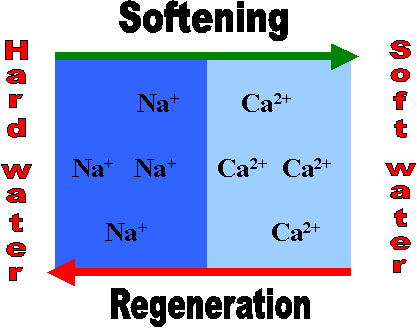
Water softeners are specific ion exchangers that are designed to remove ions, which are positively charged.
Softeners mainly remove calcium (Ca2+) and magnesium (Mg2+) ions. Calcium and magnesium are often referred to as 'hardness minerals'.
Softeners are sometimes even applied to remove iron. The softening devices are able to remove up to five milligrams per litre (5 mg/L) of dissolved iron.
Softeners can operate automatic, semi-automatic, or manual. Each type is rated on the amount of hardness it can remove before regeneration is necessary.
A water softener collects hardness minerals within its conditioning tank and from time to time flushes them away to drain.
Ion exchangers are often used for water softening. When an ion exchanger is applied for water softening, it will replace the calcium and magnesium ions in the water with other ions, for instance sodium or potassium. The exchanger ions are added to the ion exchanger reservoir as sodium and potassium salts (NaCl and KCl).
2.5 How long does a water softener last?
A good water softener will last many years. Softeners that were supplied in the 1980's may still work, and many need little maintenance, besides filling them with salt occasionally.
3.1 Which types of salt are sold for application in a water softener?
For water softening, three types of salt are generally sold:
- Rock salt
- Solar salt
- Evaporated salt
Rock salt as a mineral occurs naturally in the ground. It is obtained from underground salt deposits by traditional mining methods. It contains about 98–99% sodium chloride. The water-insoluble fraction is approximately 0.5–1.5% and consists mainly of calcium sulphate.
Solar salt as a natural product is obtained mainly through evaporation of seawater. It contains 85% sodium chloride. It has a water insolubility level of less than 0.03%. It is usually sold in crystal form. Sometimes it is also sold in pellets.
Evaporated salt is produced by solution mining: water is injected into underground salt deposits to dissolve the salt. The resulting brine is then purified and evaporated, using energy from natural gas or coal. Evaporated salt contains between 99.6 and 99.99% sodium chloride.
3.2 Should we use rock salt, evaporated salt or solar salt in a water softener?
Rock salt contains a lot of matter that is not water-soluble. As a result, the softening reservoirs have to be cleaned much more regularly, when rock salt is used. Rock salt is cheaper than evaporated salt and solar salt, but reservoir cleaning may take up a lot of your time and energy.
Solar salt contains a bit more water-insoluble matter than evaporated salt. When one makes a decision about which salt to use, consideration should be given to how much salt is used, how often the softener needs cleanout, and the softener design. If salt usage is low, the products could be used alternately.
If salt usage is high, insoluble salts will build up faster when using solar salt. Additionally, the reservoir will need more frequent cleaning. In that case evaporated salt is recommended.
3.3 Is it harmful to mix different kinds of salt in a water softener?
It is generally not harmful to mix salts in a water softener, but there are types of softeners that are designed for specific water softening products. When using alternative products, these softeners will not function well.
Mixing evaporated salt with rock salt is not recommended, as this could clog the softening reservoir. It is recommended that you allow your unit to go empty of one type of salt before adding another to avoid the occurrence of any problems.
3.4 How often should one add salt to a softener?
Salt is usually added to the reservoir during regeneration of the softener. The more often a softener is regenerated, the more often salt needs to be added.
Usually water softeners are checked once a month. To guarantee a satisfactory production of soft water, the salt level should be kept at least half-full at all times.
3.5 How come water sometimes does not become softer when salt is added?
Before salt starts working in a water softener it needs a little residence time within the reservoir, since the salt is dissolving slowly. When one immediately starts regeneration after adding salt to the reservoir, the water softener may not work according to standards.
When the water softening does not take place it could also indicate softener malfunction, or a problem with the salt that is applied.
4.1 How much does a water softener cost?
Some softeners are more efficient than others and as a result the prizes may differ. There are time operated softeners and water meter-controlled softeners available. The water meter-controlled units produce the softest water per pound of salt.
Some softeners work on electricity, but some more recent water softeners use waterpower. Costs of a water softener greatly depend upon the type of water softener and the type of energy that is used, but also upon the hardness of the water that needs softening and the water use. When the water is very hard and it is used heavily, the costs of softening will rise.
Generally the costs of a water softener can vary between € 0,20 and € 0,40 a day.
The costs of water softeners are usually far outweighed by the benefits and cost savings obtained, through using softened water.
4.2 How much does a water softener cost during operation?
The running cost is merely the cost of salt. This is likely to be around € 1,95 per person in the household in a month.
5.1 Do water-producing companies always produce softened water?
Although water-producing companies do have the opportunity to produce softened water, they will not always do so. A water producing company only has to add a water softener in its water purification system, to produce softened water cheaply.
But than consumers would not be able to have the choice to drink un-softened water.
Hard water problems are most likely to occur when water is heated. As a result, hard water causes few problems to the water supplying companies, especially when only cold water runs through their pipes.
5.2 Is softened water safe to drink?
A sodium-cycle cation-exchange softener replaces calcium and magnesium hardness ions with sodium ions, so the sodium concentration can increase. The increase depends on the hardness removed and the incoming-water composition; it is not the same for every household. WHO has not established a health-based guideline value for sodium in drinking-water, although concentrations above about 200 mg/L may affect taste. People who need to limit sodium should ask their water supplier for an analysis and seek advice from their healthcare professional. Follow local health-authority guidance for water used to prepare infant formula.5.3 Can salt from softening installations enter drinking water?
Salt is used to regenerate the resin and is normally rinsed to the drain during the regeneration cycle; it is not intended to enter the treated-water line. If softened water develops a salty taste, check the unit’s settings and operation and contact the installer or manufacturer.5.4 How much sodium does one absorb from softened water?
There is no single average: sodium added by a sodium-cycle softener depends mainly on the hardness removed. As examples, Health Canada lists approximately 46 mg/L sodium added when removing 100 mg/L hardness as CaCO3, 92 mg/L for 200 mg/L hardness and 230 mg/L for 500 mg/L hardness. These are illustrative values; use the source-water analysis and the softener’s operating data to estimate the result. Health Canada: sodium added by water softeners.
5.5 Will softening drinking water deprive it of essential minerals?
Conventional ion-exchange softening reduces hardness mainly by removing calcium and magnesium ions. In sodium-cycle systems, sodium ions take their place; potassium-cycle systems use potassium ions. Softening does not remove all dissolved minerals, but it can lower the amount of calcium and magnesium supplied by drinking water. The nutritional significance depends on the water and the rest of the diet.
6.1 When does a softener resin need replacement?
When the water does not become soft enough, one should first consider problems with the salt that is used, or mechanical malfunctions of softener components. When these elements are not the cause of the unsatisfactory water softening, it may be time to replace the softener resin, or perhaps even the entire softener.
Through experience we know that most softener resins and ion exchanger resins last about twenty to twenty-five years.
6.2 Does a softener brine tank need cleaning?
Usually it is not necessary to clean out a brine tank, unless the salt product being used is high in water-insoluble matter, or there is a serious malfunction of some sort.
If insoluble matter accumulates in the brine tank, clean the tank. If the resin bed is fouled, follow the water-softener manufacturer’s instructions for cleaning or servicing it.
6.3 What is 'mushing' and why should we avoid it?
When loosely compacted salt pellets or cube-style salt are used in a softener’s brine tank, it may form tiny crystals of evaporated salt, which are similar to table salt. These crystals may bond, creating a thick mass in the brine tank. This phenomenon, commonly known as 'mushing', may interrupt brine production. Brine production is the most important element for refreshing of the resin beads in a water softener. Without brine production, a water softener is not able produce soft water.
7.1 Can brine from softeners damage a septic tank?
The Water Quality Association has performed studies on this subject. These studies have indicated that a properly placed septic tank that works adequately cannot be damaged by brine that is discharged from a water softener. And softened water can sometimes even help reduce the amount of detergents discharged into a septic tank.
7.2 Can a water softener be used with lead pipes?
Lead pipe systems have to be replaced, before softened water can flow through them. Although lead pipe systems in hard water areas may not cause a problem, it is advisable to replace them anyway. When naturally or artificially softened water ends up in these lead pipe systems, it may cause the pickup of lead.
7.3 Can one measure water hardness inline?
Yes, although the measurement system is mainly applied in industrial water softeners.
The Testomat inline water hardness instrument
8.1 Can a water softener be taken along during moving?
With modern water softeners, it is very possible to take them along during moving. Installation techniques involve quick fitting connections, similar to those used for laundry machines.
All that has to be done is closing off the inlet and outlet valves of the softener and open up the bypass valve, allowing hard water to flow to the storage tank and household taps. After that the softener can be disconnected, moved to its new location and placed there.
8.2 Can waste from a water softener be discharged directly in the garden?
As brine alters the osmotic pressure that plants rely upon to regulate water needs, direct discharge of either sodium or potassium chloride brine should be avoided.
8.3 Is softened water any help for dry skin conditions?
There are cases to be noted, in which people with dry skin conditions have benefited from water softening, because soft water is kinder to the hair and skin.
Suggested reading for the topic: Water softener
Other interesting pages: Water treatment history
|