
Petrochemical Company
The process-intensive petrochemical industry has demanding environmental management challenges to protect water, soil and atmosphere of the refinery pollution.
Lenntech comes up with different kinds of technologies and processes to the wastewater and the process water from the refinery industries.
Petroleum refineries use relatively large volumes of water, especially for cooling systems. In fact, wastewater from the petrochemical industry usually contains hazardous chemicals, as hydrocarbons, phenol or ammoniacal nitrogen among others.
Below we will see some petroleum refinery waste and process water issues.
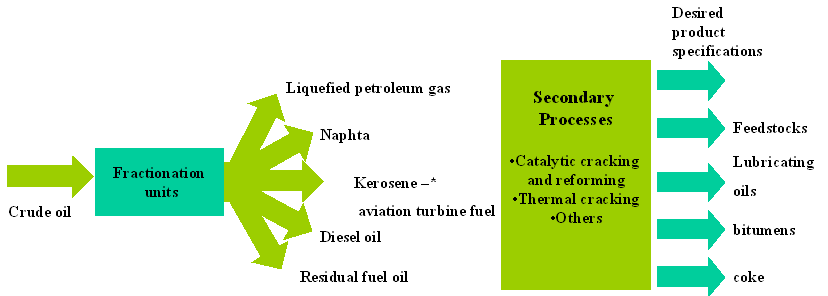
In order to understand the scope of the issue first take a look in our general drawing about the petroleum refining practices to enter in heart of the subject.
Please find below a table to summarize the different kinds of wastes generated by petroleum refineries:
(all this figures depend on the process configuration but we give here a general guide) Resource: Pollution Prevention and Abatement Handbook World Bank Group The petrochemical companies should tackle with several issues:
Petroleum refineries do not like salts in their feedstock since these corrode and foul process equipment. The first refining step is desalination where a hot water wash extracts the salts. Otherwise it's common to use an antirust or corrosion inhibitors in the fuel. If feedstock contains aromatics with a good solubilities such as Benzene or Toluene then some will be in the desalted effluent and this is a major source of refinery wastewater containing Volatile Organique compounds (VOC).
A direct treatment of the wastewater with activated carbon reduces aromatics content to below acceptable limits. In addition, the carbon also captures oil, grease and other organics. Activated carbon is also used to remove heavy hydrocarbons from hydrogen and light organic gas streams in the refinery. (Refinery gas treatment). An other application of the actived carbon is to enhance the oil refinery activated sludge. This is completed by addition of PAC (powered activated carbon) into the sludge.
In order to remove phenol and nitrogen the best solution is to use a biological treatment thanks to hydrogen peroxide for instance. Furthermore in using a catalyst combine with the H2O2 it's possible to remove COD, BOD5 and toxicity of the waste water. Besides, phenols are transformed into less biodegradable compounds which could be removed by subsequent coagulation and precipitation.
A process for removing soluble and insoluble organic and inorganic contaminants from refinery wastewater streams employing ultrafiltration and reverse osmosis is provided. before the ultrafiltration step, first the wastewater should passed through a softening system to remove divalent and trivalent metal cations prior to being passed to the reverse osmosis step to prevent fouling.
One of the main issues of the petrochemical industry is also to remove the oil from the water after processes or in case of leaks appear in the piping network. In order to meet the challenge you can use our membrane separation technology. In the event of alkaline cleaning of tankers, emulsified pollution levels are extremely high. The correction of the pH is important and it may be necessary to use a mineral coagulant for instance.
The oil is removed by filtration or flotation depends on its soluble BOD5 level and phenol concentration. The water can be biologically purified. After that a tertiary treatment can be performed to remove SS and residual phenols.
This water has a higher saline and emulsion content and may content S2- pollution. It brings about a preliminary catalytic oxidation before the oil removal by flocculation-flotation and biological purification. Two processes are mainly used: - physical-chemical purification This technique combines the rapid filtration of oily rainwater and DAF, which treats effluents from filter washing and emulsified water from desalination and other processes. - recycling Separate discharge of ballast water (saline but low in BOD5) and partial recycling, after two stages of biological purification of process water and oily rain water (low saline content) to cooling tower.
From all kind of water such as process water different heavy metals should be removed. The table below shows which heavy metal are mainly present :
Lenntech deals also with the odor and air treatment in the petrochemical industry. See also the efficiency of Ecosorb to remove odors from the refinery. |