

Thallium - Tl
Chemical properties of thalium - Health effects of thallium - Environmental effects of thallium
|
|
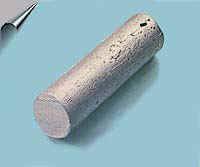
ThalliumWhen freshly exposed to air, thallium exhibits a metallic lustre, but soon develops a blueish-grey tinge, resembling lead in appearance. A heavy oxide builds up on thallium if left in air, and in the presence of water the hydroxide is formed. The metal is very soft and malleable. It can be cut with a knife. Applications Thallium is used for making low-melting point special glass for highly reflective lenses. Thallium salts are used as reagents in chemical research. Thallium sulphate is still sold in developing countries where it is still permitted as a pesticide, although banned in Western countries. Since its electrical conductivity changes with exposure to infrared light, it is used in photocells. It is used for sink-float separation of minerals. Thallium amalgam is used in thermometers for low temperature, because it freezes at -58 °C (pure mercury freezes at -38 °C). Thallium in the environment Thallium is not a rare element; it is 10 times more abundant than silver. The element is widely dispersed, mainly in potassium minerals such as sylvite and pollucite. Thallium minerals are rare, but a few are known, such as crookesirte and lorandite. World production of thallium compound is around 30 tonnes per year. There has been no assessment of how great the reserves are. Thallium is partially water-soluble and consequentially it can spread with groundwater when soils contain large amounts of the component. Thallium can also spread by adsorption on sludge. There are indications that thallium is fairly mobile within soils. Health effects of thallium
Effects of thallium on the Environment
Back to periodic table elements. |
|