

Calcium (Ca) and water
Calcium is a common dissolved mineral in natural waters. It contributes, together with magnesium, to water hardness and can form mineral scale when water chemistry favours precipitation. The relevant chemistry depends on calcium, alkalinity, pH, temperature and other dissolved ions.
Calcium in natural waters
Calcium reaches water as calcium-bearing minerals weather or dissolve. Common sources include limestone and other carbonate rocks, dolomite, and gypsum. In most natural waters, dissolved calcium is present mainly as the ion Ca2+, although it can also form dissolved ion pairs with carbonate, bicarbonate, sulfate and other constituents.
When water containing dissolved carbon dioxide contacts limestone, the carbonate mineral can dissolve. A simplified overall reaction is:
CaCO3 (s) + CO2 (aq) + H2O (l) ⇌ Ca2+ (aq) + 2 HCO3− (aq)
Elemental calcium metal also reacts with liquid water, producing calcium hydroxide and hydrogen gas:
Ca (s) + 2 H2O (l) → Ca(OH)2 (s) + H2 (g)
Calcium hydroxide is only partly soluble in water. This reaction describes the metal; it is different from the way dissolved calcium occurs in rivers, groundwater and seawater.
Hardness and calcium scale
Water hardness is caused mainly by dissolved calcium and magnesium. It is commonly reported as milligrams per litre of calcium carbonate equivalent (mg/L as CaCO3); this is a reporting convention and does not mean all hardness is present as solid calcium carbonate. Hardness is generally an operational concern because it can contribute to mineral deposits and reduce soap effectiveness, rather than a health concern in itself.
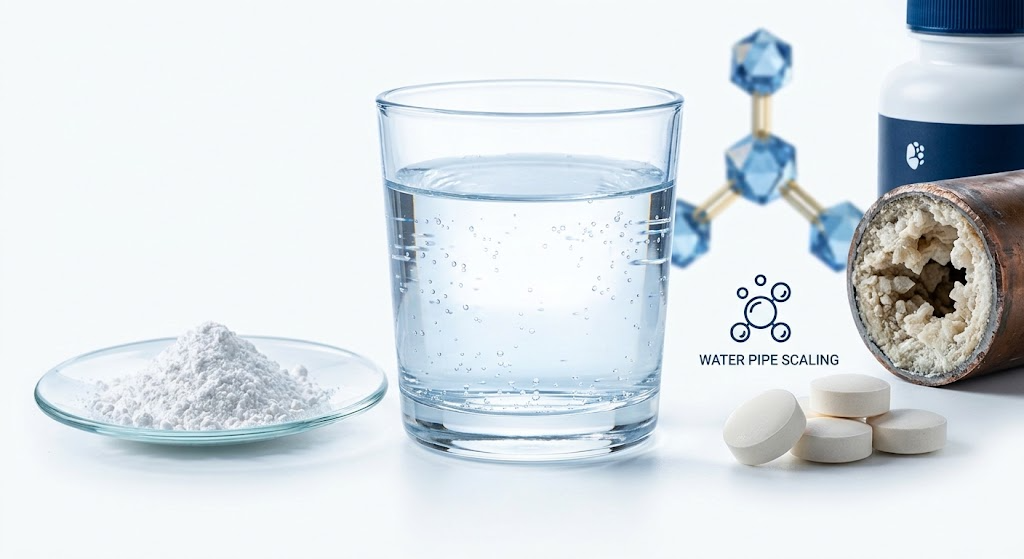
Calcium carbonate scale can form when water becomes supersaturated with respect to calcite. pH, alkalinity, dissolved carbon dioxide, temperature and calcium concentration all affect that tendency. Calcium sulfate (gypsum/anhydrite) scale is a separate risk, especially where calcium and sulfate become concentrated, such as in some brines and membrane processes. A water analysis and process conditions are needed to assess either risk.
Explore the two Lenntech calculators:
Calculator note: Both tools currently present illustrative educational results. They are not validated engineering predictions or substitutes for a validated geochemical model, treatability work or process design.
Calcium in the environment and human health
Calcium is an essential nutrient for people, animals and plants. Drinking-water can contribute some calcium to dietary intake, but concentrations vary widely with the water source. Calcium also affects freshwater chemistry; the effects of hardness on aquatic organisms depend on the species and the wider water chemistry.
Removing calcium from water
Water softening lowers calcium and magnesium. Cation-exchange softeners exchange these ions for sodium; lime softening can remove calcium by shifting carbonate chemistry and precipitating calcium carbonate. Membrane processes can also remove dissolved ions as part of broader water purification. The choice depends on the water analysis, the purpose of treatment and how the resulting brine, sludge or concentrate will be managed. Learn more about ion exchange.