

Silicon (Si), silica and water
Silicon and water: silica, silicates and treatment
Silicon is a chemical element, but natural water does not normally contain elemental silicon metal. Water analyses usually report the dissolved forms of silicon as silica (SiO2) or as silicon (Si). Much of dissolved silica in ordinary fresh water is present as silicic acid, Si(OH)4.
Silicon in water or silica in water?
Silicon is the element Si. Silica is silicon dioxide, SiO2; silicates are minerals or dissolved compounds containing silicon and oxygen, often with other elements. In environmental and water-treatment discussions, “silica in water” is usually the clearest term for dissolved SiO2-equivalent concentrations. Laboratories may report the result either as mg/L SiO2 or as mg/L Si, so the reporting basis should always be checked.
At near-neutral pH, dissolved silica is mainly uncharged silicic acid, Si(OH)4. As pH rises, a larger fraction can occur as charged silicate species. Colloidal silica and suspended silica particles are different forms and may behave differently during treatment.
Does elemental silicon react with water?
Solid elemental silicon does not react appreciably with liquid water under ordinary conditions. A thin silicon dioxide surface layer helps protect the solid. This is distinct from the slow dissolution of silica minerals, which can release silicic acid into water:
SiO2(s) + 2 H2O(l) ⇌ Si(OH)4(aq)
The dissolved silica concentration depends on the silica form, temperature, pH and the surrounding water chemistry. Crystalline quartz dissolves slowly; amorphous silica is generally more soluble.
Why is silica present in natural water?
Silica enters water as rocks and soils weather and silicate minerals dissolve. Groundwater concentrations can reflect the local geology and the time water has been in contact with rock. Rivers transport dissolved silica to lakes and the sea, while biological uptake and sediment processes also affect concentrations. Levels therefore vary by source and location rather than having one universal “average.”
Silica scale and water treatment
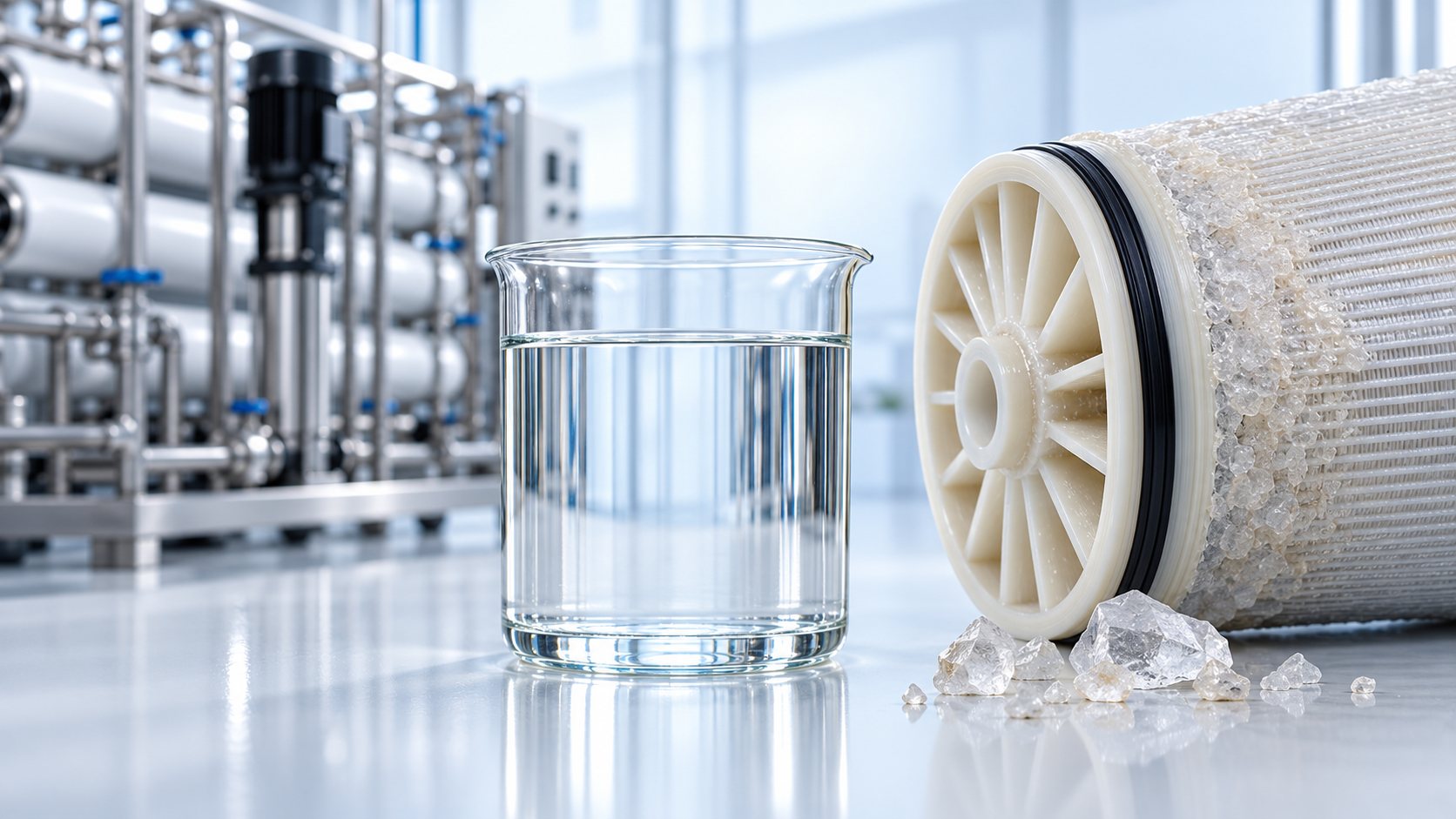
Silica can form deposits in boilers, heat-transfer equipment, reverse-osmosis systems and other process-water equipment. The risk depends on silica concentration and form, pH, temperature, recovery and the presence of hardness and other dissolved constituents. In reverse osmosis, silica may concentrate in the reject stream and contribute to membrane fouling or scale.
Use the silica solubility and scaling calculator to explore how amorphous silica saturation changes with pH, temperature and sodium chloride concentration.
Silica-management options include lime softening, selected anion-exchange resins, nanofiltration and reverse osmosis. Colloidal silica can be harder to remove than dissolved, reactive silica, so analysis should identify the form present as well as the total concentration. The suitable process depends on the feed water and the required treated-water quality.
Read more about reverse osmosis and ion exchange.
For a focused overview of common silica and silicate compounds in water, where they occur and how they can be managed, see common silica salts and silicate compounds in aqueous solutions and their removal/purification technologies.
Health and environmental context
Dissolved silica in water should not be confused with respirable crystalline silica dust. Inhalation of fine crystalline silica particles in occupational settings can cause silicosis and other serious lung disease; that hazard is different from exposure to dissolved silica in drinking water. Silicon and silica forms also differ in solubility and biological availability, so broad claims about “silicon toxicity” do not describe every form or exposure route.
The Australian Drinking Water Guidelines distinguish silicon from silica and discuss both health and scale considerations. Their numerical values are guidance for Australia, not universal legal limits. Follow the requirements that apply to the location and intended use of the water.
Last reviewed: 3 November 2026 by Lenntech.
Sources and further reading
- Australian Drinking Water Guidelines: Silicon and silica (endorsed 2025).
- U.S. Geological Survey: Silica in natural waters.
- ATSDR: Toxicological Profile for Silica.
- CDC/NIOSH: Silica and worker health.
Read more about elements and their interaction with water.