

Lead (Pb) and water
Lead in water: sources, health effects and control
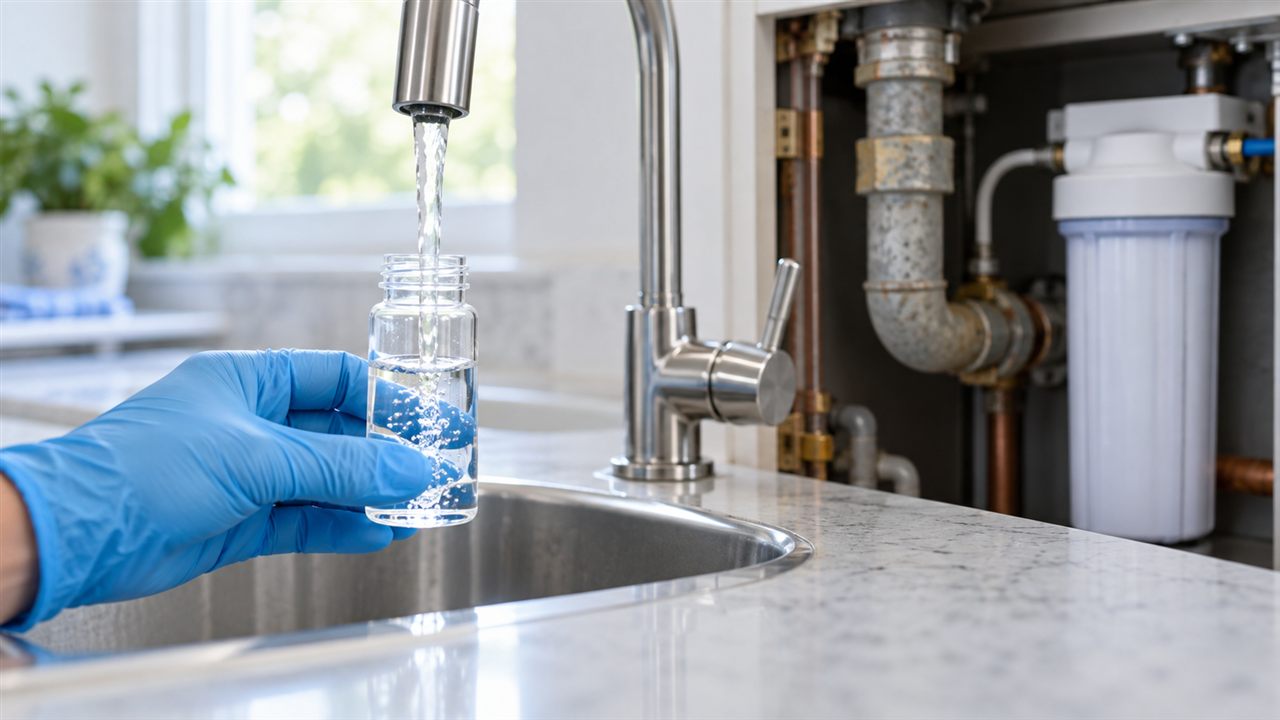
Lead in tap water usually comes from corrosion of lead-containing service lines, pipes, solder or plumbing fittings. The amount can vary with water chemistry and how long water has stood in the plumbing, so testing at the tap is important.
How does lead enter water?
Lead is rarely present in tap water because it has dissolved from natural sources. It most often enters water when corrosive water contacts lead service lines, older lead pipes, solder, brass fittings or other components containing lead. It can also reach surface water and groundwater from mining, metal processing, battery manufacture or recycling, and contaminated soil or dust.
Lead does not have one fixed solubility in water. It may be present as dissolved ions or complexes, or as particles released from corrosion scales. The amount released depends on factors including pH, alkalinity, dissolved inorganic carbon, hardness, chloride, temperature, contact time and the condition of pipe deposits. Changes to source water or treatment can alter lead release, so performance must be monitored in the distribution system.
Environmental behaviour
Lead can bind to suspended particles and accumulate in sediments and soils. Its mobility and biological availability vary with pH, mineral surfaces, organic matter and other water-chemistry conditions. Lead pollution may result from industrial releases, mining and weathering of contaminated materials, but lead found in household tap water is commonly associated with plumbing and service connections.
Health effects
Lead is toxic, and no level of exposure is known to be without health risk. Exposure can affect several body systems. The developing nervous system is especially sensitive, so fetuses, infants and children are particularly vulnerable. Lead exposure is associated with effects on children’s brain development and learning; in adults, it is also associated with effects including increased blood pressure and impaired kidney function. Lead in drinking water is one possible exposure source, alongside food, dust and other sources.
Because lead may enter water inside a building or service line, a water sample collected at the treatment plant does not show the concentration at every tap. Lead levels can also vary between samples depending on stagnation time and the sampling procedure.
Drinking-water guideline and regulatory values
Values differ by jurisdiction and do not represent a boundary between safe and unsafe exposure. WHO’s provisional guideline value is 10 µg/L; it is based on treatment performance and analytical achievability, not a health-based threshold, and WHO advises keeping concentrations as low as reasonably practical. The EU Drinking Water Directive sets a parametric value of 10 µg/L until 12 January 2036, then 5 µg/L. Health Canada’s maximum acceptable concentration is 5 µg/L at the tap. In the United States, the current Lead and Copper Rule uses a 15 µg/L action level based on system-wide tap sampling; the Lead and Copper Rule Improvements set a revised 10 µg/L action level when compliance begins. An action level is a trigger for system action, not a safe concentration for an individual tap.
How can lead in water be reduced?
The appropriate response depends on where lead enters the water and whether it is dissolved or particle-bound. Sampling should follow the applicable local protocol and be analysed by a qualified laboratory. For public water systems, corrosion control is designed around the source water and distribution system; pH, alkalinity and inhibitor use require system-specific assessment and monitoring.
- Remove lead sources: replacing lead service lines and lead-containing plumbing components is the principal long-term way to prevent lead from entering water at those locations.
- Control corrosion: water utilities can adjust water chemistry or use corrosion-control treatment to reduce lead release. Results depend on the plumbing materials and water chemistry and should be confirmed through tap monitoring.
- Use certified point-of-use treatment as an interim measure: some filters and reverse-osmosis devices are certified to reduce lead. Choose a device specifically certified for lead reduction under the relevant standard, install it as directed, and maintain or replace cartridges on schedule. A generic carbon or sediment filter should not be assumed to remove lead.
- Treat lead in source water where relevant: coagulation, settling and filtration can remove particle-associated lead in appropriately designed treatment processes. These processes do not replace corrosion control when lead is released from plumbing downstream.
Lenntech provides further information on coagulation and flocculation, sand and anthracite filtration, activated carbon and reverse osmosis.
Last reviewed: 31 October 2026 by Lenntech.
Sources and further reading
- WHO: Lead chemical fact sheet in the Guidelines for Drinking-water Quality.
- European Union: Drinking Water Directive (EU) 2020/2184.
- U.S. EPA: National Primary Drinking Water Regulations.
- U.S. EPA: Lead and Copper Rule Improvements.
- Health Canada: Guidelines for Canadian Drinking Water Quality — Lead.
- U.S. EPA: Identifying point-of-use and pitcher filters certified to reduce lead.
Read more about elements and their interaction with water.