

Chromium (Cr) and water
Chromium in water: speciation, environmental behaviour and treatment
Chromium occurs in water mainly as trivalent chromium, Cr(III), or hexavalent chromium, Cr(VI). These forms differ in solubility, mobility and toxicity. Water chemistry—especially pH, redox conditions and the presence of iron, manganese, organic matter and other ions—controls which forms are present.
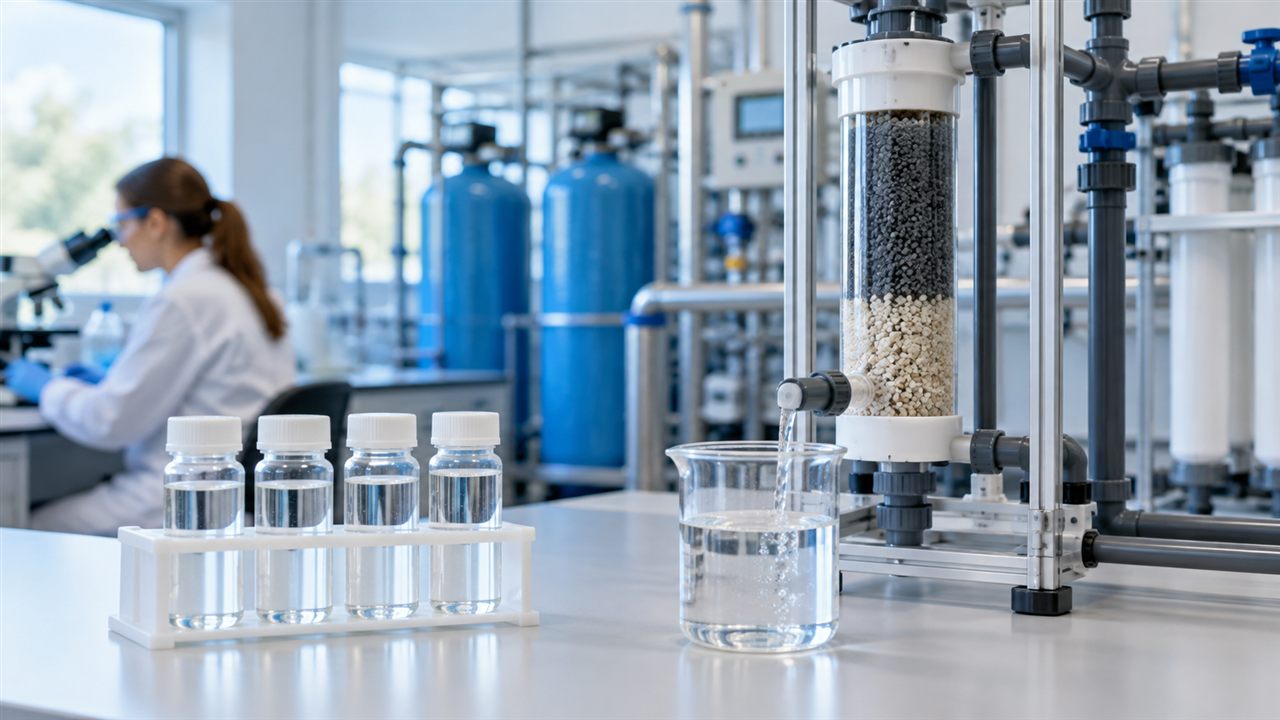
How does chromium enter water?
Chromium occurs naturally in minerals such as chromite and can enter water through the weathering of rocks and soils. Industrial sources may include metal finishing, stainless-steel production, leather tanning, pigments and other manufacturing activities. Releases can occur through wastewater discharges, spills or poorly managed waste. The source and chromium form should be established through site-specific sampling rather than inferred from total chromium alone.
How does chromium react with water?
Bulk chromium metal does not react readily with liquid water at room temperature because a thin, protective oxide film forms on its surface. In natural and treated waters, chromium is more commonly encountered as dissolved or particle-associated compounds. Its chemical form can change through oxidation and reduction reactions.
Solubility and speciation
Cr(III) is generally less soluble than Cr(VI). Depending on pH and dissolved ligands, Cr(III) may occur as dissolved cations or complexes, adsorb to mineral surfaces, or form low-solubility hydroxide solids. Many Cr(III) compounds are poorly soluble, although some salts are soluble.
Cr(VI) usually occurs as the oxyanions hydrogen chromate (HCrO4−) and chromate (CrO42−); their relative proportions depend mainly on pH and concentration. Many alkali-metal chromate salts are soluble. Cr(VI) can therefore be more mobile in water than Cr(III), although adsorption to iron and aluminium oxides and other water-chemistry effects can influence transport. There is no single chromium species that represents all natural waters.
Environmental behaviour
Redox conditions and reactive surfaces influence chromium speciation. Organic matter, sulfide and ferrous iron can reduce Cr(VI) to Cr(III), which often becomes less mobile through sorption or precipitation. Under some conditions, manganese oxides can oxidise Cr(III) to Cr(VI). Oxygen conditions alone do not determine the outcome; mineralogy, pH, reaction time and water chemistry also matter.
Health considerations
Health effects depend on chromium’s oxidation state, compound, concentration, exposure duration and route. Cr(VI) compounds are recognised as carcinogenic to humans by inhalation; evidence for cancer in humans from oral exposure through drinking-water is less conclusive, and WHO’s drinking-water assessment also considers animal studies and non-cancer effects. Cr(III) is generally less toxic than Cr(VI). The nutritional role of Cr(III) in humans remains uncertain, and no clinically defined chromium-deficiency state is established.
Drinking-water guideline values
WHO’s current drinking-water guideline value is 0.05 mg/L (50 µg/L) for total chromium. Regulatory limits are jurisdiction-specific. For example, the current U.S. federal maximum contaminant level is 0.1 mg/L for total chromium. Under the EU Drinking Water Directive, the parametric value is 50 µg/L until 12 January 2036, after which the value is 25 µg/L. Always check the requirements that apply at the installation’s location; a guideline value is not a substitute for a site-specific risk assessment.
Which water-treatment technologies can remove chromium?
Selection depends on whether chromium is present as Cr(III), Cr(VI) or both, as well as on pH, competing ions, suspended solids and the required treated-water quality. A representative water analysis should identify total chromium and, where relevant, its species.
- Cr(III): pH adjustment followed by hydroxide precipitation and solids separation can be considered. Coagulation and filtration may also remove particle-associated or precipitated Cr(III).
- Cr(VI): anion exchange or suitable adsorptive media can remove chromate species. Another approach is chemical reduction of Cr(VI) to Cr(III), followed by precipitation and filtration.
- Membrane treatment: reverse osmosis and nanofiltration can reduce chromium, with performance depending on speciation, membrane selection and operating conditions.
Chromium treatment should be designed for the water matrix and verified by testing. Lenntech also provides information on heavy-metal removal options.
For a guide to the common chromium salts and compounds found in natural and industrial waters, with solubility information and treatment options, see common chromium salts in water: solubility and treatment technologies.
Last reviewed: 3 November 2026 by Lenntech.
Sources and further reading
- WHO: Chromium chemical fact sheet in the Guidelines for Drinking-water Quality (2026 edition).
- U.S. EPA: Chromium in drinking water and the federal standard.
- European Union: Directive (EU) 2020/2184 on the quality of water intended for human consumption.
- ATSDR: Toxicological Profile for Chromium — chemical and physical information.
- NIH Office of Dietary Supplements: Chromium fact sheet for health professionals.
- U.S. Geological Survey: Groundwater chemistry and hexavalent chromium.
Read more about elements and their interaction with water.