

Nitrogen - N
Nitrogen (N) is essential to proteins and other biological molecules. Nitrogen gas makes up about 78% of dry air, but its behaviour and hazards differ greatly from those of ammonia, nitrate and nitrite.
Chemical properties · Uses and occurrence · Health effects · Environmental effects · Water and treatment
Chemical properties of nitrogen
| Symbol / atomic number | N / 7 |
|---|---|
| Group / period / block | 15 / 2 / p |
| Standard atomic weight interval | [14.00643, 14.00728] |
| Electron configuration | [He] 2s2 2p3 |
| Usual elemental form | N2, a colourless gas |
| Gas density (20 °C, 1 bar; calculated) | 1.15 g L−1 |
| Melting point | −210.0 °C |
| Boiling point | −195.795 °C |
| Electronegativity (Pauling) | 3.04 |
| Non-bonded atomic radius | 0.155 nm |
| First ionisation energy | 1402.3 kJ mol−1 |
| Stable isotopes | 14N and 15N |
| Discovery | Daniel Rutherford, 1772 |
| CAS registry number (N₂) | 7727-37-9 |
Atomic weight follows CIAAW. Intervals reflect natural isotopic variation; parentheses indicate uncertainty in the final digits. Other properties follow RSC unless noted. Atomic radii depend on their definition. Gas density is an ideal-gas estimate at 20 °C and 1 bar, calculated from ρ = pM/RT using conventional atomic weights; it is not a liquid density.
Properties, uses and occurrence
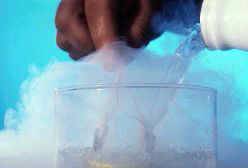
Nitrogen is a nonmetal. The strong bond in N2 makes the gas relatively unreactive under ordinary conditions. Industrial processes convert it into ammonia for fertilisers and other products. Nitrogen gas also provides protective atmospheres, while liquid nitrogen is used for cooling.
Nitrogen occurs in air, organisms, soil and water. Biological nitrogen fixation converts atmospheric nitrogen into forms that organisms can use. Nitric acid is an acid; nitrates are its salts or contain the nitrate ion. See the nitrogen cycle.
Health effects: distinguish the nitrogen species
Nitrogen gas is not poisonous in the same way as ammonia or nitrite, but it can displace oxygen and cause fatal asphyxiation without warning. Liquid nitrogen can cause cold burns and dangerous pressure build-up in unsuitable closed containers.
Nitrate and nitrite in drinking water require separate assessment. Nitrite can interfere with oxygen transport in blood; bottle-fed infants are particularly vulnerable to methaemoglobinaemia. WHO guideline values are 50 mg/L as nitrate ion and 3 mg/L as nitrite ion. When both occur, the sum of each concentration divided by its respective guideline value should not exceed 1. These are WHO guidelines, not a statement of every country's legal limits.
Nitrogen in the environment
Nitrogen is a nutrient, but excessive nitrogen inputs can promote algal growth and contribute to oxygen depletion in receiving waters. Fertiliser, wastewater and runoff are important pathways. Effects depend on the chemical form and receiving environment; nitrogen gas should not be assigned all the hazards of nitrogen compounds.
Nitrogen in water and wastewater treatment
Relevant measurements include ammonia/ammonium, nitrite, nitrate, organic nitrogen and total nitrogen. Always check the reporting basis: mg/L as N is different from mg/L as the ion. Approximately, nitrate as NO3− = nitrate as N × 4.43; nitrite as NO2− = nitrite as N × 3.29.
Nitrification biologically converts ammonium through nitrite to nitrate under aerobic conditions. It consumes oxygen and alkalinity and, by itself, does not remove nitrogen from the water. Denitrification converts nitrate/nitrite to nitrogen gas under anoxic conditions, with a suitable electron donor. Treatment design must account for loading, temperature, pH and the required effluent quality.
For drinking-water nitrate removal, options include suitable anion exchange and reverse osmosis. Selection depends on the full water analysis and residuals management. Boiling does not remove nitrate and can increase its concentration as water evaporates. Read more about nitrogen and water.
Nitrogen page last reviewed: by Lenntech.
Back to the periodic table of elements.