

Gallium - Ga
Gallium (Ga) is a low-melting metal important to electronics and specialised alloys. This guide outlines its properties, uses, exposure considerations and the assessment of gallium-bearing water streams.
Chemical properties · Uses and occurrence · Health effects · Environmental effects · Water and treatment
Chemical properties of gallium
| Symbol / atomic number | Ga / 31 |
|---|---|
| Group / period / block | 13 / 4 / p |
| Standard atomic weight | 69.723(1) |
| Electron configuration | [Ar] 3d10 4s2 4p1 |
| Common oxidation state | +3 |
| Density (solid, near room temperature) | 5.91 g cm−3 |
| Melting point | 29.7646 °C |
| Boiling point | 2229 °C |
| Electronegativity (Pauling) | 1.81 |
| Non-bonded atomic radius | 0.187 nm |
| Covalent radius | 0.123 nm |
| First ionisation energy | 578.8 kJ mol−1 |
| Naturally occurring isotopes | 69Ga and 71Ga |
| Discovery | Paul-Émile Lecoq de Boisbaudran, 1875 |
| CAS registry number | 7440-55-3 |
Atomic weight follows CIAAW; parentheses indicate uncertainty in the final digits. Physical properties follow the Royal Society of Chemistry. Atomic radii depend on their definition.
Uses, occurrence and history
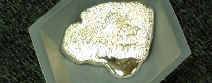
Gallium is a soft, silvery metal that melts just above ordinary room temperature. Its low melting point makes it useful in low-melting alloys. Gallium metal should be distinguished from compound semiconductors such as gallium arsenide (GaAs) and gallium nitride (GaN), which have different properties.
Gallium-based semiconductors are used in integrated circuits, light-emitting diodes, laser diodes, photodetectors and solar cells. The properties of the compound, rather than those of pure gallium metal, enable these applications.
Gallium occurs in small concentrations in several minerals and is recovered as a by-product of processing bauxite and zinc-bearing materials. Its dispersed occurrence makes recovery dependent on the host material and processing route. Production and supply data are available from the US Geological Survey.
Paul-Émile Lecoq de Boisbaudran discovered gallium in 1875. Its properties helped confirm Mendeleev's prediction of a missing element below aluminium in the periodic table.
Health effects of gallium
Gallium has no established essential biological role in humans. The metal, soluble salts, semiconductor compounds and radioactive gallium preparations should not be treated as having the same health effects. Risk depends on the chemical form, dose and route of exposure.
Gallium arsenide presents an important occupational hazard. Inhaled or ingested particles can release biologically available inorganic arsenic; NIOSH recommends controlling exposure to these particles. Cutting, grinding or polishing semiconductor material can create dust requiring appropriate engineering controls and handling procedures.
Gallium-67 citrate is used in diagnostic nuclear medicine under professional supervision. This does not mean that radioactive gallium is harmless: its prescribing information describes radiation precautions and possible adverse reactions, including allergic reactions, rash and nausea. Medical use is distinct from environmental or workplace exposure.
Environmental effects of gallium
Gallium occurs naturally in mineral deposits. Mining, refining and semiconductor processing can create gallium-containing residues and waste streams. An environmental assessment should identify the compounds present, their concentrations and associated contaminants. A stream containing gallium arsenide also requires assessment of arsenic.
The presence of gallium alone does not demonstrate either environmental safety or ecological damage. Site-specific exposure data and the composition of the material are needed to assess risk and select appropriate waste management.
Gallium in water and treatment
For a gallium-bearing process stream, establish the gallium concentration, pH, dissolved and suspended fractions, and other constituents before selecting treatment. Treating contaminated rinse water and recovering gallium from a concentrated process liquor are different objectives.
Laboratory research has demonstrated pH-dependent hydrolysis and precipitation of Ga(III) in sulfate solutions. Controlled precipitation with subsequent solids separation is therefore a treatment route to investigate, rather than a guaranteed removal process. The actual water composition, temperature and operating conditions must be assessed through treatability tests.
Where arsenic-containing materials are processed, measure arsenic separately and consider its treatment requirements alongside gallium. Further information: arsenic in water and heavy-metal removal.
Gallium page last reviewed: by Lenntech.
Back to the periodic table of elements.
Sources and further reading
- RSC: gallium properties, applications and history
- CIAAW: gallium atomic weight and isotopes
- USGS: gallium uses and mineral statistics
- USGS: gallium in bauxite deposits
- NIOSH: exposure to gallium arsenide
- DailyMed: gallium-67 citrate prescribing information
- Yamauchi and Sakao: Ga(III) hydrolysis and solubility in sulfate solution