

Argon - Ar
Argon (Ar) is a colourless noble gas that makes up just under 1% of Earth's atmosphere. Its chemical inertness is useful in industry, but a release can displace oxygen in an enclosed space.
Chemical properties · Uses and occurrence · Health effects · Environmental effects · Water and treatment
Chemical properties of argon
| Symbol / atomic number | Ar / 18 |
|---|---|
| Group / period / block | 18 / 3 / p |
| Standard atomic weight interval | [39.792, 39.963] |
| Electron configuration | [Ne] 3s2 3p6 |
| Elemental form | Monatomic gas |
| Gas density (20 °C, 1 bar; calculated) | 1.64 g L−1 |
| Melting point | −189.34 °C |
| Boiling point | −185.848 °C |
| Electronegativity (Pauling) | Not assigned |
| Non-bonded atomic radius | 0.188 nm |
| First ionisation energy | 1520.6 kJ mol−1 |
| Stable isotopes | 36Ar, 38Ar and 40Ar |
| Discovery | Lord Rayleigh and William Ramsay, 1894 |
| CAS registry number | 7440-37-1 |
Atomic weight follows CIAAW. Intervals reflect natural isotopic variation; parentheses indicate uncertainty in the final digits. Other properties follow RSC unless noted. Atomic radii depend on their definition. Gas density is an ideal-gas estimate at 20 °C and 1 bar, calculated from ρ = pM/RT using conventional atomic weights; it is not a liquid density.
Properties, uses and occurrence
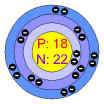
Argon is a noble gas with a filled outer electron shell and little tendency to react under ordinary conditions. It is separated from air and used where an inert atmosphere is useful, including welding, metal production and some lamps.
Argon was identified in 1894 by Lord Rayleigh and William Ramsay. Its name comes from a Greek word meaning “inactive.” Natural argon is mostly argon-40, produced in part by radioactive decay of potassium-40 in rocks.
Health effects and safe handling
Argon is not chemically toxic, but it can displace oxygen and cause asphyxiation without warning. Compressed gas presents pressure hazards. Liquid argon is extremely cold and can cause severe cold burns; evaporation can rapidly reduce oxygen levels in poorly ventilated spaces. Use appropriate ventilation, gas monitoring and cryogenic precautions for the actual system.
Argon in the environment
Argon is a natural component of air and is chemically unreactive in ordinary environmental conditions. However, concentrated releases in enclosed or low-lying spaces can create a local oxygen-deficiency hazard. It is inaccurate to infer that every argon release has no possible effect simply because the gas is inert.
Argon in water and process systems
Small amounts of argon dissolve in natural water through contact with air. Dissolved argon is not a disinfectant or nutrient and is not usually a treatment target in ordinary water systems. In specialist groundwater studies, dissolved noble gases can help researchers interpret recharge conditions and water history.
Argon is sometimes used to provide an inert atmosphere in water-related industrial processes, but it does not remove dissolved contaminants. For water quality, base treatment decisions on the measured constituents and intended use. See argon in water.
Argon page last reviewed: by Lenntech.
Back to the periodic table of elements.