|
Drinking water analyse
Drinking water in the Netherlands is carefully checked for the presence of bacteria. According to the law, 1 ml of drinking water may not contain more than 100 bacteria. An investigation into the level of bacteria in drinking water takes place as follows. A certain amount of drinking water is diluted with sterilized water in such a way that three different dilutions are obtained: 1 in 10, 1 in 100 and 1 in 1000. Of the undiluted drinking water sample, 0.1 ml is always placed on five petri dishes with sterilized culture media. The same happens with each dilution, so that a total of 20 petri dishes are used. After a few days, the number of bacterial colonies that appeared on each petri dish is counted. Some students have carried out such an investigation. Their results are shown in Table 2.
Table 2
|
Sample (0,1 nl)
|
Number of colonies per petri dish
|
|
undiluted
|
25
|
41
|
71
|
29
|
51
|
|
diluted: 1 to 10
|
8
|
3
|
5
|
2
|
7
|
|
diluted: 1 to 100
|
2
|
0
|
3
|
0
|
0
|
|
diluted: 1 to 1000
|
0
|
0
|
0
|
0
|
0
|
Give the reason why sterilized water should be used for dilution.
Sterilized water contains no bacteria.
Calculate whether the drinking water examined complies with the law.
A correct calculation leads to the answer "no".
- calculation of the average number of bacteria in 0.1 ml of undiluted water: 43 / about 40 bacteria
- calculation of the number per milliliter: 430 / about 400
- correct conclusion from the comparison of the calculated content with the content of 100 per ml stated in the law
Algae
In the upper 100 m of the North Sea, the level of algae varies with the seasons. This is shown in the diagram of Figure 1. The same diagram shows the concentration of nitrate ions (NO3-) in that seawater. Nitrate ions are not toxic to algae under normal circumstances.
water treatment chemicals, eutrophication, water FAQ.
Figure 1 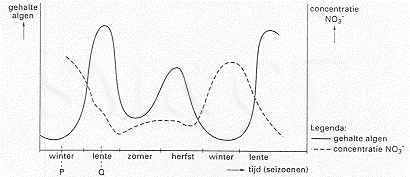
In the first half of spring, an increase in algae content is accompanied by a decrease in the concentration of nitrate ions.
Explain by which change in spring the algae content in the sea increases and as a result this leads to a decrease in the concentration of nitrate ions.
The answer must show that the temperature / illuminance increases in the spring (which promotes the growth of algae) and that the algae absorb nitrate ions
Using the data in the diagram of Figure 1, explain that the concentration of nitrate ions in the winter is most likely not a limiting factor for algae growth.
The answer must show that the algae content is low in winter, while there are many nitrate ions available
An experiment examines the influence of various factors on algae content. Two trays are filled in the winter at time P (see Figure 1) with water from the North Sea. The water in container 1 is sterilized and not in container 2. A small and equal amount of algae is added to the water in both trays. Both bins are next to each other outside. In the following spring, the algae content in both trays is determined at time Q. In tank 1 the content of algae appears to be higher than in box 2.
Give an explanation for this.
Answer: The statement must show that due to sterilization in box 1 (initially) there are no consumers.
Waste water
Household waste consists of waste water and solid waste. The waste water goes through the sewer to a waste water treatment plant. Bacteria are used in the purification of the waste water.
Do the bacteria have the function of removing organic substances from the waste water? And do they have the function of removing salts?
A. only the removal of organic substances
B. only the removal of salts
C. both the removal of organic substances and the removal of salts
Answer A.
Water pollution
The solid waste is collected by garbage trucks. That solid waste can cause environmental pollution. Two forms of environmental pollution are water pollution and air pollution.
Explain how the solid waste can cause water pollution.
Examples of correct answers:
- air pollution from the incineration of waste
- air pollution through the stench of a garbage mountain
- water pollution through the leaching of substances from landfilled waste
- a correct explanation for water pollution
- a correct explanation for air pollution
Water consumption, trees
If there are many aphids on a tree, the leaves of the tree can wilt and fall off prematurely.
Does this leaf waste change the amount of water that evaporates from the tree in the summer? And does this change the amount of water absorbed by the roots?
A. Neither changes.
B. Only the amount of water that evaporates.
C. Only the amount of water that is absorbed.
D. or the amount of water that evaporates as the amount of water that is absorbed.
Answer D
Too much phosphate in the sea water
Government policy is aimed at limiting the discharge of phosphate from manure and detergents into rivers and therefore into the North Sea. According to researchers, the amount of phosphate in the coastal waters must be reduced, because otherwise massive fish mortality will eventually occur. The amount of algae in the North Sea regularly increases sharply in the spring: water bloom. Subsequently, a large part of the algae dies. The current pattern in the North Sea ensures that much of this dead material ends up in German coastal waters. There it sinks to the bottom. There is a lack of oxygen just above and in the bottom, causing many seabed inhabitants to die.
Which of the following statements about the death of the seabed inhabitants is or are correct?
1 The seabed inhabitants die of lack of oxygen because the reducers use a lot of oxygen to mineralize the settled material in the coastal waters.
2 Biotic factors influence the death of the seabed inhabitants, abiotic ones have no influence on this.
A neither
B claim only 1
C claim only 2
D both claim 1 and claim 2
Give the biological name of the process of enriching the surface water with nutrient salts such as here enrichment with phosphate.
In addition to many phosphate ions, many potassium ions are brought into the North Sea via the Rhine. Both potassium ions and phosphate ions are necessary nutrients for algae. However, the supply of phosphate ions does cause water bloom and the supply of potassium ions does not. The phosphate ions and potassium ions supplied can remain well dissolved in the seawater.
Answer: eutrophication / hypertrophication
Give an explanation for the difference in the consequences of the phosphate and potassium ion supply.
According to a researcher from the "National Institute for Fisheries Research", however, a rigorous reduction in the amount of phosphate in the North Sea can also reduce fishing.
Answer: the (concentration of) phosphate ions is (apparently) the limiting factor for the growth of algae (and not that of potassium ions).
Describe how the impact of phosphate reduction on the algae populations can be the cause of the reduction in fish catches.
Answer: A lower phosphate concentration leads to fewer algae
Fewer algae means less food for fish / there is less food for the fish that live on algae-eating animals
Hard water
Which type of ion must be removed from hard tap water to make soft tap water?
A. Al3 +
B. Ca 2+
C. H +
D. K +
E . Na +
Answer B
Which of the methods below is suitable for softening tap water?
Method 1: Let the tap water boil for a while.
Method 2: Let the tap water flow through an ion exchanger.
A. neither method is used
B. method 1 only
C. method 2 only
D. both method 1 and method 2
Answer D
Oxygen and water
Oxygen on a moon near Jupiter
On Europe, one of the four moons on the planet Jupiter, the molecular substance oxygen is found.
The moon Europe is covered with a thick layer of ice. Water is released from this ice layer. This water has the form of fog and is converted into hydrogen and oxygen by sunlight.
Give the formula and the ice condition condition.
Answer: H2O (s)
The conversion of water to hydrogen and oxygen described above is one
A. electrolysis.
B. photolysis.
C. thermolysis.
Answer: B
The SewerWater Purification Plant (STP)
Bram and Jenny visit a sewage treatment plant (WWTP). What strikes both students is the "rotten eggs" tank.
Mr. Anker shows them around. He says that the smell is caused by the gas hydrogen sulphide (H2S). The following data is known for hydrogen sulphide:
boiling point: - 60 oC
melting point: - 85 oC
odor: more than 0.1 mg in 1 m3 of air is easy to smell
solubility in water: 0.5 g / 100 ml (20 oC)
toxicity: more than 15 mg in 1 m3 of air is toxic
Bram and Jenny find the smell very unpleasant. Mr. Anker said: "From the point of view of safety, it is pretty good that hydrogen sulphide stinks that way."
Explain that Mr. Anker is right.
Answer: If you smell the toxic substance, you know that there is a risk of poisoning and that you can take safety measures.
Mr Anker also explained how sewage water is supplied to the STP via sewer pipes, pressure pipes and receiving wells. Schematically, a sewer system can look like this:
Figure 1: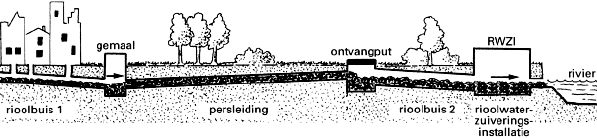
The concrete sewer pipes run down slightly and are partially filled with sewage water; there is air above. The pressure line is completely filled with sewage water.
Mr Anker said that the formation of hydrogen sulphide gas has a very different disadvantage. It appears that concrete sewer pipes can be seriously affected. He lets Bram and Jenny read a piece from a brochure. This brochure is from a company that has researched the hydrogen sulphide gas.
Folder 1:
| Concrete consists mainly of lime. Damage starts when bacteria on the moist walls convert the hydrogen sulphide gas with oxygen from the air into sulfuric acid. The concrete is attacked when the calcium (calcium carbonate) present is converted into calcium sulphate by the sulfuric acid |
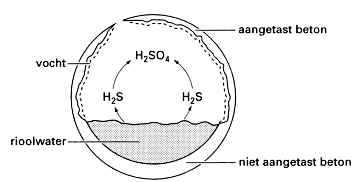 |
Give the comparison of the reaction where hydrogen sulfide reacts with oxygen (O2) to sulfuric acid
Answer: H2S + 2O2 -> H2SO4
In the reaction of the concrete with sulfuric acid, calcium carbonate is converted to calcium sulphate.
Compare the water solubility of calcium sulfate with the water solubility of calcium carbonate.
Calcium sulfate
A. less soluble than calcium carbonate.
B. soluble as well as calcium carbonate.
C. more soluble than calcium carbonate.
Answer: C
Jenny asks the tour guide: "Can't you make sure that no hydrogen sulphide is formed? Then no sulfuric acid can arise!" Mr. Anker replied that research is currently being done on this. A company has offered to add a solution of calcium nitrate to the sewage. In a brochure from this company you will find the following:
Folder 2:
Waste water contains sulfur compounds. If sufficient air can get into the sewage water, the sulfur compounds are converted into harmless sulphates. If no air can get into the sewage water, the sulfur compounds are converted by bacteria into hydrogen sulfide. If the waste water contains nitrates in addition to sulfur compounds, the bacteria leave the sulfur compounds alone. The bacteria use the nitrates. Adding the correct amounts of (calcium) nitrate prevents hydrogen sulphide from forming!
In which part of the sewerage system (see figure 1) can a lot of hydrogen sulphide arise?
A. in sewer pipe 1
B. in the press line
C. in sewer pipe 2
D. in the sewage treatment plant
Answer B
At what point in the sewage disposal system should the calcium nitrate solution be added?
A. Before hydrogen sulphide is formed in the sewage water.
B. After hydrogen sulphide has formed in the sewage water, but before hydrogen sulphide has been converted into sulfuric acid.
C. After hydrogen sulfide has been converted to sulfuric acid, but before sulfuric acid has affected the concrete.
Answer: A
The company has carried out a test with the addition of calcium nitrate in a sewer system as in Figure 1.
It was measured on a given day how much hydrogen sulfide was formed if no calcium nitrate was added. On another day, it was measured how much hydrogen sulfide was formed, if calcium nitrate was added.
The results of both measurements are shown in the diagram.
Diagram: 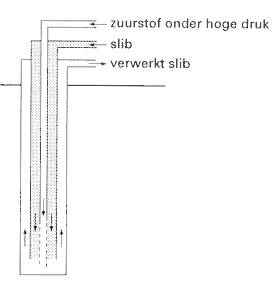
How many mg / l is the highest concentration of hydrogen sulfide that has been measured?
Answer: A correct reading leads to an answer in the 9.7 interval
Can the conclusion be drawn from the data that adding calcium nitrate is useful? Give an explanation for your answer.
Answer: When adding calcium nitrate, much less hydrogen sulfide is created, so it is useful
pH
Petra has a solution with pH = 2. She wants to raise the pH of the solution. Gert-Jan advises her to add sodium hydroxide. Karel advises to add her lime water.
40. Which of the two gives good advice?
A. neither of them
B. Gert-Jan only
C. only Karel
D. Both Gert-Jan and Karel
Answer D
De-ironing of groundwater
Farmers sometimes pump water from the soil. This groundwater contains, among other things, iron ions (Fe2 +) and hydrogen carbonate ions (HCO3 -). The iron ions can cause precipitation and thus blockages in pipes and faucets. That is why this water is "de-ironed" with the help of a de-ironing installation:
figure 1
In the installation the water is sprayed by means of nozzles. This brings the water into contact with oxygen from the air. At the top of the installation, iron ions and hydrogen carbonate ions react with oxygen and water. There arise
carbon dioxide gas and solid iron (III) hydroxide.
The reaction equation below, with which this reaction is shown, is not correct. Only the coefficient for CO2 is missing.
4 Fe 2+ + O 2 + 2 H 2 O + 8 HCO 3 - 4 Fe (OH) 3 + ... CO 2
Which number stands for CO2 if the comparison is correct?
A 3
B 4
C 8
D 10
E 12
Answer C
The speed of a reaction can be influenced by a number of factors. One of those factors is the temperature. By spraying the water, a factor is also changed, so that the reaction proceeds faster than if the water were allowed to drip or flow.
Which factor is that?
Answer: The distribution degree
In the iron removal installation (figure 1) the iron ions are removed from ferrous groundwater.
Explain why conversion of iron ions into iron (III) hydroxide is necessary to remove the iron ions from the groundwater by filtration.
Answer: iron (III) hydroxide is insoluble (and iron ions are dissolved) (and only solid / insoluble substances can be removed by filtration).
Water molecules
For a long time it was thought that the space between the stars contains no matter.
It is now known that the universe is not entirely vacuum, although the number of particles per cm3 is very small: between 10 and 106 particles per cm3. Hydrogen molecules are the most common particles in the universe.
Calculate the density in g cm-3 of a piece of universe that contains 5.0 · 105 hydrogen molecules per cm. For this calculation, assume that there are no other particles in the space.
Answer: A correct calculation leads to the result 1.7 · 10-18 (g cm-3).
A new method has recently been developed to process sewage sludge. The sludge is reacted with oxygen in a long pipe, deep underground.
In a newspaper article about this method it says the following:
Text excerpt 1:
For a long time it was thought that the space between the stars contains no matter.
It is now known that the universe is not entirely vacuum, although the number of particles per cm3 is very small: between 10 and 106 particles per cm3. Hydrogen molecules are the most common particles in the universe.
Calculate the density in g cm-3 of a piece of universe that contains 5.0 · 105 hydrogen molecules per cm. For this calculation, assume that there are no other particles in the space.
Answer: A correct calculation leads to the result 1.7 · 10-18 (g cm-3).
Water molecules
A new method has recently been developed to process sewage sludge. The sludge is reacted with oxygen in a long pipe, deep underground. In a newspaper article about this method it says the following:
Text excerpt 1
Sludge is pumped into a thick, long pipe. There is more than a kilometer of sludge in that pipe. That gives an extremely high pressure below, of around a hundred atmospheres. As a result, organic substances at the bottom of the pipe react with oxygen at low temperatures. They are, as it were, burned while no flame is involved.
To start the process, the installation is preheated underground. Once the process has started, heating is no longer necessary. |
|
Give an explanation for the fact that the organic substances at the bottom of the pipe already react with oxygen at low temperatures.
Answer: at high pressure the concentration (of oxygen) is greater than at low pressure (1p) therefore the reaction speed is greater (and the reaction can take place at low temperature)
Why will heating no longer be necessary once the process has been started?
Answer: The reaction is (apparently) exothermic. / Heat is (apparently) released during the reaction.
One of the problems encountered with the development of this technique was that over time the pipe became clogged with solid calcium sulfate. In the same article the following was said about the origin and removal of this calcium sulphate:
Text excerpt 2:
Sulfur in the sludge burns to sulphate, which then reacts with calcium in the sludge to form solid calcium sulphate. This has also been taken into account in business operations. Every six days a nitric acid solution is pumped through the pipe to dissolve the precipitate.
The formation of sulphate referred to in text fragment 2 is a redox reaction. If the formula S is used for the sulfur in the sludge and it is assumed that the sludge is weakly basic, one half reaction of this redox reaction can be represented as follows:
S + 8 OH- à SO42- + 4 H2O + 6 e-
Give the comparison of the other half reaction and derive from both half reactions the comparison of the total reaction of the combustion of sulfur to sulphate.
Answer: A correct derivation leads to the following comparison: 
In text fragment 2 it is written about "calcium" that reacts with the sulphate to form calcium sulphate. With this calcium it is impossible to mean the metal calcium.
Indicate by which property of the calcium metal the sludge cannot possibly contain this metal.
Answer: Calcium (is a very base metal and) would have reacted with the water in the sludge.
When dissolving solid calcium sulfate in the nitric acid solution, an acid-base reaction occurs, the sulfate ion reacting as a base.
Give the equation for dissolving solid calcium sulfate in the nitric acid solution.
Answer: 
Source: MAVO, HAVO exam bundles
Also test your knowledge of bacteria and viruses, the environment and substances.
|