

DuPont Electrodeionization (EDI) Modules
DuPont EDI modules continuously polish reverse osmosis permeate for high-purity industrial water applications.
The four plate-and-frame models cover nominal product-water flows of 5 and 8 m³/h. Electrodeionization combines ion-exchange resins, ion-selective membranes and direct current, without chemical regeneration of the resin bed.
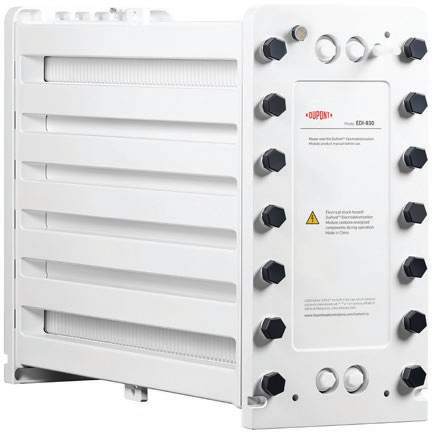
How electrodeionization works
EDI uses ion-exchange resins, ion-selective membranes and DC power to remove ions from RO permeate continuously. The electrical process regenerates the resin during operation, eliminating periodic chemical regeneration.
The modules generally follow second-pass reverse osmosis. In selected ultrapure-water applications, a polishing mixed-bed stage can follow EDI to reach the required final water quality.
Two-outlet and three-outlet designs
EDI-520 and EDI-820: two outlets
Product water and concentrate leave through separate outlets. Electrode water is discharged with the concentrate, so a separate electrode-water discharge line is not needed. The dilute connections are 1¼-inch BSP male and the concentrate connections are ¾-inch BSP male.
EDI-530 and EDI-830: three outlets
A dedicated electrode-water outlet allows separate electrolyte discharge. Electrode feed is split internally from the dilute stream, so no external electrode inlet is required. The modules have 32 mm dilute connections, 20 mm concentrate connections and a 10 mm electrode-water connection, and support co-current or counter-current operation.
Compare DuPont EDI modules
All four models use a plate-and-frame design.
EDI-520
Nominal flow: 5 m³/h
Flow range: 2.6–7.7 m³/h
Resistivity¹: ≥16 MΩ·cm
opens in a new tab
EDI-530
Nominal flow: 5 m³/h
Flow range: 2.6–7.7 m³/h
Resistivity¹: ≥16 MΩ·cm
opens in a new tab
EDI-820
Nominal flow: 8 m³/h
Flow range: 4.0–11.5 m³/h
Resistivity¹: ≥16 MΩ·cm
opens in a new tab
EDI-830
Nominal flow: 8 m³/h
Flow range: 4.0–11.5 m³/h
Resistivity¹: ≥16 MΩ·cm
opens in a new tab
¹ EDI-520, EDI-530, EDI-820 and EDI-830: test conditions are 20 µS/cm NaCl feedwater, 25 °C and 90% recovery. Actual resistivity and silica removal depend on feedwater quality and operating conditions.
DuPont EDI-520
Plate-and-frame module with two outlets for product water and concentrate. No separate electrode-water discharge line is required.
- Nominal product-water flow: 5 m³/h; operating flow range: 2.6–7.7 m³/h.
- Maximum electrical ratings: 300 VDC / 6 A.
- Feed temperature: 5–40 °C. Recovery up to 95%; typical silica removal: 90–99%, depending on feedwater and operating conditions.
EDI-520 data sheet (PDF)
opens in a new tab
DuPont EDI-530
Plate-and-frame module with a dedicated electrode-water outlet for electrolyte control, alongside the product-water and concentrate outlets.
- Nominal product-water flow: 5 m³/h; operating flow range: 2.6–7.7 m³/h.
- Maximum electrical ratings: 400 VDC / 5.2 A.
- Feed temperature: 5–40 °C. Recovery up to 95%; typical silica removal: 90–99%, depending on feedwater and operating conditions.
EDI-530 data sheet (PDF)
opens in a new tab
DuPont EDI-820
Higher-flow plate-and-frame module with two outlets, suited to systems requiring 8 m³/h nominal product-water flow per module.
- Nominal product-water flow: 8 m³/h; operating flow range: 4.0–11.5 m³/h.
- Maximum electrical ratings: 500 VDC / 6 A.
- Feed temperature: 5–40 °C. Recovery up to 95%; typical silica removal: 90–99%, depending on feedwater and operating conditions.
EDI-820 data sheet (PDF)
opens in a new tab
DuPont EDI-830
Higher-flow plate-and-frame module with a separate electrode-water outlet, combining 8 m³/h nominal flow with three-outlet operation.
- Nominal product-water flow: 8 m³/h; operating flow range: 4.0–11.5 m³/h.
- Maximum electrical ratings: 400 VDC / 5.2 A.
- Feed temperature: 5–40 °C. Recovery up to 95%; typical silica removal: 90–99%, depending on feedwater and operating conditions.
EDI-830 data sheet (PDF)
opens in a new tab
RO pretreatment and system integration
A typical treatment train uses first-pass RO, second-pass RO and EDI. Two-pass RO reduces hardness and the scaling potential in the concentrate and electrode compartments. Feedwater quality, flow balance and electrical settings must remain within the limits for the selected module.
The compact, stackable plate-and-frame design supports modular skid layouts. Ion-exchange resins, membranes and electrodes are the core components governing ion removal and electrical performance.
Applications and feedwater
The plate-and-frame range serves high-purity water applications in power generation, green hydrogen, chemical and petrochemical processing, metallurgy, pulp and paper, and selected microelectronics applications such as solar photovoltaics and semiconductor assembly and test.
Feed the modules with RO permeate and observe the model-specific feedwater limits. These products are not intended for drinking-water applications. Refer to each data sheet for full feedwater requirements, pressure limits, installation guidance and operating conditions.
Discuss your EDI application
For module selection and enquiries, contact Lenntech at info@lenntech.com.