
Polypropylene
What is polypropylene?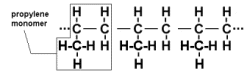
Polypropylene (PP) is a thermoplastic. It is a linear structure based on the monomer CnH2n. It is manufactured from propylene gas in presence of a catalyst such as titanium chloride. Beside PP is a by-product of oil refining processes. It is said that PP has an intermediate level of crystallinity between low density polyethylene (LDPE) and high density polyethylene (HDPE); On the other hand PP has higher working temperatures and tensile strength than polyethylene. Properties of polypropylene Listed below you will find the reasons why polypropylene is commonly used in our daily life: - Light in weight
- Excellent resistance to stress and high resistant to cracking (i.e. it has high tensile and compressive strength) In order to improve some properties PP formulas may include additives such as pigments, carbon black, rubbers, antioxidants, and UV stabilizer. PP is available as molding powder, extruded sheet, cast film, textile staple, and continuous filament yarn. ApplicationIn general homopolymers (i.e. with only one type of monomer) can be used for housing, housewares, packaging, cassette holders and fibers, monofilaments and film tapes; copolymers (i.e. different monomers are involved) are prefered for all applications exposed to cold and they are widely used for pipes, containers, boat hulls, seat shells and automotive parts e.g. battery cases and bumpers.
Polypropylene can be manufactured to a high degree of purity to be used for the semiconductor industry. Its resistance to bacterial growth makes it suitable to be used in medical equipment. Polypropylene is used in most of our nonwoven fabrics such as rope used in a variety of industries, including fishing and agriculture. PP can be used for flexible packaging applications (e.g. yogurt containers, syrup bottles, straws, etc.), construction sector (e.g. drainage pipes, pumps, etc.), automotive sector, etc. Environmental issues and occupational health and safety issues Plastics represents a 14 to 22% in volume of solid waste. It can be melted and recycled, making it a thermoplastic elastomer but the recycling degrade the properties. Another difficulty is the management of plastics that are difficult to separate from other materials for its recycling. On the other hand recycling can be a cost-effective possibility if we take into account the social cost of landfills as well as fees. The use of PP does not have any remarkable effect from an occupational health and safety point of view, in terms of chemical toxicity. The manufacture of the polymer at high temperature can released irritating vapors to respiratory system and eyes. There is no known effect from chronic exposure to this product. More information about the elements of the periodic table Other materials: | ||||||||||||
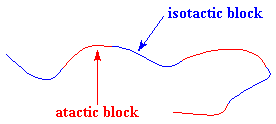 Most polypropylene used is highly crystalline and geometrically regular (i.e. isotactic) opposite to amorphous thermoplastics, such as polystyrene, PVC, polyamide, etc., which radicals are placed radomly (i.e. atactic).