|
An enormous amount of research has been conducted on the enhanced greenhouse effect. The IPCC has brought out reports showing modelling results about expected temperature change and consequences for the next century. There are however skeptics and scientists that argue with the results of the IPCC. Some do not even believe that an enhanced greenhouse effect exists at all.
This page and related pages are produced by a Master student of Environmental Systems Analysis. We must note that although this material appears on our website, Lenntech is impartial and this is not in any way a representation of our opinion. This web page is strictly of informational value. 1. The discussion on skeptical environmentalism
|
 |
Bjorn Lomborg, known to many as 'The Skeptical Environmentalist' and named one of the world's 100 most influential people by Time Magazine, has criticized current expectations of climate change and the consequences in his book. Many leading experts on environmental topics have commented on this. NGO's such as Greenpeace, an organization of which Lomborg used to be an active member, have attacked him on various occasions (see 1.4). Both Lomborg's chapter on global warming and the reply of a leading IPCC expert are discussed here. |
1.1 Bjorn Lomborg
1.1.1 General
Lomborg argues that 'the limitations of computer modelling, the unrealistic nature of basic assumptions made about future technological change and political value judgments have distorted the scenarios being presented to the public'.
Lomborg does not disagree with today's explanation of the greenhouse effect mechanism. He also does not deny that there must be some kind of anthropogenic addition to the greenhouse effect. He agrees with the idea that the centuries before 1900 where much colder than current times. He does however mention that this is mainly because of the Little Ice Age, which lasted from 1400-1900. There is no disagreement to the so-called Medieval Warm Period, when temperatures were 2-3 degrees warmer.
1.1.2 Proxy indicators
Lomborg does comment on the use of tree ring records by Mann to determine temperatures in the centuries before the thermometer was invented. He argues that only North American tree ring data were used and that the data only cover land surface temperatures during summer. Additionally, disturbances in measurements by other factors influencing tree ring development were not corrected. Data of different origin has a lack of spatial scale coherence, causing Lomborg to question whether there is even enough temperature proxy data. This is an important finding, because the results of Mann's tree ring research has already been taken up in the 2001 IPCC report.
Tree rings and other proxy indicators show changes in a 1000 year period. Measurements over a 1000 year period are not very accurate according to Lomborg, because evidence has suggested that a climatic cycle takes roughly 1500 years.
1.1.3 Greenhouse gases and temperature change
When it comes to greenhouse gas emissions Lomborg states that we should not ask ourselves whether greenhouse gases emitted by human activities have an impact, but how much effect these emissions have on temperature. This requires an adequate prediction of climate development in the future, which is very hard because of the complexity of the climate system. Current computer models are already relatively complex but do not even represent all important factors and processes yet. Scenarios (projections of future events) may not always be based on reasonable assumptions and some data may still be missing. How much CO2 impacts climate is strongly dependent on the representation of crucial areas in models, such as sulphur aerosols, water vapour feedback and clouds. These areas are briefly explained here.
Sulphur aerosols reflecting solar energy may counter the impact of greenhouse gases, causing a smaller impact on temperature. The IPCC has admitted this and it is now included in model simulations. This is however subject to large uncertainty and it does not include other aerosols besides sulphur. Furthermore, tropospheric temperatures are an important determinant of surface temperatures and according to satellite footage of the NOAA these do not increase as much as depicted by the IPCC. Both satellite measurements and weather balloon results do not show as much warming as the outcome of climate models used by the IPCC. This difference, if significant, would lower water feedback by evaporation and consequently lower the CO2 warming. This is because CO2 warming is enhanced by water vapour, which also traps heat. Another large uncertainty admitted by the IPCC is how much clouds will impact temperature change. Clouds may interfere with radiation that causes global warming and prevent major temperature increases. However, clouds cannot be entered in climate models in a sufficient manner yet. They therefore represent a significant source of potential error in climate simulations. Despite all these remarks concerning the impact of CO2 emissions on temperature, the IPCC predictions of temperature change were hardly altered in the past 10 years.
1.1.4 Other causes of temperature change
Lomborg also states that we should ask ourselves whether greenhouse gas emissions are the real causes of temperature change. It is the question whether temperature change really leads to the catastrophic events that have been predicted by the IPCC models.
It is important to mention that not only greenhouse gases, but also solar energy impacts global warming. The debate on global warming has had the tendency to only focus on one out of two factors. The IPCC mentions solar energy only briefly. Lomborg states that it is possible that incorporating solar activity will also lead to a lowering of the estimates of the CO2 warming effect. Solar brightness has increased over the past decade, increasing temperature by an estimated 0,4oC. A recent study showed that direct solar radiation has caused about 40% of the observed global warming of the past 30 years. Danish meteorologists have pointed out a clear connection between the duration of the solar cycle and average temperature on earth. This theory is still argued. Research that was conducted so far has shown that longer solar cycle duration resulting in lower solar activity. This leads to more cosmic radiation and increases cloud formation. These cosmic rays produce low-level clouds from ions which reflect solar energy, preventing warming of the earth's surface. This theory also states that shorter solar cycles lead to higher surface temperatures according the the reverse mechanism. This apparently explains temperature changes from 1860-1950, which have been accredited to natural variation by other scientists. IPCC studies have found that this solar hypothesis explains 57% of temperatures deviations. The climate sensitivity estimate is 33% lower than that of the IPCC (1,7oC).
1.1.5 IPCC scenarios
Lomborg has some concrete comments on the scenarios made in 1992 by the IPCC. He states that their predictions of population growth may be too high, as they are much higher than those of the UN today. He also disagrees with their expectation of 82% tropical forest disappearance in 2100 and with their expectation of a CO2 emission doubling in 109 years. Sustained growth at the observed rate would mean a doubling in no less than 154 years. Computer simulations use a very high growth rate for CO2, namely 1%. A measure of 0,6% would be more accurate according to Lomborg. Measuring other gases and expressing them as CO2 equivalents also cause the estimated rates to be way above the estimates based on current rates. Lomborg argues that all greenhouse gases should be expressed separately. All these overestimates of emissions cause a prediction of much more warming in a given time. This is repeated by the press without mentioning the applied overestimates in the computer models.
In the new scenarios constructed in 1996 the IPCC abandons the idea of predictions and starts using the term projections. The emissions estimates for sulphur dioxide in different scenarios are now lower than those made in 1992. This has an important impact on the greenhouse effect because sulphur aerosols in the atmosphere may decrease global warming, as was explained before.
The IPCC scenarios with a sustainable way of living seem to score much better than the wealthy scenarios. But according to Lomborg we must ask ourselves if transferring to a sustainable world as depicted in the scenarios is really worth it, as it means that our children may earn only 50% of our current income. This is a central question in dealing with global warming.
Lomborg finds the energy improvement in the sustainable scenarios a bit peculiar. This is because high energy use in the wealth scenarios should eventually drive up energy prices, so that the difference between energy improvement between the scenarios might actually not be so high. One of the wealth scenarios shows a remarkable transfer to renewable energy sources. This price increase could be the reason for that. However, Lomborg wonders if the prices for renewables would ever decrease so much that they would actually be cheaper than fossil fuels. Most IPCC scenarios do assume this, or even assume that mere environmental concern will cause the transfer. Lomborg advises an actual analysis of the extent to which fossil fuels would be replaced by renewables, and why. He wants to know how likely the transfer towards more sustainable scenarios would be, but this is not treated to a great extent by the IPCC as they regard all scenarios as likely. A model made by political economists determined that the prices of renewables are already decreasing by 30% per decade and they may even be competitive by 2040. This result causes the scenario where fossil fuel use continues to rise to be rather implausible. The model also calculated a higher actual global temperature change than was projected by the IPCC.
1.1.6 Consequences of global warming
Many consequences of global warming have been predicted and modelled by the IPCC. In agriculture a severe decrease in crop yield is expected which will eventually cause overall production to fall. But Lomborg finds that even the most pessimistic evaluation of UK Met Office experts expects crop production to grow dramatically over the next 50 years, so that overall production will not fall. Most plants grow better at higher atmospheric CO2 concentrations and higher temperatures, because of an enhanced fertilizer effect. This effect will cause production declines to be much smaller. Global warming may enhance the difference between developed and developing countries, because developed countries can adjust their farming methods more effectively and a longer growing season may not have as much of a negative impact. However, by the time the impact of global warming will be visible developing countries may be much more developed. The IPCC scenarios are only based on current development records. The IPCC also does not take into account the possibility of development of stronger crop varieties resistant to global warming impact.
Global warming has often been connected to sea level rise and melting of polar ice caps. Indeed, the sea level has risen 10-25 cm in the past century and will continue to rise by a further 31-49 cm in the next century. Three-fourths of this rise is a result of water expansion by warming and the other fourth is because of ice cap melting. According to the IPCC sea level rise will expose 70-200 million more people to flooding in the next century. But Lomborg mentions that one cause for the increase in people living on flood plains is growing population. He also emphasizes that as the world becomes richer we may be able to afford more (effective) measures to decrease the number of people exposed to flooding. This is not included in the models, which only concern measures that are already taken today. Lomborg also expects that the costs of flood protection will eventually decrease.
It is often said that global warming will put human health under pressure, particularly that of urban poor and elderly with no air-conditioning. According to Lomborg however, we must take into account that a richer world will give more people access to air-conditioning. In a warmer world also fewer people would be dying from cold weather, which has a much higher death toll than warm weather. A recent study of populations in Europe showed that people can adjust successfully to small increases in summer temperatures. This leads Lomborg to believe that populations are likely to adjust to changing temperatures consequential to global warming. Moreover, the decrease in winter deaths would outweigh an increase in summer deaths, according to him. It is also argued by the IPCC that certain diseases such as Malaria will increase in warmer weather. According to Lomborg this is not only the case in warmer weather, as Malaria was a major epidemic far into the Arctic Circle throughout the Little Ice Age, because mosquitoes would hibernate in sheltered sites. Only building techniques and better medicine could rid people of Malaria after the Little Ice Age. Even though the global area of Malaria could be expanded, development and resources could force back epidemics. Actual Malaria transmission would undergo little change as a result of global warming, because most newly exposed would come from richer countries where there is sufficient medicine.
Global warming is said to increase the number of events of extreme weather, leading to extinction of some endangered species. There have been periods in the Holocene when temperatures were 1-2 degrees warmer and no extreme weather occurred. Computer models have given inconclusive results when it comes to extreme weather. Some models do predict it, while others predict no change at all. The IPCC states that only on a regional scale clear signs of extreme weather have been found, but these patterns are also inconclusive in climate variability. There appears to be no clear evidence supporting the occurrence of extreme weather events. Lomborg states that claims of more extreme weather that are meteorologically unsubstantiated are often backed-up by an economic observation of increasing weather-related costs. It is however unclear if this direct comparison of costs is reasonable. It ignores increasing population and more people that are moving to coasting risk-prone areas. A 1999 study showed that extreme weather events were not the main cause of catastrophes in the 1990's. Societal changes are a much more likely cause.
Not all temperatures have changed. Globally, minimum night temperatures are most likely to increase. More warming has taken place during winter than during summer. Consequentially only Australia and New Zealand had their maximum temperature go up. This may cause agricultural yield to increase. These temperature changes might increase the number of days of heavy rainfall. Flooding may occur as a result, but this will probably be prevented by future measures, such as wetland conservation and dam construction. The combined increase in temperature, CO2 and precipitation will make the earth greener. IPCC models have also projected this change.
Lomborg states that it is important to decide what considerations we should employ to determine whether or not and how we should take action. No matter what we decide, it will be a costly operation. And all measures should be based on reliable evidence, which is hard now that we still rely on inadequate model data. These considerations will cause the global warming debate to continue far into the future.
1.1.7 Costs of Kyoto
The IPCC has estimated the costs of global warming by aggregating the total cost if CO2 concentrations would double instantly and than stabilize. Lomborg comments that this is not likely to occur and that this cost estimate does not take into account possible future adaptations to climate change. He also states that the higher end of the IPCC estimated range of temperature rise (1,4-5,8oC) is not very likely. Not all important sectors have been included in the IPCC estimates of costs of the consequences of global warming. The transport sector and the question of political instability have not been included. Costs are the costs of adaptation and the costs of consequences of non-adaptation taken together.
The costs in relative terms are unevenly distributed according to Lomborg, because costs to the developing world are equal to those of the richer developed world. The IPCC expects that developing countries will be hit harder by global warming because of a lower adaptive capacity resulting from poverty. Lomborg claims that the solution to this problem is a cut-back of greenhouse gas emissions, particularly CO2, in the developed world. Kyoto is a first attempt to do this. However, Lomborg states that Kyoto may not make much of a difference because it did not impose any limit on emissions by developing countries which would mean that carbon-intensive industries may move there and continue emitting greenhouse gases without restriction. The US is of the opinion that Kyoto will make no difference unless developing countries are included. However, many developing countries state that the larger part of the problem is caused by the developed world and mostly harms the developing world. This would mean that cuts must be made by the developing world. According to Lomborg this would be technically possible if Kyoto would give developing countries emissions permits for the business-as-usual scenario, which they could sell to developed countries. This will however make the initial distribution of rights even harder, because of the required redistribution from developed to developing countries and possible future abandonment of agreements by countries with weak administration. Lomborg also states that we must wonder whether including developing countries in Kyoto will really be more feasible for us and them than actually directly investing in the countries, for example in sustainable energy provision. This would help them manage their emissions now rather than obligating them to handle their emissions in the future.
Kyoto would decrease temperature rise and sea level rise. Lomborg states that Kyoto does not have a significant impact, because all it does is to postpone the consequences of global warming by six years; from 2094 to 2100. Scientists admit that it takes much larger emission cut-backs in the future for Kyoto to actually have an impact on global warming.
The costs of Kyoto can be shared more effectively by trading emissions permits. This basically means that emission cut-backs are performed by the country that generates the lowest cost. This is made possible because it is argued that it does not matter which country emits greenhouse gases, because dispersion in the atmosphere will cause the impact to be noticeable worldly. Free trade would cause countries that trade permits to both be better off. However, the EU rather wants its own countries to trade amongst themselves, whereas the US votes for a larger degree of trade. The trade mechanism largely determines Kyoto costs. A global trade mechanism generates least costs and no trade at all is most expensive.
Lomborg also argues that a CO2 emission cut-back of 5,2% is very high, because it is a cut-back compared to 1990 levels. This also means that the necessary cuts will increase and eventually they must be 50% by 2050. This causes an increase in Kyoto costs because higher cuts will costs more and more money. Lomborg states that this will cause emission cuts in 2050 to be about equally expensive as global warming in 2100. And these costs must still be paid according to Lomborg, because Kyoto will only postpone temperature rise, rather than prevent it. This would mean that countries pay the double price for global warming.
1.1.8 Action or inaction
Finally, Lomborg emphasizes that we need to be careful in our choice of how to act. He claims that if we reduce CO2 emissions more than 11% or stop using fossil fuels totally, this will cause great economic losses. Apparently the optimal policy calls for a relatively modest level of control of CO2. Lomborg states that it would be better to simultaneously invest in cleaner technologies such as solar power. He also wonders why reports on global warming do not treat the consequences of major emission cut-backs for the economy and society. If the costs of cuts outweigh the eventual costs of global warming, economy may be negatively affected. Lomborg admits that we can afford the cut-backs, but he wonders whether postponing GDP growth for a couple of years after 2050 is really worth it.
Source: Lomborg, B., The Skeptical Environmentalist - Measuring the Real State of the World. Cambridge University Press 1998, United Kingdom, CH24: Global Warming (258-324) 1.2 Schneider's opposing view
 Stephen Schneider, a leading expert on global warming and leading author of several IPCC chapters and IPCC guidance papers un uncertainties, contests Lomborg's account on the topic in the 'Scientific American'. Stephen Schneider, a leading expert on global warming and leading author of several IPCC chapters and IPCC guidance papers un uncertainties, contests Lomborg's account on the topic in the 'Scientific American'.
He states that most of the nearly 3000 citations in 'The Skeptical Environmentalist' are of secondary literature and media articles. Some are pre-approved reports or secondary articles. The small number of peer-reviewed articles that are cited are only those that support the rosy view of things that Lomborg typically holds. Schneider mentions that the IPCC claims have been reviewed many times, contrary to those of Lomborg. It is also remarkable that a statistician such as Lomborg never mentions any kind of probability in his work. The IPCC gives fairly wide ranges to its projections, but in Lomborg's work the ranges are fully missing.
Schneider claims that Lomborg misunderstands certain mechanisms. He also uses research that has results for only a few years as evidence for one of his claims. The above-mentioned solar hypothesis cited by Lomborg is dismissed by Schneider and the IPCC because its advocates have not demonstrated any radiative forcing sufficient to match that of more parsimonious theories, such as that of anthropogenic forcing.
Schneider comments Lomborg's failure to discuss ecological impacts. Instead Lomborg focuses merely on health and agriculture. He thinks these sectors will not be harmed much by climate change.
Schneider dismisses Lomborg's theory of an upcoming renewable energy economy as merely a wish. He does not find it likely that high prices for fossil fuels will automatically lead to a transfer to renewables. In fact high pricing of fossil fuels does not guarantee new policies for stimulation of renewable energy source application. He also states that a fossil fuel scenario cannot be regarded as unlikely as is done by Lomborg, who also gives no probability of occurrence for this claim.
According to Schneider the consequences of climate change may vary from benefits to catastrophic losses. Ironically, Lomborg only mentions one possible cost value of climate change. Climate mitigation is proposed by the IPCC because catastrophic events cannot be ruled out yet. This would mean that a wider range of costs is possible, which is also mentioned by the same economists cited by Lomborg.
Lomborg does cite a range for climate policy costs. This is however based on the findings of economists only, whereas it fails to take into account pre-existing market imperfections. When a society takes away these imperfections it may actually reduce emissions costs substantially.
Schneider is unhappy about Lomborg's dismissal of the Kyoto Protocol. He states that it is not possible to extrapolate the protocol from 2012 to 2100, as Lomborg has done in his work. The IPCC report mentions that eventual emissions cut-backs should be up to 50%. Lomborg finds this very hard on economy, but Schneider replies that only Kyoto cannot achieve this. Both developing and developed countries will have to fashion cooperative and cost-effective solutions over time. Lomborg thinks that international cooperation is still too narrow for Kyoto to actually make a difference, but Schneider replies that when it comes to international cooperation, Kyoto actually could be a first step that may not be dismissed so easily.
In general, Schneider comments the subtitle of Lomborg's book; 'The real state of the world', because the IPCC has clearly shown that the real state of the world will not turn out as fine as Lomborg describes. It may be within any of the proposed scenarios, but both the IPCC and Lomborg cannot be sure of how the future will unfold. He also comments the Cambridge University press for publishing an un-reviewed work. 1.3 Lomborg replies
 Bjorn Lomborg states that many of the arguments used by Schneider are incorrect. He finds that the information he used is of fine quality because he has taken it from top international world organizations and existing statistics. He does not state that things will all be fine as Schneider mentions, but rather that we should not act on myths of doom as they are sometimes represented about global warming and its consequences. Bjorn Lomborg states that many of the arguments used by Schneider are incorrect. He finds that the information he used is of fine quality because he has taken it from top international world organizations and existing statistics. He does not state that things will all be fine as Schneider mentions, but rather that we should not act on myths of doom as they are sometimes represented about global warming and its consequences.
Lomborg replies that he does not deny that global warming and the anthropogenic contribution to this phenomenon exist. He uses IPCC information and is of the opinion that he has not misrepresented this.
According to Lomborg other scientists have stated that Schneider cited secondary literature when he tries to undermine Lomborg's arguments. Ironically this is exactly one of the arguments Schneider initially used against Lomborg.
Lomborg repeats his argument that we should not necessarily act on global warming, as our instincts tell us to do. Rather we should carefully weigh the costs of action against those of inaction and than decide whether and how we should respond.
He also repeats his argument of Kyoto being to costly for all the good it does. He finds that it may be better to assist developing countries in their development, in order to increase sustainability. He also states that Schneider neglects to mention all the extra costs that would be generated by eventually expanding Kyoto to a 50% decrease in greenhouse gases. This would be at the cost of our capability to deal with other environmental problems.
Source: The Scientific American, 2001. For the full reply by Lomborg see http://www.lomborg.org and for other replies by authors, see http://www.sciam.com/search/index.cfm?QT=Q&SCC=Q&Q=lomborg
1.4 Greenpeace vs. Lomborg
|
 | Miraculously enough, Bjorn Lomborg used to be an ecological activist and member of the international environmental organization Greenpeace. When he published his work 'The Skeptical Environmentalist' Greenpeace highly protested its content. They gave him the title 'Anti-Christ of the Green Religion'. Some campaigners have even taken it to the point where they call Lomborg 'an intellectual fraudster who is motivated by a fascistic desire to discredit the environmental Left'. |
Not only Greenpeace protests Lomborg's views. As was shown above, scientists also try to discredit him. Stuart Pimm and Jeff Harvey in Nature magazine:
"The text of The Skeptical Environmentalist on global warming and climate change employs the strategy of those who, for example, argue that gay men aren't dying of AIDS, that Jews weren't singled out by the Nazi's for extermination, and so on".
Lomborg has written a chapter on global warming that questions the seriousness of the problem and criticizes our methods of dealing with it. This does not mean Lomborg does not believe a greenhouse effect exists. In other chapters however, he takes matters one step further by claiming certain environmental problems really are not as serious as we think and acting on it as we do today may be unnecessary. He claims that the world is not running out of resources and species are not rushing to extinction at the rate that is claimed. Greenpeace highly contests this view.
Lomborg claims that Greenpeace misrepresents his views by claiming he states that everything is getting better. Rather, he states that some environmental problems are not as serious as we think compared to past levels and that we need to get a sense of priority.
Lomborg's thesis is not meant to be anti-environmental. He simply wants to point out that environmental protection today is based to much on scaremongering and ideology, whereas it should be based on rational analysis and risk-assessment.
The Daily Telegraph calls Lomborg 'a marked man', because of threats he now receives from enraged environmentalists consequential to the claims in his book. In September 2001 one environmentalist even hit Lomborg in the face with a baked Alaska pie for claiming Arctic wildness is not dying out.
Source: Thomas, D., Anti-Christ of the Green movement, Daily Telegraph 20/1/2002 2. The three that call climate change a 'dogma'
|
 |
Labohm, Rozendaal and Thoenes from the Netherlands have written a book on global warming that discusses current scientific evidence for the greenhouse effect. The writers of this book are so-called climate skeptics that take the discussion even further back than Bjorn Lomborg did; they doubt the very concept of anthropogenic global warming. They also believe Kyoto to be insufficient and expensive and believe the scarce sources used for this protocol could be used for better purposes. In their prologue, they state that global warming is a topic that requires wider discussion and should not be dealt with solely by experts. They also call for the inclusion of a wider scientific audience in the research. They even discuss religious values and the impact on people's climate change beliefs. They simply start by stating the facts on global warming. | 2.1 Facts
CO2 and other greenhouse gases can trap heat and thereby enhance the greenhouse effect. This heat-trapping may result in warming but this is a hypothesis, not a simple truth.
CO2 concentrations have risen substantially in the past 100 years and especially in the past decades. It is plausible that anthropogenic emissions have caused this increase. Several estimates state that anthropogenic contribution to CO2 emissions is less than 5% of the total production. 2.2 Assertions
The writers state that a substance so crucial to all life forms would not be likely to cause climate change beyond what naturally occurs in the climate system. They think that it has been greatly exaggerated in order to safeguard donations of people to environmental organizations that depend on them. All media attention the greenhouse effect has received has given green parties and environmental NGO's the opportunity to keep convincing people to support them.
The writes argue that scientists manipulate data to generate a certain outcome. They give the outcome of the Club of Rome research as an example. This result stated that people in rich countries were consuming too much food and we would soon run out. One of the assumptions in the computer model that was used was apparently that each family had 4 children, whereas an assumption of 3,3 children produced no food crisis forecast at all. The writers argue that the figure of 4 children was selected on purpose. This also is an example of the incapability of computer models. Even on the most sophisticated computers, it is argued, climate complexity would far exceed their capabilities. This results in much of the climate excitement being based on computer models that are still too crude. There are large uncertainties in the models, for example when it comes to the role of clouds in the climate change system.
The writers also mention the lack of temperature data as a result of the late invention of the thermometer. Only England has temperature data of one region that dates back all the way to 1659. The record shows that a warming trend of 0,8oC per year has started 300 years ago; long before the increase in greenhouse gas emissions.
Global warming did not cause any severe impact on the human population in the past. However, global cooling has been known to have been a great threat over the past 5000 years. Some researchers are trying to explain the collapse of historic human societies by global warming, but the writers argue that this is only done to support their controversial theory. Warmer temperatures that would occur as a result of global warming would only manifest during the night and at lower temperature ranges. This would have a positive impact on harvest, according to the writers and also according to Bjorn Lomborg.
Rising concentrations of carbon dioxide may cause plants to grow faster. Apparently plants grow more rapidly along highways than in forests. It is also claimed that areas lost to drought and other impacts that stop plant growth may become more fertile again because of increased atmospheric CO2 concentrations. Studies by NASA suggest that the earth has become about 6% greener over the last two decades. More plants have grown in warm areas, whereas plant covers in colder regions such as Siberia decreased. The writers believe that this positive impact of global warming should receive much more attention in the public debate.
Like Lomborg, the writers argue that money spend on climate change research may be much more useful if applied for development aid in the Third World. If developing countries are assisted in sustainable development this may save many more people than investing in a theory that has not even be substantially grounded, so they claim.
Water vapour is a more prominent greenhouse gas than carbon dioxide, causing 60-70% of the current greenhouse effect. The writers claim that it does not receive sufficient coverage in the climate debate. All attention goes out to carbon dioxide, instead. This is caused by the impossibility to tax water vapour emissions. Carbon dioxide emissions are easier to abate because part of them comes from an unmistakably anthropogenic source; fossil fuel combustion.
Global mean temperatures are incorrect figures to use for calculations of climate change according to the writers. The reason they give for this claim is that temperatures represent a condition and not an exact amount. When conditions change, for example wind speed, this may impact global mean temperatures whereas there is little change on a local scale. There are a number of complicated mechanisms that cause these changes. There may always be an impact, either positive or negative, which causes global mean temperatures to change randomly. According to the writers, only the enthalpy (the sum of internal and external energy) could be used for climate change measurements. However, this is not practically possible, because a physical limit is not determined and all ice masses and cloud volumes should be included. This causes a shortcoming in the IPCC records.
CO2 is essential for plant, animal and human life. CO2 is the main constituent of all organic matter embodies in organisms. Before any animal life was possible on earth, atmospheric concentrations of CO2 where much higher than they are today. These conditions caused vegetation to grow, which eventually made human and animal life possible. All oxygen that sustains life is provided by plants from CO2 and other compounds. Consequentially, the writers argue that carbon dioxide is wrongfully referred to as a pollutant. This reference occurred since the discovery of a relation between atmospheric CO2 concentrations and climate change. CO2 concentrations in the atmosphere have increased over the past century because humans started burning fossil fuels. However, human emissions of CO2 are twice as much as the increase of atmospheric CO2 concentrations. The writers argue that half of the anthropogenic CO2 is taken up by plants or absorbed by oceans. In total it amounts to about 4% of atmospheric CO2, meaning that natural production is about 25 times higher. They conclude therefore that it all could have been much worse. They also add that natural production data are not precisely known and may be even higher than depicted today.
Source: Labohm, H., Rozendaal, S. and Thoenes, D, Man-made Global Warming: Unraveling a Dogma. Multi-Science Publishing 2004, Essex, United Kingdom 3. The Hockey Stick theory by Mann
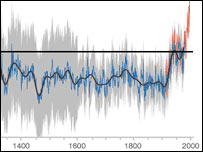 |
Stephen McIntyre and Ross McKritick have contradicted the so-called 'hockey stick theory' founded by Michael Mann. According to this theory current temperature rise is unique and the chart of temperatures in the past decade is shaped like a hockey stick (see figure).
This chart was the result of tree ring records, coral ice core data and historical records, which were used to determine temperatures over the past 6 centuries. It was included in the IPCC 2001 report. |
The two Mc's went through the same database Michael Mann and others had used for the earlier paper and used a similar calculation. However, the outcome was completely different and led to the belief that Mann and others manipulated their data. According to their calculations the 15th century was warmer than the 20th century. They stated that Mann's records contained ' collation errors, unjustifiable truncation or extrapolation of source data, obsolete data, geographical location errors, incorrect calculations of principle components and other quality control defects'.
Michael Mann and his colleagues claim that the Mc's have not carried out a proper audit of their results. According to Mann the same data was not used and their exact procedures were not followed. He was so far not given the opportunity to really respond to the Mc's critique on his data. This discussion is therefore far from over. The Mc's have already announced they will soon publish a new critique.
The theory of Mann was also contested by Lomborg (see earlier). Labohm, Rozendaal and Thoenes use similar arguments to discard the theory. Von Storch has attempted to reconstruct current climate by entering Mann's tree ring record into a climate reconstruction model. The reconstruction appeared far from correct. Bradley and others commented in Science that Mann had too few calibrated data for the tropics and the southern hemisphere. This makes the extrapolation of the results to global scales implausible.
This critique on Mann's records does not necessarily mean that the theory of current climate change being unique and therefore anthropogenic is disregarded. The evidence is still too narrow to really alter our beliefs. Other scientists have also shown current warming patterns to be unique and so far they have not been proven wrong by the skeptics.
Sources:
- Labohm, H., Rozendaal, S. and Thoenes, D, Man-made Global Warming: Unraveling a Dogma. Multi-
Science Publishing 2004, Essex, United Kingdom
- NRC Handelsblad, 6 februari 2005: 'Herrie om een Hockeystick' 4. Mark Maslin on what skeptics say
 |
Mark Maslin is the author of 'Global Warming, a very short introduction', a book written with the sole purpose of informing people about global warming and the greenhouse effect. In his book he reviews and criticizes what skeptics say about global warming. | 4.1 CO2; cause or consequence?
Some skeptics claim that ice-core data suggests that global CO2 responds to global temperature. They therefore conclude that CO2 is a consequence, rather than a cause of global temperature change. Maslin argues that examination of ice-core CO2 data suggests that increases in atmospheric levels occurred at the same time as the gradual warming in Antarctica. Step-wise warming of the northern hemisphere occurred in a later period. Time-series analysis by a professor of Cambridge University has pointed out significant atmospheric CO2 levels 5000 years before global variations in ice caps. All this evidence leads Maslin to believe that global CO2 levels increased before overall global temperature rises and ice cap melting. 4.2 Data manipulation
A well-known and often recurring critique of skeptics is that global warming data is manipulated to gain a desired outcome. This causes many discussions on whether global warming really exists. Labohm et al. have for example used this argument (see above). Maslin argues that this is a misunderstanding that is created because all global warming data requires some adjustment. Not all insights into data sets concerning global warming were immediately present. Accordingly, changing the data sets is all part of the scientific process. Constant questioning of the data adds to the confidence climatologists have in their results. The IPCC tries to make sure they verify their results by checking them through different studies and by using very different sources. 4.3 Solar activity
Bjorn Lomborg is one of the skeptics that mentions that solar activity, not CO2 concentrations, is mainly responsible for past temperature ranges. Both skeptics and non-skeptics agree that this has some impact. Scientists state that not only solar activity but also volcanoes have an important impact on past temperatures. However, Maslin states that the skeptics may put too much weight on the solar activity hypothesis. Even though there are still some major uncertainties in this area, it is clear that a combination of solar activity and greenhouse gas concentrations together have been able to simulate a global temperature curve for the past 130 years. Moreover, evidence suggests that solar activity and volcanic eruptions have been similar for the last millennium. This means that not only natural forcing causes global warming. An anthropogenic effect by greenhouse gases is certainly present. 4.4 Satellite data
Satellite data has suggested that over the past two decades there has been a slight cooling. However, re-examination of data and examination of the source demonstrated that there are some inconsistencies in satellite data. Altitude adjustments, friction with the atmosphere and inter-instrumental comparisons casted serious doubts about whether the obtained data were consistent. Moreover, two decades is too short a time to find any usable temperature trend. Al temperature cycles together take much longer than 20 years. Which of the cycles is present at the time of satellite operation remains to be seen. 4.5 Cloud feedback
Clouds can have both a positive and a negative feedback on global warming. Skeptics have claimed they may reduce the impact of global warming to a negligible amount. The role of clouds in the climate process is still one of the major uncertainties acknowledged by the IPCC. Clouds can both absorb and emit radiation, thereby either cooling or warming the surface. Which of the to effects takes place is largely dependent on the location and characteristics of clouds. This largely depends on the atmospheric distribution of cloud forming particles. Cloud representation in climate models has improved, yet uncertainties still remain. Climate models so far have shown that the cooling effect of clouds does not have a large enough impact to counter global warming trends. 4.6 Climate model reliability
A question that has been asked by skeptics many times is whether or not we can trust climate models. Climate models often give different results, they fail to predict abrupt weather conditions, they fail to reconstruct natural variability, deep ocean circulation and past climate trends and proxy data may be more extensive than model outcomes.
Maslin argues that science is not a discipline that will predict the exact future, even though people often seem to expect this. Strangely enough we do not expect this in any other discipline. No climate model is ever exactly right, but they do provide our best estimate of future events. Many different models have predicted roughly the same future temperature trend so far. This strengthens our confidence in the models, which have been built by many different scientists from all over the world. Maslin emphasizes that if models would provide an exact prediction of the future, no one would believe it. It would still lead to the same discussions we face today.
Skeptics feel that abrupt changes in the weather have an impact on our climate. But climate models cannot predict these abrupt changes because of a too course spatial resolution. But these abrupt changes only impact weather forecasts. Longer-term trends in regional and global climate are not impacted by short-term changes in weather conditions. It is however true that we cannot model abrupt climate changes, yet.
The reconstruction of natural climate variability has become increasingly good. The realization that these variations significantly impact regional climate has caused scientists to include them in climate models. The confidence level of simulations of natural variation is not yet very high. However, constant improvements cause better and better predictions on this part.
Deep-ocean circulation has been included in climate models from the very beginning and it therefore can be predicted with a relatively high level of confidence. However, deep-ocean circulation is a very complex process and therefore uncertainties remain in predictions of future occurrences. This may be fixed in the future as climate models evolve.
Climate change data from climate models is narrower than climate change suggested by proxy data. Comparison has demonstrated that model outcomes are about 75% correct. Models may therefore systematically underestimate climate changes. Maslin concludes that climate change may very well be at the top end of current estimates.
Source: Maslin, M., Global Warming, a very short introduction. Oxford University Press, Oxford 2004, page 60-65, 78-82 5. The NOAA/ IPCC contradiction on methane
The IPCC uses climate change models for its predictions and projections. The IPCC expects that methane (CH4) emissions will increase in the next century. Increases are most pronounced in regional wealth SRES scenarios where emissions may rise to between 549 and 1069 Mt CH4 by 2100, compared to 310 Mt CH4 in 1990. In globalized scenarios, the CH4 emissions level off and subsequently decline sooner or later in the 21st century.
The National Oceanic and Atmospheric Climate Administration (NOAA) reports on the basis of satellite images that the atmospheric build-up of methane has slowed greatly (figure 1). It is claimed that if current trends continue, it may reach zero within a few decades (Dlugokencky et al., 1998). This finding was however not reported on major news broadcasts or websites, for some reason. It may lead to an IPCC overestimate of global warming by 5%. This was also mentioned by Lomborg in his book (see earlier).
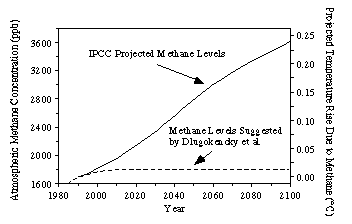
Figure 1: contrast between findings of the IPCC and NOAA
Even in the globalized scenarios of the IPCC methane emissions were not expected to decrease as fast as predicted by the NOAA. The author of the IPCC chapter dealing with future methane concentrations has admitted that the assumptions about methane of the IPCC were based on an understanding of methane build-up that was five to 15 years old. This may explain the differences between IPCC and NOAA scenarios.
Source: National Oceanic and Atmospheric Climate Administration (NOAA) 6. Specific data discussions
All data that are produced on global warming are discussed on many occasions as this continues to be a topic subject to large uncertainties. Some of the current discussions are mentioned here. 6.1 Documentation of temperature measurements
Critics have claimed that average earth temperatures may not be accurate because there can be local variations around the world of up to 100 degrees between two locations. This means that average global temperature can only be valuable when it is expressed as an anomaly, for example the difference between the current average global temperature and a period of reference, being the last 25 years for example. But even these anomalies are lacking in precision.
To measure global average temperatures in 2000 rectangles of 5 degrees longitude and 5 degrees latitude are applied. However, not all rectangles contain measuring stations and therefore many average temperatures are estimates from neighbouring rectangles. So far a more accurate method has not been developed. To include local temperature variations in the global average temperature at least one station in every 10x10 km would be required. This would mean more than 5 million measuring stations evenly distributed across land and oceans, whereas in reality there are only 5000 measuring stations currently.
The temperature measurements over the past century were very inaccurate. Critics point out that not all thermometers were good and that measurements were only conducted on land, whereas the earth consists of 70% water. Also, measurements were largely conducted in urban areas, where houses increase warmth in their direct environment (this can be a 1-2oC).
 |
Some of these critics argue that satellite measurements of earth temperatures may be more accurate because they cover the entire surface. Relative accuracy of satellites appears to be small. The IPCC does not agree with these arguments, because inconsistencies in satellite data, as was pointed out by Schneider (see earlier). |
Sources:
- Labohm, H., Rozendaal, S. and Thoenes, D, Man-made Global Warming: Unraveling a Dogma. Multi-Science Publishing 2004, Essex, United Kingdom
- Various internet articles 6.2 CO2 emissions and temperature change
Astrofysica Sallie Baliunas claims that at least 80% of anthropogenic CO2 emissions have entered the atmosphere after 1945. This means that the significant global warming caused before 1945 (0,45 degrees Celcius between 1910 and 1945) is not necessarily caused by an increasing CO2 concentration in the atmosphere. After 1945 CO2 concentration significantly increased, whereas temperatures started to decrease. This makes extrapolation of the CO2 impact on temperatures very difficult. This claim has caused some critics to even state that temperature rises cause an increase in atmospheric CO2 concentrations; not the other way around. Other critics point out that human contribution to CO2 emissions is relatively small, compared to some natural sources, such as volcanic eruptions. Humans cause an annual 8 billion tons of CO2 emission, whereas natural emissions are as high as 200 billion tons annually.
Labohm et al. state that CO2 only absorbs infrared radiation in a small part of the spectrum. They therefore doubt that an increase in CO2 content would have a significant effect on the heat balance of the earth. They claim that the comparison of the earth to a greenhouse is unjust because the earth system is much more complex than simply an incoming and outgoing flow of radiation. Many factors may positively or negatively influence this flow and it may come from different angles. A net radiation in a region therefore does not automatically mean that temperatures will rise. In the IPCC reports this mechanism, known as 'radiative forcing' is stated true. According to the writers this concept is fundamentally wrong. They also state that no significant temperature rise has been noted in the past 70 years, whereas CO2 concentrations have significantly increased. They do not consider climate change unlikely, but they doubt whether it will always manifest as a change in temperature.
Related pages
Climate change glossary
Fossil fuels: characteristics and effects
The greenhouse effect mechanism
Emissions and infrared absorption by greenhouse gases
Explanation of the IPCC SRES scenarios
The IPCC SRES scenarios: causes of climate change
The IPCC SRES scenarios: consequences of climate change
Overview of emission reductions for each country according to Kyoto
Possible policy measures to achieve Kyoto targets
Trading emission permits to achieve Kyoto targets
History of global warming
Perspectives on global warming |