Faecal colibacteria
| Colibacteria are relatively harmless microorganisms, which are present in the intestines of humans and animals in large numbers. They play an important role in food digestion.
Faecal colibacteria (enterobacteriaceae) are a subgroup of colibacteria. Escherichia coli (E. coli) is the most comminly known species of faecal colibacterium.
Faecal colibacteria are different from other species of colibacteria, because they grow under conditions of increased temperature, and because they are only present in human and animal faeces.
|
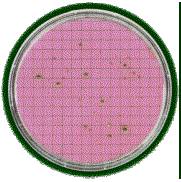
Bacterial feed with cfu coliforms
|
When faecal colibacteria are present in aquatic environments, this indicates that water is polluted by human or animal faeces. This generally leads to the conclusion that pathogenic bacteria or viruses are present, which come from faeces. These microorganisms can introduce disease in humans and animals that swim in polluted water. Waterborne diseases linked to these microorganisms include fever, intestinal disease and hepatitis A.
The presence of faecal colibacteria is an indicator of a potential health risk for swimmers. Faecal colibacteria enter surface water sources from sewer overflows and through discharge of human and animal waste.
Determining the amount of colibacteria in the water is carried out by membrane filtration. Bacteria do not pass the membrane filter, and can be separated and analyzed in the laboratory. Each separate cell develops to a colony forming unit (cfu), and these can be counted.
Faecal streptococci
| Like colibacteria, streptococci are present in human and animal intestines, but also in the stomach. Many species of strepotcoccus are pathogenic. They cause diseases such as bacterial pneumonia, ear infection and bacterial meningitis.
Faecal strepotococci (enterococcus) are a subgroup of the genus streptococcus. Faecal streptococci can be found within stomachs and intestines of humans and animal. They can be distinguished because of their great resistance.
|
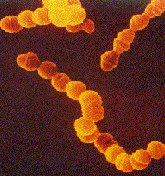
Faecal streptococci
|
Like faecal coliforms, faecal streptococci are applied as indicators for water pollution. The presence of faecal streptococci indicates the presence of faecal pathogens in water.
Faecal streptococci have a number of characteristics, distinguishing them from faecal colibacteria:
- Are a less specific indicator for pathogens in faeces; because of their great resistance they also survive on other locations besides the stomach and intestines
- Are more suitable for food sampling than surface water sampling
- Are present in faeces in lower numbers than coliforms
- Always or almost always present in human and animal faeces; coliforms are sometimes absent
- Incredible resistance to changing conditions
Facal colibacteria and faecal streptococci are both parameters for the indication of clean swimming water conditions.
Sources
Omegam laboratory www.omegam.nl
Agr Belgium www.agr.kuleuven.ac.be
Faecal coliforms water quality information www.state.ky.us
|