
Water chemistry FAQ Frequently Asked Questions
The question library on water related issues
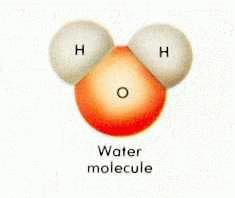
What is water?Water is a very important substance, as it makes up the larger part of an organism's body. But what exactly is water? Inside the body of a human being there is a skeleton, which makes your body solid and makes sure you can stand up without falling apart. Water is also a kind of skeleton. It consists of tiny particles, the atoms, just like every other substance on earth. One of these atoms is called hydrogen and the other is called oxygen. As you probably know the air that we breathe also contains oxygen. One particle of water is called a molecule. When lots of water molecules melt together we can see the water and drink it or use it, for instance to flush a toilet. How is a water molecule built up?
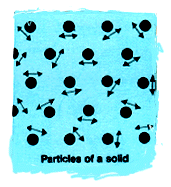
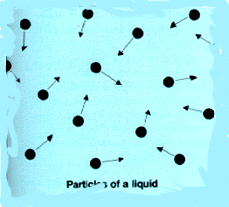
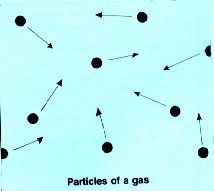
How much does a water molecule weigh? The weight of a molecule is determined by the atomic masses of the atoms that it is built of. The atomic mass of an atom is determined by the addition of the number of protons and neutrons in the nucleus, because the electrons hardly weigh anything. When the atomic masses of the separate atoms are known, one simply has to add them up to find the total atomic mass of a molecule, expressed in grams per mol. A mol is an expression of the molair weight of a molecule, derived from the weight of a hydrogen molecule, which is 1 mol. The molair weight of separate atoms can be found in the periodic table of Mendelejef. In what states (phases) can water be found? Water exists in three states: solid, liquid and gaseous. At a normal temperature of about 25oC it is liquid, but below 0oC it will freeze and turn to ice. Water can be found in the gaseous state above 100oC, this is called the boiling point of water, at which water starts to evaporate. The water turns to gas and is then odourless and colourless. What happens if water changes phase?
The changes from a liquid to a solid or to a gas are called phase changes. When a substance such as water changes phase, its physical appearance changes, but not its chemical properties. This is because the chemical structure remains the same, but the molecules of which it consists will float a little further apart. In the solid state the water molecules are fairly close together, but in the liquid state they are a bit further apart. The water becomes liquid as a result of parting molecules. When water changes from liquid to gas the molecules will part even further, that is why we cannot detect it. Why does ice float on water?When substances freeze, usually the molecules come closer together. Water has an abnormality there: it freezes below 0oC, but when temperatures goes below 4oC, water starts to expand again and as a result the density becomes lower. Density of a substance means the weight in kilograms of a cubic metre of a substance. When two substances are mixed but do not dissolve in one another, the substance with the lowest density floats on the other substance. In this case that substance is ice, due to the decreased density of water. How come not all substances are water-soluble? Polarity determines if a substance is water-soluble. A polair substance is a substance that has two kinds of 'poles', as in a magnet. When another substance is also polair the poles of the substances attract each other and as a result the substances mix. A substance then dissolves in water. What is hard water? When water is referred to as 'hard' this simply means, that it contains more minerals than ordinary water. These are especially the minerals calcium and magnesium. The degree of hardness of the water exceeds, when more calcium and magnesium dissolve. For more information on hard water check out the water softener FAQ What are physical and chemical properties?Physical properties of a substance are properties that have everything to do with the substance's appearance. Chemical properties are properties that are often used in chemistry, to address the state of a substance. Physical and chemical properties can tell us something about the behaviour of a substance in certain circumstances. Which physical and chemical properties does water have? There are several different physical and chemical properties, which are often used alternately. We can name the following: Click here for advanced water chemistry information For water terminology check out our Water Glossary or go back to water FAQ overview Feel free to contact us if you have any other questions |